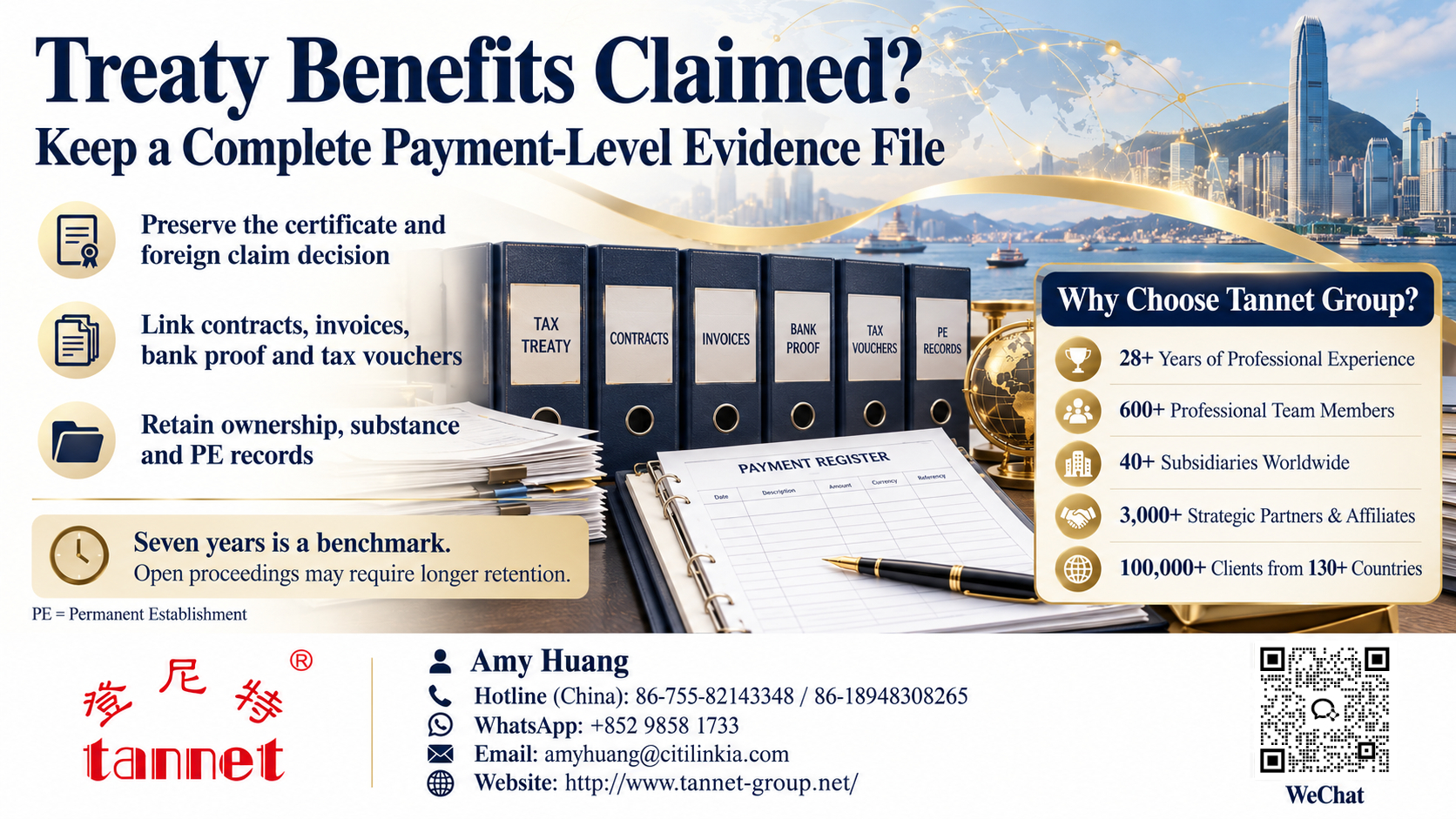
Key Takeaway
After claiming tax treaty benefits, a Hong Kong company should preserve a complete, payment-level evidence file.
This guidance is for companies that received reduced foreign withholding, obtained a refund, or relied on a treaty exemption for dividends, interest, royalties, services, capital gains, shipping, or business profits.
Keep the Certificate of Resident Status, foreign forms, contracts, invoices, tax vouchers, beneficial-ownership evidence, substance records, permanent-establishment analysis, and all authority correspondence.
The main warning is that Hong Kong’s general seven-year rule may not be the final deadline. Foreign law, an open audit, refund, appeal, or Mutual Agreement Procedure may require longer retention.
Why records still matter after relief is granted
A treaty claim can be reviewed after payment. The payer may be audited. A foreign tax authority may request additional evidence. The Hong Kong Inland Revenue Department may also ask for records supporting a profits tax return, foreign tax credit, or Foreign-sourced Income Exemption position.
The Hong Kong IRD states that a Certificate of Resident Status proves residence for the relevant DTA. It does not guarantee treaty relief. The foreign authority still decides whether the income, claimant, beneficial ownership, anti-abuse conditions, and procedure qualify.
The file should explain what was claimed, why it was available, how the rate was calculated, and what changed later.
1 Keep the residence certificate and application file
Retain the original digital PDF or paper Certificate of Resident Status.
A portal history is useful, but it should not be treated as the company’s permanent archive.
Preserve the version actually submitted to the foreign authority.
2 Keep the foreign treaty-relief submission
Record whether relief was granted at source, through a refund, or after an assessment.
A concise internal memo should explain the income classification and conditions applied.
If the foreign authority asked questions, preserve each request and response. These documents show which facts the authority reviewed and whether approval was conditional.
3 Keep payment and withholding-tax evidence
Reconcile the gross income, tax withheld, net receipt, and refund to the general ledger.
Obtain the official withholding-tax certificate, tax voucher, or final assessment.
This register should link to the supporting file.
4 Keep contracts and income-classification records
The legal character of the income often determines the treaty article.
For royalties, keep intellectual-property ownership, registration, development, licensing, and usage evidence.
For dividends, keep the shareholder register, acquisition date, ownership percentage, board minutes, and distribution records.
5 Keep beneficial-ownership evidence
Residence alone does not establish that condition.
Retain evidence showing that the company had the right to use and enjoy the income.
Preserve intercompany agreements and payment trails where funds moved onward. Explain commercial reasons for distributions, debt service, royalties, or management charges. An agent, nominee, or conduit may not qualify for the reduced rate.
6 Keep commercial-substance and management records
Store board agendas, minutes, resolutions, director attendance, decision papers, approval matrices, office records, employee files, payroll records, service-provider agreements, and operating expenditure evidence.
Formal minutes should match emails, banking activity, and actual conduct.
Outsourcing does not remove the need to prove the company’s own role.
7 Keep permanent-establishment evidence
Where treaty relief depended on having no permanent establishment abroad, retain records of offices, project sites, employee travel, local workdays, agents, negotiations, contract authority, and customer activity.
Preserve evidence about who negotiated and signed contracts. Record whether premises were available to the company or used only temporarily.
The file should support both the existence decision and the amount taxed.
8 Keep ownership and restructuring records
Retain organization charts, registers of members, share-transfer documents, subscription agreements, trust or nominee arrangements, and beneficial-owner information for the claim period.
Document acquisitions, disposals, mergers, director relocations, financing changes, and business-model changes. These events may affect residence, direct-holding tests, beneficial ownership, anti-abuse analysis, or certificate relevance.
Create a dated change log.
9 Keep related-party and transfer-pricing records
For related-party loans, royalties, services, or guarantees, retain agreements, calculations, benchmarking, allocation keys, invoices, and evidence that services were actually received.
Preserve the master file, local file, country-by-country reporting support, or other transfer-pricing documentation where applicable.
Explain unusual margins, back-to-back arrangements, or changes in pricing. The treaty file should reconcile to the financial statements and tax computations.
10 Keep Hong Kong tax records
Section 51C of the Inland Revenue Ordinance requires a person carrying on business in Hong Kong to keep sufficient records of income and expenditure. The IRD states that relevant business records must generally be retained for at least seven years.
Section 377 of the Companies Ordinance requires a company to preserve specified accounting records, accounts, and returns for seven years after the end of the financial year to which the last entry or matter relates.
A treaty claim abroad does not determine the Hong Kong tax treatment.
11 Keep FSIE and foreign tax-credit evidence
An MNE entity receiving specified foreign-sourced income in Hong Kong may need records supporting economic substance, participation, nexus, or intra-group transfer relief under the FSIE regime.
The IRD states that FSIE transaction, act, or operation records must be retained until the later of seven years after completion or seven years after the income is received, or regarded as received, in Hong Kong.
Notify the IRD if the foreign tax amount used in a claim changes.
12 Keep dispute, refund, and MAP records
Record every procedural deadline and responsible person.
If taxation appears inconsistent with the DTA, retain the request and evidence for the Mutual Agreement Procedure. MAP does not replace domestic filing or appeal deadlines.
Apply a legal hold while any review, refund, appeal, litigation, or MAP case remains open. Do not destroy relevant records merely because the ordinary retention period has expired.
13 Set a defensible retention policy
Use the longest applicable period. Compare Hong Kong tax law, the Companies Ordinance, the foreign jurisdiction’s rules, contractual obligations, and the status of any open proceeding.
Do not use one deletion date for every document. The seven-year periods may start from different events.
Require written approval before destruction and keep a destruction log.
14 Control digital evidence
Store records in a searchable folder structure by jurisdiction, treaty, year, payer, and payment. Use consistent file names and a document index.
Restrict editing, retain original formats, maintain version history, and back up the archive. Record who approved the claim and who changed the file.
Test whether records remain readable.
Common mistakes
Common errors include keeping only the residence certificate, relying on portal access, losing the original tax voucher, failing to link evidence to individual payments, and deleting records after seven years while an appeal remains open.
Other mistakes include weak beneficial-ownership evidence, minutes that conflict with actual conduct, no permanent-establishment day count, missing foreign refund decisions, and a treaty register that does not reconcile to the ledger.
Frequently asked questions
Q1. Is seven years always enough?
No. Seven years is an important Hong Kong benchmark, but another law or an open case may require longer retention.
Q2. When does the seven-year period start?
It depends on the rule. Section 51C focuses on completion of the transaction, while Companies Ordinance section 377 refers to the end of the relevant financial year. FSIE can use a later-of test.
Q3. Can digital copies replace paper originals?
Electronic records may be acceptable if they are complete, readable, reliable, and retrievable. Keep originals where a foreign authority or legal rule requires them.
Q4. Must every payment have a separate file?
Not necessarily. A master file can hold common evidence, but each payment should be traceable to its invoice, bank record, tax voucher, claim form, and result.
Q5. Should unsuccessful claims be retained?
Yes. They may support an objection, refund, MAP request, later review, or explanation of the accounting and tax treatment.
Q6. What if the company changes advisers?
Obtain a complete export, document index, access credentials, correspondence history, and deadline register before the handover closes.
Q7. Does the IRD portal replace the company archive?
No. Portal access and availability can change. The company remains responsible for keeping its own records.
Keep the claim index current.
When Tannet may assist
Tannet may help design a treaty-claim index, organize certificate and payment files, reconcile withholding-tax schedules, identify missing evidence, coordinate record requests with overseas advisers, and review related Hong Kong tax documentation. Legal conclusions, foreign retention periods, and claim acceptance remain subject to the relevant authorities and professional advice.
Written by: Tannet Business Services Team
Reviewed by: Consultant Amy Huang
First published: 30 Oct. 2026
Last reviewed: 30 Oct. 2026
Official sources consulted: Comprehensive Double Taxation Agreements; Mutual Agreement Procedure; Foreign-sourced Income Exemption; and Hong Kong Companies Registry, Companies Ordinance Part 9, section 377.
30th Anniversary Offer: Tannet has been established for 28 years, we are offering exclusive limited-time promotional pricing to celebrate Tannet’s 30th anniversary. Slots are limited and available on a first-come, first-served basis. Contact Consultant Amy Huang for details.
————————————————Simplifying Business, Empowering Entrepreneurs————————————————