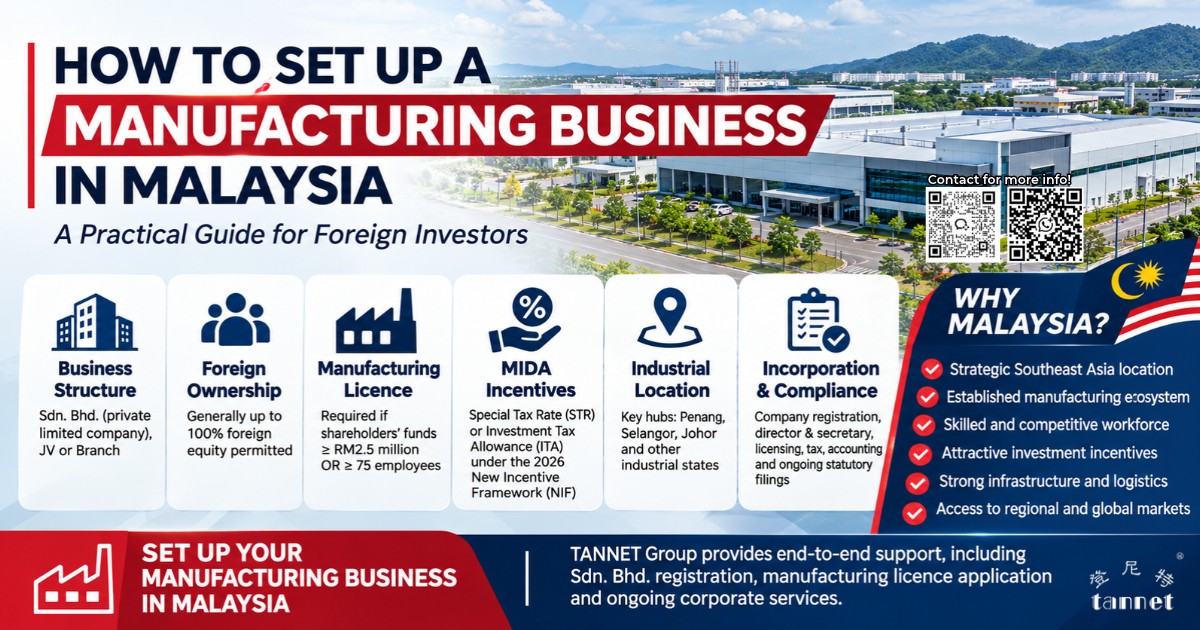
Malaysia has become an increasingly attractive destination for foreign manufacturers seeking to establish production facilities in Southeast Asia. With its strategic geographical location, established industrial ecosystem, skilled workforce and access to international markets, Malaysia offers opportunities for businesses looking to set up a manufacturing business in Malaysia
For Australian manufacturers, international trading companies and industrial investors, Malaysia provides access to established manufacturing clusters, regional supply chains and export infrastructure. Key industries include electrical and electronics, automotive components, medical devices, machinery, chemicals, food processing and advanced manufacturing.
However, setting up a manufacturing business in Malaysia involves more than incorporating a company. Foreign investors must understand the country’s foreign ownership policies, manufacturing licence requirements, investment incentives, industrial location options and ongoing regulatory obligations.
Understanding these requirements before committing capital can help investors minimise regulatory risks, plan their investments effectively and establish sustainable manufacturing operations.
1. Choosing the Right Business Structure in Malaysia
Foreign investors planning to establish manufacturing operations in Malaysia generally consider several business structures, depending on their investment objectives and operational requirements.
Private Limited Company (Sdn. Bhd.)
A Sendirian Berhad (Sdn. Bhd.) is the most common structure for foreign investors establishing a manufacturing business in Malaysia.
A Malaysian Sdn. Bhd. is a separate legal entity that can own assets, enter into contracts, employ staff, lease industrial premises and conduct business activities within the country.
This structure is particularly suitable for foreign manufacturers planning long-term operations, establishing production facilities or serving Malaysian and regional markets.
Joint Venture (JV)
A joint venture allows foreign investors to collaborate with Malaysian business partners. This arrangement may be suitable for businesses seeking local market knowledge, established distribution networks, technical expertise or strategic partnerships.
Before establishing a joint venture, investors should clearly define shareholding arrangements, management responsibilities, profit distribution, intellectual property ownership and exit provisions.
Branch Office
A branch office is an extension of an overseas parent company rather than a separate Malaysian legal entity. It may be considered by foreign companies seeking to extend certain existing business operations into Malaysia.
However, investors should evaluate whether a branch structure is appropriate for their proposed manufacturing activities, regulatory approvals and liability considerations.
For most foreign manufacturers intending to establish a dedicated production facility, a Malaysian Sdn. Bhd. is generally the preferred option.
2. Foreign Ownership Requirements for Manufacturing Companies
One of Malaysia’s key advantages for international manufacturers is its relatively liberal foreign equity policy.
Generally, foreign investors are permitted to hold up to 100% equity in Malaysian manufacturing companies. This means Australian and other international investors can establish wholly foreign-owned manufacturing companies without necessarily requiring a Malaysian shareholder.
However, certain industries, products and business activities may be subject to additional regulatory requirements, sector-specific policies or licensing conditions.
Before establishing a manufacturing company, investors should evaluate:
-
Whether the proposed manufacturing activity permits full foreign ownership.
-
Whether additional government or industry-specific approvals are required.
-
Whether the proposed products are subject to import, export or technical regulations.
-
Whether the business requires specific local technical personnel.
-
Whether foreign directors or management personnel require employment and immigration approvals.
Foreign ownership eligibility should be assessed together with the proposed manufacturing activities and licensing requirements to ensure the intended business structure is suitable.
3. Manufacturing Licence Requirements in Malaysia
A key consideration when setting up a manufacturing business in Malaysia is whether the company requires a Manufacturing Licence under the Industrial Co-ordination Act 1975 (ICA).
Under the general requirements, a manufacturing company must apply for a Manufacturing Licence if it meets either of the following criteria:
-
Shareholders’ funds of RM2.5 million or more; OR
-
Employs 75 or more full-time paid employees.
Companies that fall below both thresholds may apply for an exemption confirmation from the relevant authority.
The Malaysian Investment Development Authority (MIDA), under the Ministry of Investment, Trade and Industry (MITI), facilitates manufacturing investment and related licensing applications.
A manufacturing licence application generally requires information about the proposed project, including:
-
Company and shareholder information.
-
Proposed manufacturing activities and product descriptions.
-
Total investment and capital expenditure.
-
Production capacity and machinery requirements.
-
Workforce and employment projections.
-
Factory location and operational details.
-
Project implementation timeline.
Investors should also consider whether their proposed manufacturing activities require additional operational approvals.
Depending on the industry, these may include environmental approvals, food-related licences, medical device regulatory requirements, product certifications, local authority approvals and other technical permits.
Identifying the necessary licences before commencing factory operations is essential to avoid regulatory delays.
4. MIDA Investment Incentives for Foreign Manufacturers
Malaysia offers various investment incentives to encourage manufacturing activities, technology development and higher-value industrial investment.
The Malaysian Investment Development Authority (MIDA) plays an important role in facilitating eligible manufacturing investments and providing guidance on applicable incentive programmes.
As of 2026, Malaysia’s New Incentive Framework (NIF) applies to new manufacturing investments from 1 March 2026.
Under the framework, qualifying manufacturing projects may be considered for two principal tax incentive options:
Special Tax Rate (STR)
Eligible companies may qualify for a preferential corporate income tax rate for a specified period, subject to the applicable conditions and approval.
Investment Tax Allowance (ITA)
Qualifying companies may receive an investment tax allowance based on eligible capital expenditure. The allowance can be utilised against statutory income, subject to the relevant conditions.
The new framework adopts an outcome-based approach, assessing the economic contributions of proposed investments rather than focusing solely on the amount of capital invested.
Important considerations may include:
-
Development of high-value manufacturing activities.
-
Creation of skilled and higher-income employment.
-
Technology advancement and automation.
-
Strengthening local supply chains.
-
Research, development and innovation.
-
Environmental sustainability and industrial productivity.
For foreign manufacturers, this means that investment planning should consider not only factory construction and machinery expenditure but also the project’s long-term contribution to Malaysia’s industrial development.
Investors should assess incentive eligibility, application requirements and approval timelines before commencing their projects.
5. Choosing the Right Industrial Location in Malaysia
Selecting the right industrial location can significantly influence a manufacturing company’s operating costs, production efficiency and supply chain performance.
Malaysia has several established industrial hubs, each offering different advantages depending on the manufacturing sector and target market.
Selangor
Selangor is one of Malaysia’s major industrial and commercial centres. It offers access to established industrial estates, logistics providers, suppliers, business services and a large workforce.
It is suitable for various manufacturing activities, including machinery, automotive components, food processing and general industrial production.
Penang
Penang is internationally recognised for its electrical and electronics manufacturing ecosystem.
It is particularly attractive to investors in semiconductor-related industries, precision engineering, electronics, automation and medical devices.
Johor
Johor offers strategic access to Singapore and regional logistics networks. Its industrial development and connectivity make it an attractive option for manufacturers targeting cross-border supply chains, industrial production and distribution.
Melaka and Negeri Sembilan
These states provide alternative industrial locations for selected manufacturing activities, with access to industrial estates, transportation infrastructure and established manufacturing communities.
When selecting an industrial location, foreign investors should consider:
-
Availability and cost of industrial land or factory premises.
-
Access to ports, airports and major highways.
-
Electricity, water and other utility requirements.
-
Availability of skilled and technical workers.
-
Proximity to suppliers and customers.
-
Environmental and industrial zoning requirements.
-
Opportunities for future production expansion.
For Australian companies exporting internationally, access to ports and efficient logistics infrastructure may be particularly important.
Investors should evaluate the total cost of production, utilities, workforce and transportation rather than selecting a location based solely on rental or land prices.
6. Company Incorporation and Compliance Requirements
Once the investment structure, manufacturing activities and proposed location have been evaluated, foreign investors can proceed with establishing their Malaysian company.
A Malaysian Sdn. Bhd. must comply with the Companies Act 2016 and incorporation requirements administered by the Companies Commission of Malaysia (SSM).
The general incorporation process includes:
Step 1: Company Name Approval
Select and submit the proposed company name for approval.
Step 2: Determine the Shareholding Structure
Identify the foreign shareholders, ownership percentages and proposed share capital.
Step 3: Appoint Company Directors
A Malaysian private limited company must have at least one director who ordinarily resides in Malaysia.
Step 4: Establish a Registered Office
The company must maintain a registered office address in Malaysia.
Step 5: Incorporate the Company
Submit the necessary incorporation information and documents to SSM.
Step 6: Appoint a Company Secretary
A qualified company secretary must be appointed within 30 days after incorporation.
Step 7: Arrange Corporate Banking
Establish corporate banking facilities and arrange the necessary investment funding.
Step 8: Apply for Relevant Licences
Proceed with manufacturing licence applications, operational permits and other regulatory approvals applicable to the business.
Company incorporation is only the beginning of the establishment process. Foreign-owned manufacturing companies must also maintain ongoing corporate and operational compliance.
These responsibilities include:
-
Maintaining statutory company records and beneficial ownership information.
-
Preparing annual financial statements.
-
Arranging statutory audits where applicable.
-
Filing annual returns with SSM.
-
Maintaining proper accounting records and tax filings.
-
Complying with applicable employer and employee statutory contributions.
-
Meeting employment and immigration requirements.
-
Renewing relevant operational licences and permits.
Businesses employing foreign technical personnel should also consider expatriate employment approvals and immigration requirements.
Establishing a proper corporate compliance structure from the beginning can help manufacturers manage their operations more efficiently as the business grows.
7. Common Challenges Foreign Manufacturers Should Consider
Although Malaysia offers opportunities for international manufacturing investment, foreign companies should evaluate several potential challenges before commencing operations.
Regulatory Requirements: Different industries may require approvals from multiple government agencies. Investors should identify the relevant licensing requirements before committing to factory premises or machinery purchases.
Capital Investment: Manufacturing requires substantial upfront expenditure on industrial facilities, machinery, equipment, labour and working capital. Realistic financial projections are essential.
Workforce Availability: Certain manufacturing activities require specialised technical personnel. Investors should evaluate local recruitment capabilities and understand the requirements for employing foreign workers and expatriates.
Supply Chain Management: The availability of local suppliers, raw materials and logistics providers can influence production efficiency and operating costs.
Ongoing Compliance: Companies must maintain their statutory, tax, employment and operational obligations even after obtaining the necessary approvals.
A well-planned market-entry strategy can help investors identify potential risks, manage regulatory requirements and make more informed investment decisions.
Conclusion: Set Up Your Manufacturing Business in Malaysia with TANNET Group
Malaysia offers significant opportunities for Australian manufacturers and international investors seeking to establish or expand their manufacturing operations in Southeast Asia.
However, entering a new market requires more than identifying an industrial location and registering a company. Investors must understand foreign ownership policies, manufacturing licence requirements, investment incentives, operational permits and ongoing corporate compliance.
This is where TANNET Group can help.
As an international business services provider, TANNET Group supports foreign investors throughout their Malaysia market-entry journey, providing coordinated corporate establishment and business support services.
Our services include:
-
Malaysia Sdn. Bhd. company registration.
-
Foreign shareholder and company structure coordination.
-
Company secretarial services.
-
Manufacturing licence application assistance.
-
Business and operational licence coordination.
-
Accounting, bookkeeping and tax compliance.
-
Corporate maintenance and statutory filing support.
-
Business establishment and market-entry advisory coordination.
Whether you are an Australian manufacturer exploring your first production facility in Malaysia, an international trading company planning to establish local manufacturing operations, or an industrial investor expanding your Southeast Asian footprint, TANNET Group can help simplify the administrative and corporate establishment process.
From company incorporation to licensing and ongoing corporate compliance, let TANNET Group be your business establishment partner in Malaysia.
Contact TANNET Group today to discuss your manufacturing investment plans and discover how we can support your expansion into Malaysia.
📞 Free 1-on-1 Consultation Now,
Official Service Hotline: +86-755-82148419
Cell: +86-13823131503;+60 19-309 2363
WeChat ID: 13823131503;
WhatsApp:+86-13823131503;+60 19-309 2363
Email: mytannet08@gmail.com; susiehu@citilinkia.com