Understanding Shenzhen’s 2026 Investment Incentives, Foreign Business Support and Market Entry Opportunities
Shenzhen is strengthening its position as an international business and investment destination ahead of the 33rd APEC Economic Leaders’ Meeting in 2026. Beyond hosting a major international economic event, the city is using this opportunity to improve its business environment, attract foreign investment and make cross-border operations more accessible.
On 23 March 2026, Shenzhen introduced its Work Plan for Seizing APEC Opportunities and Building a First-Class Business Environment. The plan outlines 21 key initiatives covering cross-border mobility, international trade and logistics, capital flows, data movement and business services.
In addition, Shenzhen’s 2026 measures for attracting and utilising foreign investment took effect on 1 January 2026, introducing further support for multinational headquarters and foreign-invested research and development centres.
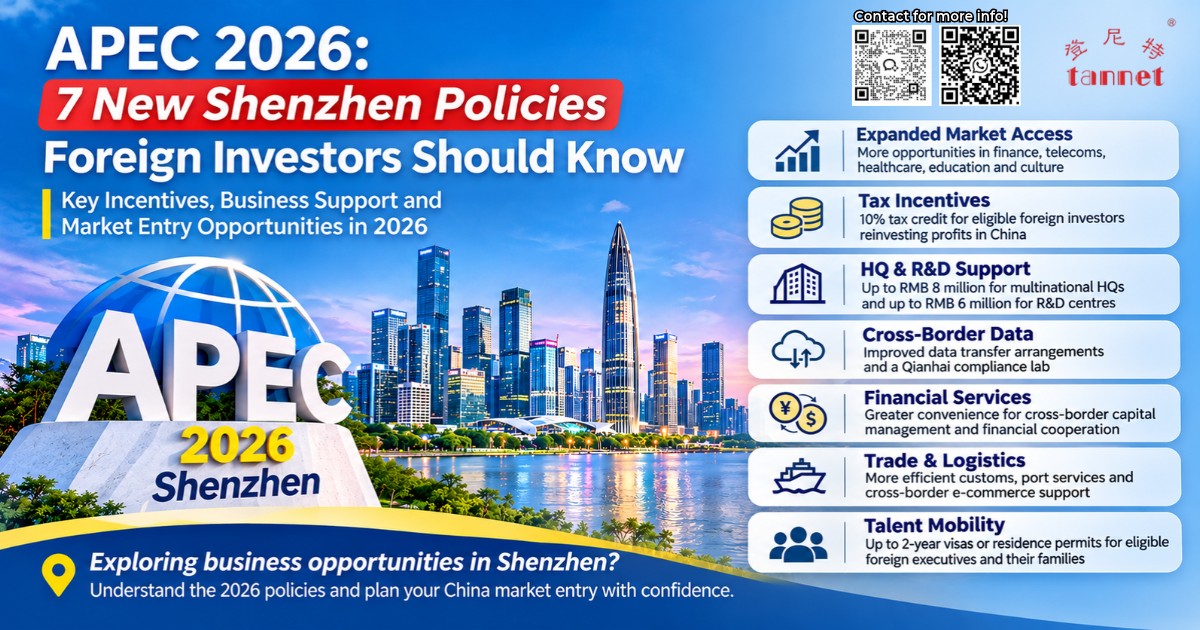
For international companies considering China market entry, these developments are worth understanding. Here are seven Shenzhen 2026 policies for foreign investors.
1. Expanded Market Access in Key Service Industries
Shenzhen is continuing to promote the opening-up of its service industries, with particular attention to finance, telecommunications, healthcare, education and culture.
Under its 2026 international business environment work plan, the city aims to develop institutional innovations and attract significant service-sector projects.
This creates potential opportunities for foreign companies operating in professional services, technology, financial services, healthcare-related businesses and education.
However, expanded opening-up does not mean unrestricted foreign ownership in every sector. Some industries remain subject to foreign investment restrictions, licensing requirements, qualifications or regulatory approval.
What foreign investors should consider:
Before establishing a company in Shenzhen, investors should review the latest national and applicable free trade zone negative lists, determine whether their intended business activities are permitted, and identify any industry-specific licences required.
Choosing the correct business scope and corporate structure at the beginning can help reduce regulatory complications.
2. Tax Incentives for Reinvesting Profits in China
China has introduced a tax credit policy encouraging eligible foreign investors to reinvest profits distributed by Chinese resident enterprises into domestic businesses.
Under the national policy, qualifying reinvestments made between 1 January 2025 and 31 December 2028 may receive a tax credit equivalent to 10% of the reinvested amount, subject to the applicable requirements.
The policy covers qualifying direct equity investments, including capital increases, establishing new enterprises and acquiring equity from non-affiliated parties.
However, eligibility is conditional. Among the key requirements:
- The reinvested profits must originate from distributions by Chinese resident enterprises.
- The invested enterprise must operate in an industry included in the encouraged foreign investment catalogue.
- The foreign investor must hold the investment continuously for at least 60 months.
- The funds must follow the prescribed direct transfer requirements.
The applicable tax treaty rate may also affect the calculation.
For foreign investors already operating subsidiaries in China, this policy may provide an additional reason to consider expanding existing operations instead of distributing all profits overseas.
Investors should obtain professional tax advice before implementing a reinvestment arrangement to confirm eligibility and compliance.
3. Incentives for Multinational Headquarters and Foreign R&D Centres
Shenzhen’s updated foreign investment measures, effective from 1 January 2026, include support for multinational headquarters and foreign-invested research and development centres.
The measures introduce two particularly relevant incentive categories.
First, qualifying multinational company headquarters recognised by Guangdong Province between 2025 and 2027 may receive a one-time reward of up to RMB 8 million, provided they meet the applicable requirements, including the minimum threshold for newly added actual foreign capital.
Second, recognised foreign-invested R&D centres may receive a one-time reward of up to RMB 1 million. Qualifying global R&D centres of multinational companies may receive additional support of up to RMB 5 million, bringing the potential combined reward to RMB 6 million.
These incentives are particularly relevant to international manufacturers, technology companies, advanced equipment businesses and multinational groups planning to establish regional management or research functions in Shenzhen.
It is important to understand that these are conditional incentives, not automatic grants for every newly registered foreign-invested company. Recognition, investment thresholds and other eligibility conditions apply.
Foreign investors should assess their business scale, investment plans and proposed functions before deciding whether to establish a regional headquarters or R&D centre.
4. More Support for Cross-Border Data Transfers
For international businesses, transferring business information between overseas headquarters and Chinese subsidiaries is an important operational consideration.
Shenzhen’s 2026 work plan proposes improvements to the cross-border data transfer environment.
Key initiatives include developing a data security compliance laboratory in Qianhai, operating a Shenzhen-Singapore cross-border data verification platform and improving the green-channel mechanism for data export security assessments involving foreign-invested and key enterprises.
These developments are relevant to multinational companies managing customer information, financial data, research information, supply chains and regional business systems.
Nevertheless, foreign companies must not assume that all business data can be freely transferred overseas.
China’s Personal Information Protection Law, Data Security Law and applicable cross-border data transfer regulations remain relevant. Depending on the type, volume and sensitivity of the data, businesses may need to complete a security assessment, standard contract filing or personal information protection certification, where applicable.
Companies should review their data collection, storage, processing and international transfer arrangements before launching operations.
5. Improved Cross-Border Capital and Financial Services
Efficient capital movement is essential for multinational companies operating across several jurisdictions.
Shenzhen’s 2026 APEC-related business environment work plan includes measures to improve cross-border financial cooperation and capital management.
One initiative is to expand the application of the integrated domestic and foreign currency cash-pooling framework for qualifying multinational corporate groups.
This framework can help eligible companies manage cross-border funding arrangements and centralise treasury operations more efficiently, subject to regulatory requirements and approved business arrangements.
The plan also promotes deeper financial cooperation between Shenzhen and Hong Kong, including improvements to cross-border financial services and capital market connectivity.
For foreign investors, these developments may be particularly relevant when planning:
- Capital contributions to Chinese subsidiaries.
- Cross-border group funding.
- Dividend distribution arrangements.
- Regional treasury management.
- Financing and investment activities.
Companies should establish a compliant financial structure and work with qualified banking and tax professionals to understand applicable foreign exchange and reporting requirements.
6. Greater Trade and Logistics Convenience
Shenzhen remains an important manufacturing, export and logistics hub in southern China.
Its 2026 international business environment initiatives place considerable emphasis on improving international trade and logistics efficiency.
The city plans to deepen its cross-border e-commerce pilot programmes, promote the implementation of a regulatory pilot for pre-shipment inspection of cross-border e-commerce exports and strengthen integrated trade services covering customs, currency settlement, taxation, financing and insurance.
The work plan also includes initiatives to improve international port services and promote more efficient customs clearance.
Separately, Shenzhen issued 19 measures to optimise its 2026 port business environment, covering customs clearance, port facilities and international passenger and trade services.
These developments may benefit foreign businesses involved in manufacturing, sourcing, distribution, international trading and cross-border e-commerce.
However, companies must still meet relevant product registration, customs declaration, import and export licensing, product certification and taxation requirements.
For businesses planning to import goods into China or export products from Shenzhen, understanding the relevant customs and regulatory requirements is essential before starting commercial operations.
7. Easier Business Mobility for Foreign Executives and International Talent
Establishing a business in China often requires foreign shareholders, senior management and technical personnel to travel regularly between their home countries and Chinese operations.
Shenzhen’s APEC-related work plan includes measures to improve international talent mobility.
One notable measure concerns eligible senior executives of foreign companies preparing to establish subsidiaries or branches in the Qianhai-Shekou area of the China (Guangdong) Pilot Free Trade Zone.
These executives may be issued visas or residence permits valid for up to two years. Their accompanying spouses and family members may also receive corresponding entry and temporary stay arrangements, subject to the applicable requirements.
The city also plans to improve services for international professionals, including healthcare, accommodation, education and business registration assistance.
For overseas companies planning to establish a Chinese subsidiary, these measures may make it easier to organise management teams and coordinate initial business operations.
However, visa or residence permit arrangements remain subject to eligibility, application procedures and approval by the relevant authorities. They should not be treated as automatic entitlements for every foreign company director.
What Should Foreign Investors Do Before Entering the Shenzhen Market?
Although Shenzhen’s 2026 policies create new opportunities, successful market entry requires more than simply registering a company.
Foreign investors should consider several important steps.
First, identify the correct investment structure. Determine whether a wholly foreign-owned enterprise, joint venture, branch or another structure is appropriate for the intended business activities.
Second, check industry access and licensing requirements. Review the applicable foreign investment negative lists, business scope restrictions and regulatory approvals.
Third, assess tax and financial arrangements. Understand corporate income tax, withholding tax, dividend repatriation, foreign exchange requirements and potential eligibility for investment incentives.
Fourth, prepare a compliant operational structure. Consider accounting, tax filing, employment, data protection, customs compliance and ongoing corporate maintenance.
Finally, evaluate the right location. Shenzhen’s districts and special development areas have different industrial strengths and business support arrangements. Qianhai, for example, may be particularly relevant to businesses interested in modern services and cross-border cooperation.
A proper market entry assessment can help investors avoid unnecessary restructuring and compliance costs after incorporation.
Conclusion: Is Shenzhen the Right Location for Your China Market Entry?
APEC 2026 is providing Shenzhen with an important opportunity to strengthen its international business environment. From foreign investment incentives and headquarters support to cross-border financial cooperation, data governance and trade facilitation, the city’s policy direction demonstrates a continued effort to attract international businesses.
For foreign investors, the key is to understand which policies apply to their business activities, investment structure and operational requirements.
Entering China requires careful planning, from company registration and foreign investment compliance to tax arrangements, licensing and ongoing corporate maintenance.
TANNET provides professional business consulting and corporate services to international companies seeking to establish, expand and manage their operations in China and other markets. Our services include company incorporation, corporate secretarial support, accounting, taxation, business licensing and cross-border business advisory.
Whether you are exploring Shenzhen as your first China investment destination or expanding an existing Chinese operation, TANNET can help you understand the requirements and plan your next steps with greater confidence.
📞 Free 1-on-1 Consultation Now,
Official Service Hotline: +86-755-82148419
Cell: +86-13823131503;+60 19-309 2363
WeChat ID: 13823131503;
WhatsApp:+86-13823131503;+60 19-309 2363
Email: mytannet08@gmail.com; susiehu@citilinkia.com