Key Takeaway
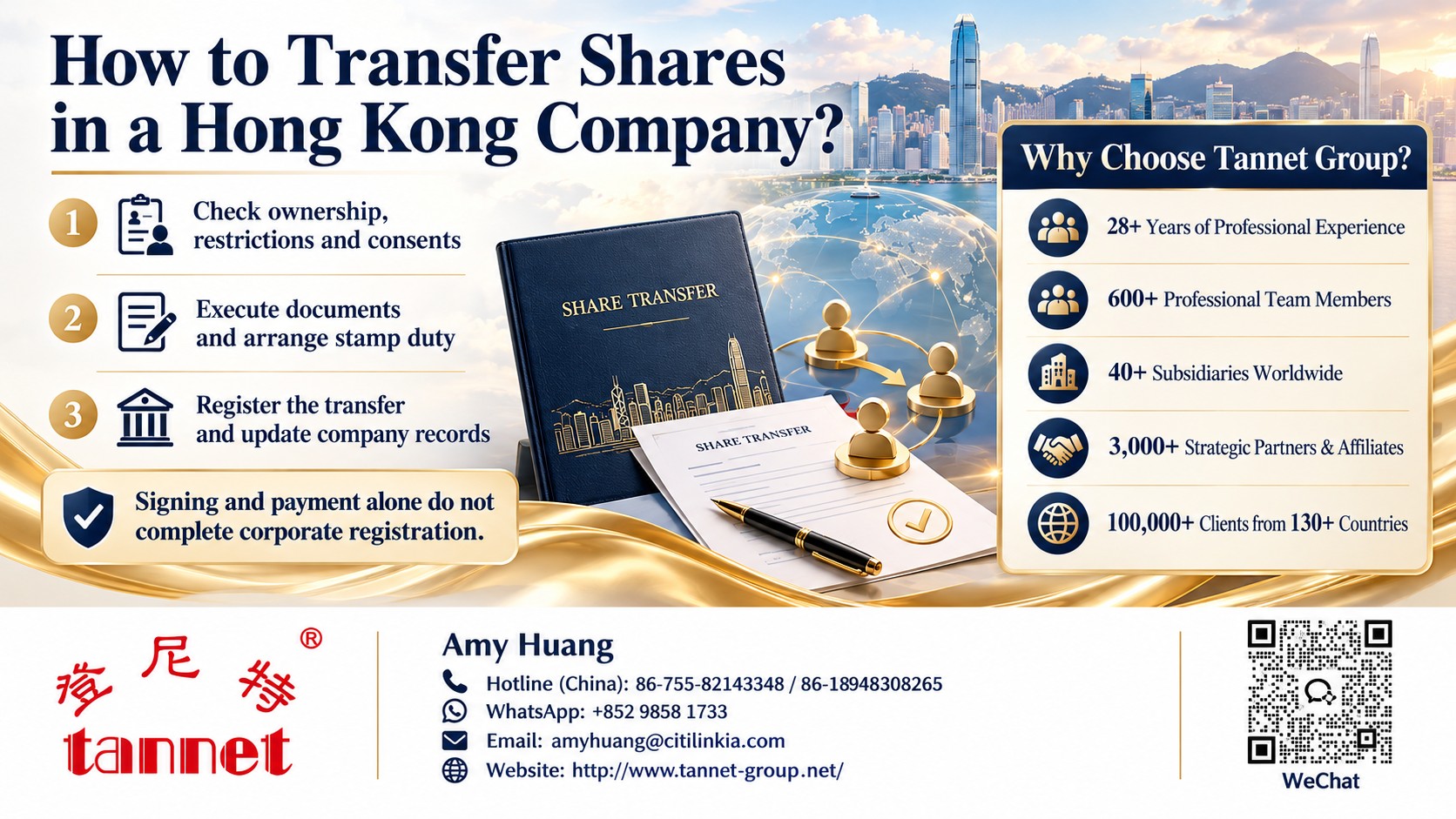
To transfer shares in a Hong Kong private company, check its articles and shareholder agreements, verify the parties and ownership, agree the transaction, execute the required documents, arrange stamp duty, and lodge the transfer with the company. Complete registration in the register of members and update related records.
This guide is for founders, investors, family owners, directors, and company secretaries handling existing shares. The central warning is that signing documents or paying the seller does not, by itself, complete corporate registration. Share transfers, share allotments, director changes, bank mandates, and beneficial ownership updates are separate processes with different requirements.
Start with the transaction type
A transfer moves existing shares from one holder to another. The price normally goes to the seller, not the company. A new allotment creates shares and can bring investment into the company. Do not select documents merely because both routes change ownership percentages.
This article addresses ordinary transfers in private companies limited by shares. Listed securities, regulated businesses, estates, disputed ownership, trusts, and group reorganizations may require additional analysis. A transfer also does not erase the company’s existing liabilities.
Step 1 Check ownership and restrictions
Inspect the register of members, original certificates, articles, shareholder agreements, and any charges or security arrangements. Confirm the seller owns the relevant shares and has authority to transfer them. Verify the class, number, paid status, and rights attached to those shares.
Private company articles restrict transfers. There may also be rights of first refusal, consent requirements, permitted transfer provisions, or lender restrictions. Obtain necessary consents and waivers before treating the transaction as unconditional. A share certificate alone does not resolve every ownership question.
Step 2 Verify the parties
Collect identification and current address information for individuals. For corporate parties, obtain incorporation records, ownership information, and signing authority. Check names against the company’s statutory records. Explain any differences before documents are executed.
An overseas shareholder is not automatically required to become a Hong Kong resident. However, document certification, translation, identity checks, sanctions screening, or banking requirements may affect preparation. Confirm these requirements with each institution rather than assuming one checklist covers everyone.
Step 3 Agree price and completion terms
Record the shares, consideration, payment method, completion conditions, and allocation of costs. A sale agreement may address warranties, indemnities, tax liabilities, shareholder loans, and missing records. Complex sales warrant legal drafting rather than reliance on a standard transfer form.
Keep the share price separate from repayment or assignment of shareholder loans. Review guarantees given personally by the departing shareholder. Selling the shares does not automatically release a guarantee, change a director, or remove an authorized bank signatory.
Step 4 Assemble the documents
For an ordinary sale, the package normally includes bought and sold notes, an instrument of transfer, the existing certificate, and relevant corporate approvals. Additional documents depend on the articles and transaction. Avoid assuming every transfer requires the same shareholder resolution.
The Stamp Office may require audited accounts, recent certified management accounts, property information, dividend resolutions, and other valuation evidence. A newly incorporated company that has never traded may instead need a supported written confirmation. Explain missing accounts; do not invent financial information.
Step 5 Determine stamp duty
GovHK states that each bought note and sold note for Hong Kong stock attracts duty at 0.1% of consideration or value. Both sides together generally produce 0.2%, plus HK$5 for the ordinary instrument of transfer. Relevant rounding rules apply.
For example, assume an ordinary sale with a dutiable amount of HK$1,000,000 and one instrument. The bought note is HK$1,000, the sold note HK$1,000, and the instrument HK$5. Total duty is HK$2,005 before service fees or additional instruments.
Do not substitute nominal consideration for a defensible valuation. A gift is not automatically exempt: voluntary dispositions generally attract HK$5 plus 0.2% of stock value. Group relief has specific conditions and procedures. Family relationships alone do not establish an exemption.
Step 6 Execute and stamp on time
IRD guidance gives ordinary sale contract notes two days after a transaction effected in Hong Kong, or thirty days if effected elsewhere. Gifts have different deadlines. Identify where and when the transaction is effected; overseas signatures alone do not settle that question.
Electronic stamping is distinct from electronic execution. The IRD explains that most instruments subject to stamping cannot be executed electronically under the general Electronic Transactions Ordinance framework. Confirm execution requirements before using electronic signatures. Eligible transactions may still use electronic stamping services.
Step 7 Lodge and register the transfer
Deliver the proper transfer instrument and supporting evidence to the company. Under Companies Ordinance section 151, the company generally has two months after lodgement to register the transfer or give the prescribed refusal notice. Directors must consider the articles and applicable law.
After registration, update the register of members and deal with the old and replacement certificates. Section 155 addresses certificate delivery within two months after lodgement, subject to statutory qualifications, including stamping. Record actual dates rather than backdating approvals or register entries.
Step 8 Complete the ownership handover
Government 1823 guidance says an ordinary share transfer is not immediately reported to the Companies Registry. It is reported in the first annual return after the transfer. This does not postpone internal registration or excuse separate filings triggered by other changes.
Review the Significant Controllers Register separately. Significant control is not identical to registered shareholding. Apply the statutory identification, confirmation, notice, and entry requirements to the relevant controller category. Update the bank and other counterparties when their terms or legal requirements require notification.
Budget and timetable
Budget for duty, professional work, accounts preparation, valuation, certification, translation, courier costs, and legal review where relevant. There is no universal all-inclusive fee or guaranteed completion period. Missing accounts, consents, original documents, valuation questions, or bank reviews can extend the process.
Common mistakes
Frequent mistakes include confusing a transfer with an allotment, ignoring pre-emption rights, using unsupported nominal prices, assuming gifts are duty-free, overlooking stamping deadlines, and treating the annual return as the transfer itself. Another mistake is leaving company records inconsistent with the signed documents.
Frequently asked questions
Q1 Can a non-resident buy the shares?
Generally yes for an ordinary private company, subject to applicable restrictions and checks. Residency does not replace identification, authority, or beneficial ownership evidence.
Q2 Must the seller visit Hong Kong?
Not necessarily. Overseas execution and document delivery may be possible. Confirm originals, witnessing, certification, and stamping arrangements before signing.
Q3 Is selling for one dollar enough to reduce duty?
No. Value remains relevant to the duty calculation. Prepare supporting accounts and explain the transaction’s commercial terms.
Q4 Does Form NSC1 report a transfer?
No. NSC1 concerns allotments. Ordinary transfers are reflected through company records and the subsequent annual return, as applicable.
Q5 Does the buyer automatically become a director?
No. Share ownership, directorship, and bank signing authority require separate decisions and documentation. Plan any appointments or resignations independently.
Q6 Can the bank account continue unchanged?
Do not assume so. Ask the bank about ownership notifications, due diligence, mandates, and account access. The bank decides its requirements.
Q7 Can shares pass directly after a shareholder dies?
Death raises transmission and estate authority issues. Confirm probate or other appropriate authority and the articles rather than using an ordinary sale package unquestioningly.
Set a practical completion checklist
Consider a founder selling half the shares to an investor. The founder may remain a director and lender even after ownership changes. The investor may need agreed access to accounts without becoming a bank signatory immediately. Document those choices instead of assuming every role changes together.
Assign one person to maintain a closing index. Record each consent, signature, stamping submission, registration action, certificate, and notification. Distinguish a document requested from a document received and checked.
After completion, compare the final ownership percentages with voting rights and the accounting records. Give both parties the agreed completion evidence through a secure channel. Keep sensitive identification documents access-controlled throughout the handover. A structured handover helps later accountants, banks, and advisers understand what changed without reconstructing the transaction from emails.
When Tannet may assist
Tannet may assist with document collection, secretarial coordination, stamping preparation, register updates, and ownership handover checklists. Transactions involving disputes, complex warranties, trusts, succession, regulated activities, or uncertain tax treatment may also require legal or specialist advice. Approval and tax outcomes depend on the relevant authorities and facts.
Written by: Tannet Business Services Team
Reviewed by: Consultant Amy Huang
First published: 2 Nov. 2026
Last reviewed: 2 Nov. 2026
30th Anniversary Offer: Tannet has been established for 28 years, we are offering exclusive limited-time promotional pricing to celebrate Tannet’s 30th anniversary. Slots are limited and available on a first-come, first-served basis. Contact Consultant Amy Huang for details.
————————————————Simplifying Business, Empowering Entrepreneurs————————————————