Key Takeaway
Treaty shopping rules can deny a tax treaty benefit when a Hong Kong holding company is used to obtain relief in circumstances the applicable treaty does not protect. They matter to investors receiving dividends, interest, royalties, or disposal proceeds through Hong Kong.
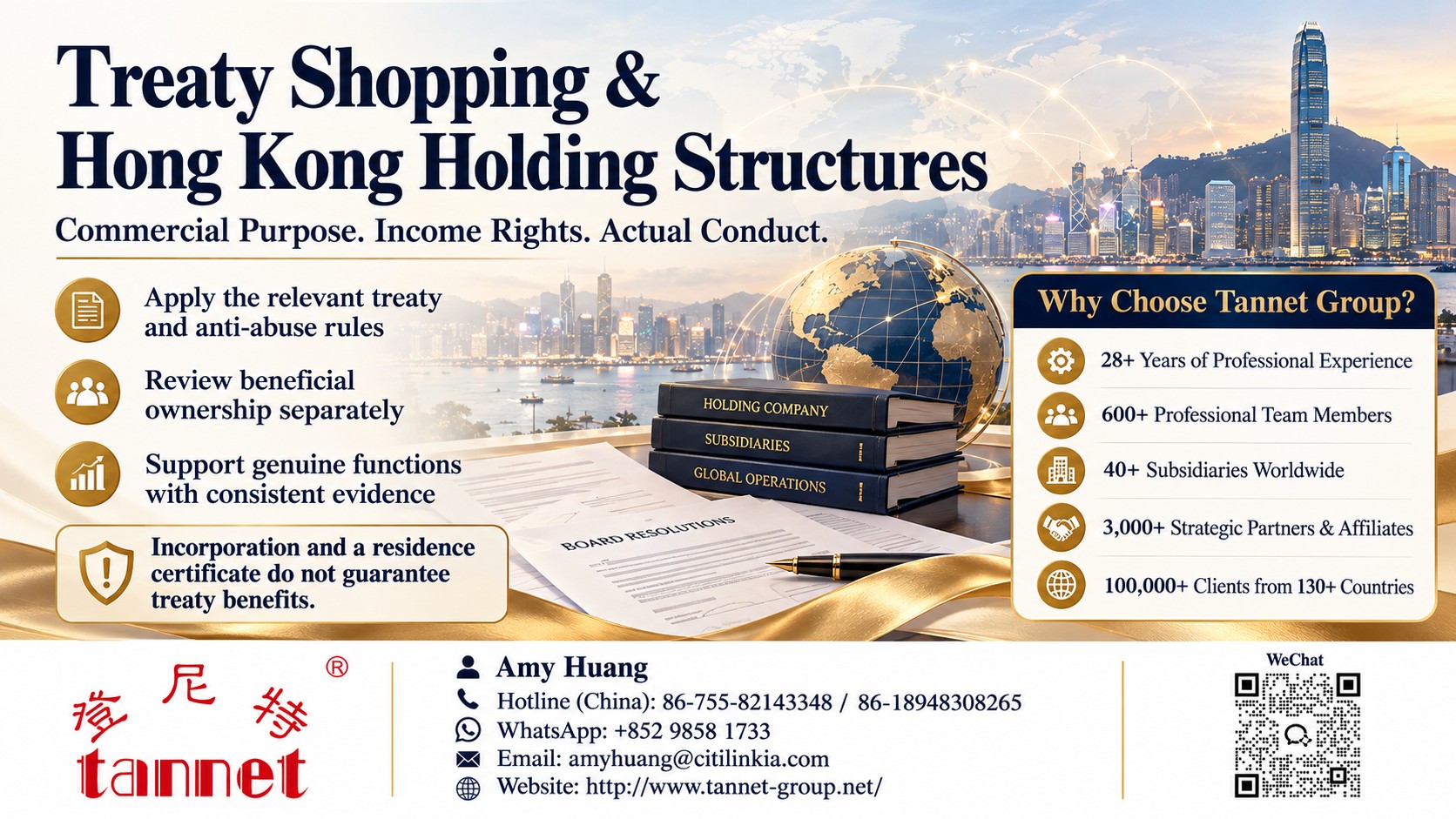
Incorporation and a Certificate of Resident Status do not settle entitlement. Review the relevant treaty, its effective amendments, residence, income conditions, beneficial ownership where required, and anti-abuse provisions separately. The main warning is that commercial substance is evidence, not a universal exemption.
A real business reason must be supported by actual conduct and evaluated under the governing rules.
What treaty shopping means
Treaty shopping commonly describes arrangements through which someone seeks treaty benefits indirectly by using an intermediary jurisdiction. A Hong Kong holding company is not abusive merely because its owners live elsewhere. The question is whether the particular benefit and arrangement satisfy the applicable legal conditions.
The OECD identifies preventing treaty abuse as a BEPS minimum standard. Different agreements implement that standard differently. A principal purpose test, limitation-on-benefits provisions, specific anti-conduit rules, and domestic anti-avoidance measures can interact. Do not substitute a general description of the OECD standard for the operative treaty.
Separate the eligibility questions
First identify the taxpayer, payer, source jurisdiction, payment date, and income category. Dividends, financing income, royalties, business profits, and capital gains do not share identical treaty conditions. A holding structure can qualify for one payment while failing on another.
Next determine residence under the relevant agreement. The IRD explains that a Certificate of Resident Status supports residence but does not guarantee relief. The source jurisdiction ultimately determines entitlement. A certificate does not certify that every transaction has a sufficient commercial purpose.
Then test the income article. Ownership thresholds, holding periods, beneficial ownership, or other conditions may apply. Complete a separate anti-abuse review even if those requirements appear satisfied. Meeting a reduced dividend rate’s numerical conditions is not the end of the analysis.
Understand the principal purpose test
Under a typical PPT, a benefit can be denied when the facts reasonably indicate that securing it was one principal purpose of the relevant arrangement or transaction. Tax advantage need not be the sole motive. The exact wording and its application must be checked.
The test also contains an important qualification concerning the object and purpose of the relevant treaty provisions. Do not turn it into a blanket prohibition on considering tax. Equally, do not assume that adding any commercial explanation automatically defeats a challenge.
The Chinese Mainland and Hong Kong Arrangement contains an entitlement-to-benefits provision in Article 24A, introduced by the Fifth Protocol. Its operation is not simply dependent on the MLI. For other partners, check protocols, MLI matching positions, reservations, and the effective dates relevant to the income.
Do not confuse beneficial ownership with the PPT
Beneficial ownership concerns the recipient’s relationship with the income under the applicable rules. The PPT examines purposes and treaty entitlement more broadly. A shareholder chart identifying the ultimate natural person does not, by itself, answer either question.
For Chinese Mainland dividends, interest, and royalties, STA Announcement 9 of 2018 requires a factual assessment. It considers income control, onward payment obligations, activities, and other relevant factors. The announcement expressly preserves the application of the PPT or domestic general anti-avoidance rules where appropriate.
Its onward-payment factor includes obligations to pay at least half the income to a third-jurisdiction resident within twelve months, including specified factual payments without a contract. This is an adverse factor, not a universal automatic denial rule or a worldwide safe harbour for payments below that level.
What makes a holding arrangement vulnerable
Risk increases when transaction documents require immediate onward payment, decision-makers cannot exercise meaningful discretion, or the company assumes little genuine responsibility. Inserting an entity shortly before a dividend or sale can prompt questions about why the ownership chain changed at that time.
These are review indicators, not findings of abuse. A longstanding entity can still enter an abusive transaction. A new entity can have genuine commercial functions. Evaluate the transaction’s sequence, alternatives, responsibilities, and actual operation rather than treating age as a decisive test.
Use substance evidence correctly
Identify what the company actually does. Relevant functions could include investment assessment, subsidiary oversight, financing decisions, regional coordination, and risk monitoring. Match directors’ capabilities, resources, service arrangements, and expenditure to those functions. A passive investment vehicle and an operating headquarters need different factual explanations.
There is no single office size, employee count, local director quota, or meeting frequency that guarantees treaty access across jurisdictions. Outsourcing also does not automatically establish or destroy substance. Document who instructs providers, evaluates their work, controls decisions, and bears the relevant risks.
For Chinese Mainland beneficial ownership analysis, Announcement 9 recognizes substantial investment holding management as a potentially substantial activity. Therefore, a holding company does not necessarily need manufacturing or unrelated trading operations. The quality of its investment management matters more than an invented operating story.
Build evidence before claiming relief
Keep the investment proposal, acquisition chronology, commercial alternatives, financing terms, board materials, and decision correspondence. Explain why Hong Kong was selected and how the entity’s functions support that choice. Preserve records created when decisions occurred, not only a later summary prepared for an audit.
Reconcile the narrative with bank mandates, agreements, accounting entries, and actual distributions. If minutes claim discretion but a binding agreement predetermines every payment, address the inconsistency. Do not backdate decisions or create fictitious staff, premises, or activities to support a claim.
Review each payment and change
A prior successful claim does not permanently approve the structure. Reassess after an acquisition, refinancing, shareholder change, director relocation, new distribution policy, or disposal plan. Separate the company’s general role from the commercial purpose and conditions of the particular transaction being reviewed.
Check source-jurisdiction filing rules independently. Chinese Mainland treaty claims generally use self-assessment, filing, and document retention for later inspection under Announcement 35 of 2019. A completed submission or accepted withholding calculation does not eliminate subsequent substantive review.
Model the consequences of denial
Prepare cash forecasts using the rate legally applicable if relief is unavailable. Determine whether contracts allocate additional withholding costs and whether a refund route remains open. Consider interest, penalties, or adjustment procedures only under the relevant law; they are not uniform consequences worldwide.
Treat Hong Kong profits tax, foreign tax credits, and foreign-sourced income exemption rules as separate analyses. Source-country treaty relief does not automatically exempt an income stream in Hong Kong. Likewise, residence certification does not resolve another jurisdiction’s corporate residence or reporting claims.
Illustrative review
Suppose a holding company coordinates several investments and retains authority over distributions. Compare that role with an entity required to forward a specific receipt under predetermined terms. The structures may look similar on a chart, but their factual profiles differ. Neither description alone establishes the result; examine the complete arrangement and applicable law.
Common mistakes
Frequent mistakes include relying only on a residence certificate, copying a substance checklist, confusing beneficial ownership with ultimate ownership, and assuming a listed-parent exception resolves every anti-abuse issue. Another is describing tax as irrelevant when internal transaction papers show it was central to the decision.
Frequently asked questions
Q1 Is a foreign-owned Hong Kong holding company automatically treaty shopping?
No. Foreign ownership alone does not determine abuse. Apply the relevant treaty conditions and evaluate the transaction’s facts and purposes.
Q2 Will renting an office guarantee relief?
No. Premises may support the facts, but they do not replace genuine functions, income rights, or the applicable anti-abuse analysis.
Q3 Does a residence certificate prevent a source-country challenge?
No. It addresses residence evidence. Other treaty conditions and source-jurisdiction review remain relevant.
Q4 Is retaining income for twelve months a guaranteed solution?
No. There is no universal waiting-period solution. Review contractual obligations, actual control, commercial purposes, and the particular legal framework.
Q5 Can a holding company qualify without employees?
Possibly. Examine its functions, resources, outsourcing, and relevant rules. No universal employee requirement settles every holding-company claim.
Q6 What should happen after a challenge?
Obtain the reasons, preserve evidence, and protect local objection or refund deadlines. Consider MAP where available; it does not guarantee relief or suspend every domestic deadline.
When Tannet may assist
Tannet may coordinate ownership and payment mapping, document-gap reviews, residence-certificate preparation, record organization, and communication with relevant advisers. Transaction-specific anti-abuse conclusions, disputes, restructuring implementation, and foreign legal advice may require qualified specialists. No service provider can guarantee acceptance of treaty benefits.
Written by: Tannet Business Services Team
Reviewed by: Consultant Amy Huang
First published: 2 Nov. 2026
Last reviewed: 2 Nov. 2026
30th Anniversary Offer: Tannet has been established for 28 years, we are offering exclusive limited-time promotional pricing to celebrate Tannet’s 30th anniversary. Slots are limited and available on a first-come, first-served basis. Contact Consultant Amy Huang for details.
————————————————Simplifying Business, Empowering Entrepreneurs————————————————