Key Takeaway
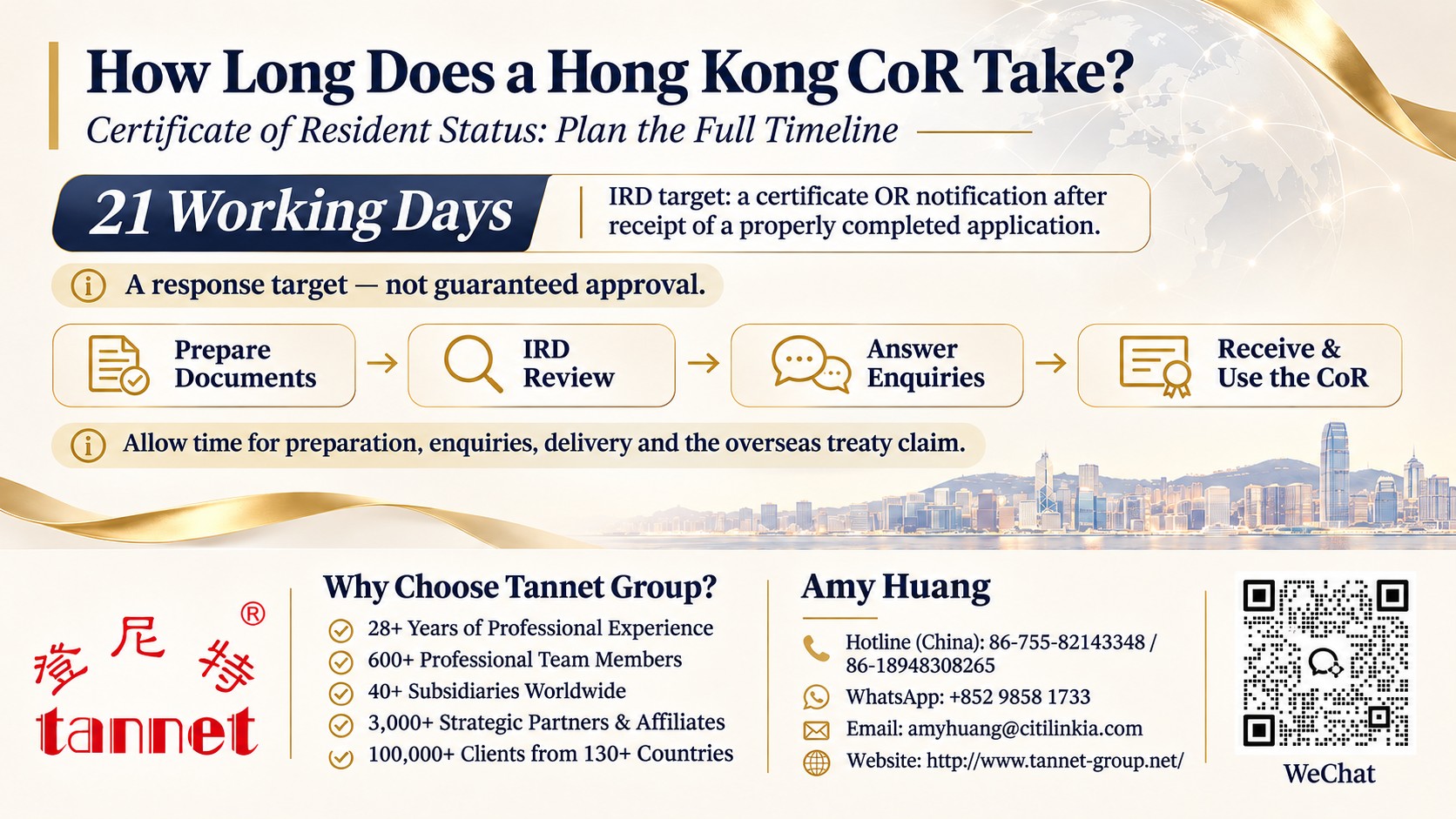
Hong Kong’s Inland Revenue Department targets issuing a Certificate of Resident Status or a notification within 21 working days after receiving a properly completed application. The notification may request information or explain that the application cannot be accepted.
This guide is for companies planning overseas income, withholding relief, and payment deadlines. The essential warning is that 21 working days is neither guaranteed approval nor the complete period from hiring an adviser to receiving usable evidence.
Preparation, enquiries, delivery, and the foreign claim can add time. Build a timetable around the payer’s requirements and monitor the application until its actual outcome.
What the official processing target means
The IRD’s CoR guidance and FAQ describe a target tied to receipt of a properly completed application. The starting point is not the day a company first asks about the service. It is also not necessarily the day documents are sent to an intermediary.
The target allows several outcomes. The department may issue the certificate. Alternatively, the assessing officer may seek further information or explain why the application cannot be accepted. Therefore, a response within the target period does not necessarily mean the company has obtained its certificate.
The Performance Pledge from April 2026 lists an 80% target for certificates or notifications issued within that period. This is a service performance target. It is not an 80% approval rate, an individual probability of success, or evidence of an average processing time.
Count working days rather than calendar days
Do not describe the target as 21 calendar days or promise delivery in three weeks. Allow for nonworking days and relevant Hong Kong holidays. Where an exact deadline matters, confirm the applicable counting approach rather than converting a working day target into an assumed calendar date.
Record when the IRD received the application and what was submitted. A postal dispatch receipt shows dispatch, not necessarily receipt or completeness. An electronic acknowledgement shows submission, but should not be treated as substantive confirmation that every requirement has been met.
Separate preparation from government processing
Preparation can involve identifying the treaty partner, confirming the calendar year of claim, checking company particulars, and assembling the required attachments. These tasks occur before the department can assess a complete application. Their duration depends partly on the company’s readiness and availability of responsible people.
Select IR1313A for the Chinese Mainland arrangement and IR1313B for other treaty jurisdictions. Review the current appendix requirements. The company form notes identify supporting establishment documents and appropriate signatories. An incomplete or inconsistent submission can generate questions rather than the certificate expected by the finance team.
Portal access and authority also need attention. Decide whether the company will submit through the Business Tax Portal or use an appropriately appointed agent. Arrange access before the payment deadline becomes urgent. Online availability does not mean the application is automatically assessed immediately.
What can extend the actual timeline
The IRD can request additional information. An unclear income description, inconsistent company history, missing appendix, or unanswered factual issue may require a response. These are practical examples, not a published ranking of delay causes. The relevant enquiry determines what the company must address.
Residence questions can require careful explanation where operations span several jurisdictions. Avoid inventing a universal office or employee threshold to obtain a quick answer. Supply the facts required by the form and relevant treaty. Specialist advice may be appropriate when the residence position is uncertain.
The response time also depends on how quickly the company retrieves records and approves its reply. Keep someone responsible for checking correspondence. An unanswered message can leave the application unresolved even though the department has already responded within its initial service target.
Do not assume a fresh guaranteed 21 working day approval period begins after every supplementary reply. The published general target does not establish one universal completion date for every enquiry cycle. Ask about the particular application’s status and remaining information needs.
Digital and paper delivery affect receipt
For Chinese Mainland treaty claims, successful applicants receive digital certificates under arrangements effective from 10 November 2025. The PDF is generally delivered through the applicant’s tax portal inbox. Authorized access and regular monitoring remain necessary to retrieve the document promptly.
For other treaty jurisdictions, the current guidance generally provides for paper certificates by post. Applicants wishing to collect a certificate personally should make the written request when submitting the application and required documents. Collection arrangements concern delivery; they do not guarantee faster assessment.
Distinguish the issue date from the date the company or overseas payer receives the evidence. Allow for postal transit where relevant. Ask the payer what form of evidence it accepts before relying on a scan or assuming that any emailed copy will satisfy local procedures.
Build a timetable backwards from payment
First identify the date the payer needs residence evidence, not only the expected date of income receipt. Its payroll, treasury, or withholding team may require documents before releasing payment. Confirm the applicable requirement directly rather than assuming every jurisdiction follows the same process.
Next allow time for the company’s preparation, the official processing target, potential enquiries, and delivery. Add a separate allowance for the foreign claim procedure. These are planning components, not an official additional waiting period or a promise that a particular buffer will always be sufficient.
For example, if the payer requires evidence before a scheduled distribution, test whether the plan still works if the initial IRD response asks a question. If it does not, discuss timing and permitted alternatives before making an unconditional payment or tax commitment.
What to do when the application is urgent
Identify the genuine deadline and explain it accurately in correspondence. Ask the IRD whether the circumstances can be accommodated. Do not assume that an urgent label, an agent’s involvement, or a larger professional fee creates a guaranteed priority route under the published general guidance.
The IRD’s FAQ states that it does not charge a CoR application fee. Professional preparation and coordination charges are separate. An adviser can help reduce avoidable administrative gaps, but cannot promise to control the assessing officer’s decision or workload.
If evidence may arrive too late, ask the payer or source jurisdiction adviser about lawful alternatives. Depending on local rules, these might involve different payment timing or a subsequent refund claim. Eligibility, filing periods, and required evidence must be checked for that jurisdiction.
Follow up with a useful application history
Keep the submission reference, dates, company name, claim year, and copies of replies together. The IRD’s CoR FAQ explains the portal enquiry function. A focused enquiry should ask what remains outstanding and whether further information is needed, rather than merely demanding an immediate certificate.
Once issued, check the certificate’s details before sending it onward. Residence evidence does not guarantee treaty relief. The foreign authority still determines entitlement. Receiving the certificate is one milestone; successful application of the requested tax treatment is a separate outcome.
Maintain an internal status note that distinguishes documents being prepared, application submitted, enquiry received, reply submitted, certificate issued, and evidence delivered to the payer. Record dates against those events. This is a recommended management tool, not an IRD requirement.
It helps colleagues communicate confirmed progress accurately without suggesting that an application acknowledgement establishes approval.
Common mistakes
Avoid treating 21 working days as a fixed approval deadline, counting from the adviser’s engagement date, and ignoring postal time. Other mistakes include leaving enquiries unmonitored, promising that online filing guarantees speed, and confusing certificate validity with processing time. Keep each milestone distinct in client communications.
Frequently asked questions
Q1 Is the certificate always issued within 21 working days?
No. The target includes notifications seeking information or explaining nonacceptance. It does not guarantee approval.
Q2 Does using an agent guarantee faster processing?
No. An agent may improve preparation and coordination but cannot guarantee the department’s timetable.
Q3 Will a digital certificate be approved instantly?
No. Electronic delivery changes how successful applicants receive evidence, not whether review is required.
Q4 Can I use the application receipt to claim treaty relief?
Do not assume so. Ask the payer or foreign authority what its rules permit.
Q5 Should I submit another application if nothing arrives?
Check existing messages and follow up using the reference first. Avoid duplicating the case without instructions.
Q6 When should Tannet become involved?
Tannet may assist before a payment deadline with document readiness, submission coordination, and enquiry tracking. Complex residence questions and foreign withholding procedures may require specialist advice.
Written by: Tannet Business Services Team
Reviewed by: Consultant Amy Huang
First published: 3 Nov. 2026
Last reviewed: 3 Nov. 2026
30th Anniversary Offer: Tannet has been established for 28 years, we are offering exclusive limited-time promotional pricing to celebrate Tannet’s 30th anniversary. Slots are limited and available on a first-come, first-served basis. Contact Consultant Amy Huang for details.
————————————————Simplifying Business, Empowering Entrepreneurs————————————————