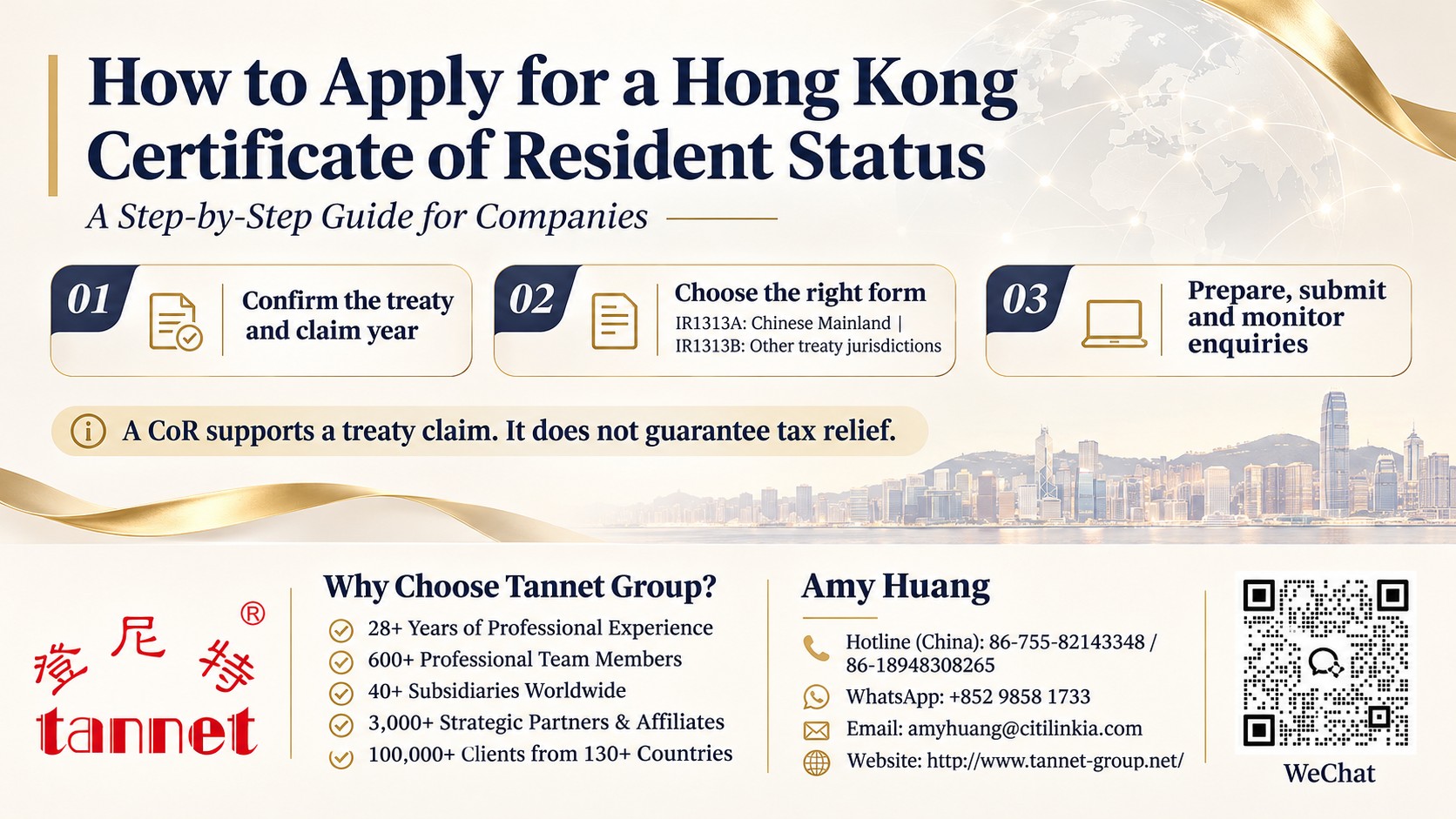
Key Takeaway
A Hong Kong company applies for a Certificate of Resident Status through the Inland Revenue Department to support a claim under an effective tax treaty.
The process involves confirming the treaty and claim year, choosing the correct company form, preparing accurate information, submitting the application, and answering any enquiries. This guide is for directors, finance teams, and company secretaries handling overseas income.
The most important caution is that a certificate proves residence for treaty purposes; it does not guarantee a reduced withholding rate. Plan both the Hong Kong application and the separate overseas claim before the payer’s deadline.
Understand what the certificate does
The Certificate of Resident Status, often called a CoR, is issued for claiming benefits under a Comprehensive Double Taxation Agreement or Arrangement. It is not a company incorporation certificate, a general certificate of tax payment, or an immigration document. Explain its specific purpose when requesting it.
The IRD states that the treaty partner ultimately decides whether relief is available. A certificate does not resolve every income classification, beneficial ownership, ownership threshold, or anti-abuse question. Keep the residence application separate from the assessment of the particular payment’s treaty treatment.
Step 1 Confirm the relevant treaty
Identify the jurisdiction taxing the income. Check the IRD’s treaty list and the relevant agreement, including protocols and applicable amendments. Distinguish a signed agreement from one that has entered into force. Also check when its provisions apply to the income concerned.
Record the payer, recipient, income type, expected payment date, and calendar year of claim. Ask the payer which residence evidence and local forms it needs. Do not apply merely because a customer requests a generic tax document without identifying an actual treaty purpose.
Step 2 Check the company residence definition
Read the residence article of that agreement. The IRD generally accepts applications from companies incorporated in Hong Kong and companies incorporated elsewhere but managed or controlled in Hong Kong. Treaty wording governs the particular application. Incorporation does not establish every condition for the subsequent relief claim.
Since the revised arrangements effective in June 2023, the IRD bases certification on the relevant treaty’s residence definition. Avoid inventing a universal minimum office size, staff count, or tax payment requirement. Nevertheless, describe operations truthfully and supply information required by the current form or assessing officer.
Step 3 Select the correct company form
Use IR1313A for the arrangement with the Chinese Mainland. Use IR1313B for other treaty jurisdictions. Download the current version directly from the IRD. These company forms also cover specified other entities; individual applicants use different forms. Do not submit an individual’s application for a company.
Check whether an appendix is required. Under the current instructions, IR1313B has appendix requirements for certain foreign-established applicants and applications concerning Japan. IR1313A has distinct rules, including specified dividend claims under STA Circular 2018 No. 9. Read the notes rather than copying another company’s submission.
Step 4 Assemble the supporting information
Prepare the company’s exact legal name, establishment details, relevant registration numbers, Hong Kong business and postal addresses, and contact details. Confirm the claim years and describe the nature and amount of income for each year. Reconcile these entries with the transaction records available to the company.
The form notes generally require a company incorporation certificate and any name change certificate. Follow the separate instructions for a re-domiciled company. Where the same document was supplied in another application, the notes permit using the relevant application reference instead of resubmitting it, subject to their conditions.
Complete the business operations fields accurately. These include headquarters, main branches, and information about directors, management, and other staff. A request for those facts does not itself impose a universal local hiring threshold. Explain unusual circumstances instead of inventing employees or addresses.
Keep supporting contracts, payment schedules, ownership records, and relevant decision documents available where they explain the application. These are practical preparation recommendations, not a claim that every applicant must attach the same extensive evidence bundle. Respond to the form requirements and any subsequent enquiries.
Step 5 Review the declaration and authority
For the paper company forms, the notes identify a director, secretary, or manager as the appropriate signatory. Check the current instructions and the person’s designation. If a service agent assists, agree who prepares information, checks it, submits it, and monitors replies. Do not share personal portal credentials.
Review the beneficial owner entry carefully. It concerns the income and relevant legal conditions, not simply a list of ultimate shareholders. The form notes address constrained onward payments and nominees. Obtain advice if a financing or distribution arrangement makes the correct disclosure uncertain.
Step 6 Submit through an accepted channel
Companies can use the Business Tax Portal under eTAX, or an appropriately appointed service agent can use the relevant portal. The IRD also accepts applications by post or in person. Choose the route that fits the company’s access and authority arrangements; online submission does not remove substantive review.
For physical submission, address the application to Assessor (Tax Treaty), Tax Treaty Section, Inland Revenue Department, 17/F, Inland Revenue Centre, 5 Concorde Road, Kai Tak, Kowloon, Hong Kong. Check the current official address before dispatch. Retain the submitted version and evidence of delivery or electronic acknowledgement.
Step 7 Monitor enquiries and timing
The IRD’s target is to issue a certificate or a notification within 21 working days after receiving a properly completed application. A notification may request more information or state that the application cannot be accepted. This is not a promise that every application will be approved within that period.
Assign someone to check portal messages and correspondence. Answer each question directly and retain the response. If an overseas filing deadline is approaching, ask the payer or local adviser about permitted withholding or refund procedures. A pending Hong Kong application does not automatically extend a foreign deadline.
Step 8 Receive and use the certificate
For Chinese Mainland treaty claims, successful applicants receive digital certificates under arrangements effective from 10 November 2025. Other jurisdictions currently generally receive paper certificates by post. The IRD allows a written request for personal collection when the application and required documents are submitted.
Check the issued company name, relevant jurisdiction, and certified year before forwarding it. Preserve the original digital file or paper document and record where it was sent. The payer may still require separate claim forms. Reconcile the final withholding and keep the tax evidence.
For Chinese Mainland claims, a certificate for one calendar year generally also supports the following two calendar years, subject to the stated conditions and relevant changes. Do not apply this administrative arrangement to every partner. Review the certificate and receiving authority’s requirements before reusing it.
Maintain a claim record
Create a separate record for each jurisdiction and claim year. Record the certificate reference, payment amounts, payer contact, filing date, and outcome. This practical control helps finance staff distinguish an uncompleted application from relief already applied at source.
Before the next payment, check whether ownership, operations, or the income arrangement changed. Update the responsible adviser and payer when relevant. Existing residence evidence should not become a reason to ignore changes affecting the separate treaty claim.
Common mistakes
Avoid selecting the wrong form, confusing calendar years with accounting periods, omitting a required appendix, and using an outdated company name. Other errors include treating certification as treaty approval and promising a guaranteed processing date. Keep government application charges separate from professional service fees.
Frequently asked questions
Q1 Can my company apply online?
Yes. Use the appropriate eTAX portal and authority arrangements, or submit by post or in person.
Q2 Must we first pay Hong Kong profits tax?
Do not assume that. Certification follows the relevant treaty residence definition, not a universal minimum tax payment rule.
Q3 Does every company need the same appendix?
No. Requirements depend on the selected form and circumstances. Read the current notes, including the special cases described there.
Q4 Is the certificate enough to obtain a lower rate?
No. The source jurisdiction checks the applicable treaty conditions and its claim procedures separately.
Q5 Can Tannet submit everything without our involvement?
The company must provide accurate facts and appropriate authority. Tannet may help select the application route, organize documents, coordinate submission, and track enquiries. Complex residence or treaty eligibility questions may require specialist advice.
Written by: Tannet Business Services Team
Reviewed by: Consultant Amy Huang
First published: 3 Nov. 2026
Last reviewed: 3 Nov. 2026
30th Anniversary Offer: Tannet has been established for 28 years, we are offering exclusive limited-time promotional pricing to celebrate Tannet’s 30th anniversary. Slots are limited and available on a first-come, first-served basis. Contact Consultant Amy Huang for details.
————————————————Simplifying Business, Empowering Entrepreneurs————————————————