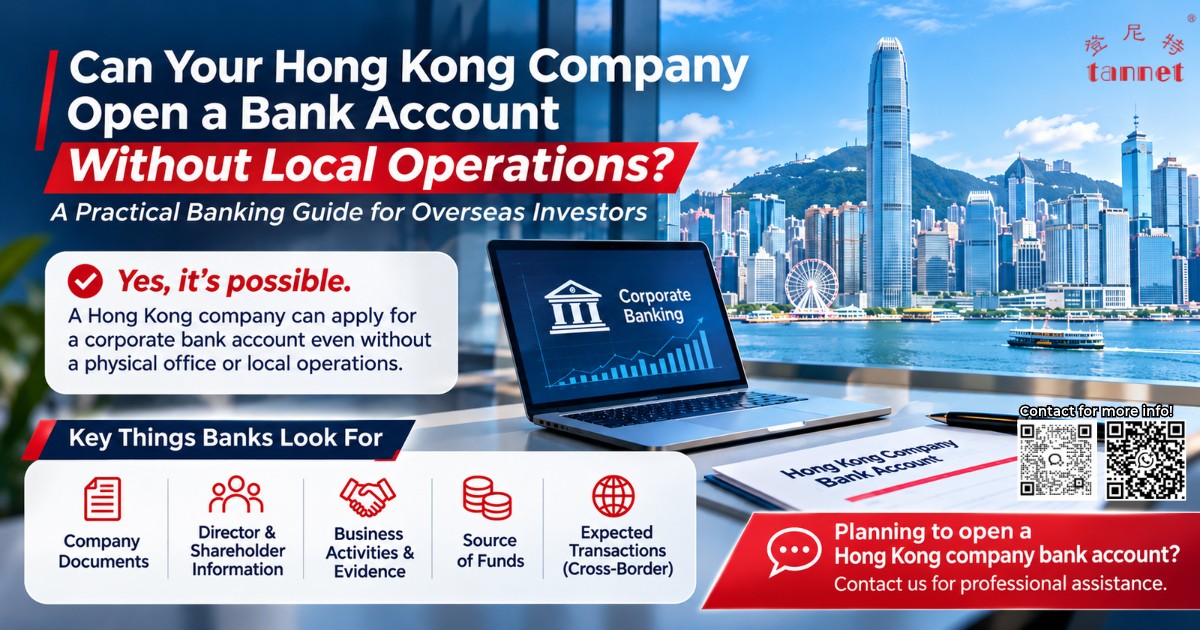
One of the most common questions overseas entrepreneurs ask after incorporating a Hong Kong company is whether they can open a corporate bank account without maintaining a physical office, hiring local employees or conducting business directly in Hong Kong.
The short answer is yes, it is possible. A Hong Kong company does not automatically need to maintain physical business operations in Hong Kong to apply for a corporate bank account.
However, incorporation alone does not guarantee banking approval. Banks must understand why the company needs a Hong Kong account, what business activities it conducts, who owns and controls the company, and where its funds originate.
For foreign investors, overseas entrepreneurs and Mainland Chinese business owners, understanding these requirements before applying can significantly improve application preparation and reduce unnecessary delays.
1. Can you open a Hong Kong company bank account without local operations?
Yes. A Hong Kong company may apply for a corporate bank account even if its directors and shareholders reside overseas and its customers or suppliers are located outside Hong Kong.
For example, a Mainland Chinese trading company may establish a Hong Kong subsidiary to manage international sales, receive payments from overseas customers and settle payments with international suppliers. Although its warehouse and manufacturing facilities remain in Mainland China, the Hong Kong entity may still have a legitimate commercial reason to maintain a Hong Kong bank account.
Similarly, an overseas entrepreneur may establish a Hong Kong company to manage regional distribution, international consulting services or cross-border investments.
The Hong Kong Monetary Authority (HKMA) has clarified that banks should not reject applications merely because a company is incorporated offshore or its directors and beneficial owners are non-residents. There is also no blanket HKMA requirement that every business customer must maintain operational premises in Hong Kong.
Nevertheless, banks are responsible for conducting customer due diligence (CDD) and assessing each application according to their internal policies and risk appetite.
Therefore, the key question is not simply whether your company has a local office, but whether you can demonstrate a genuine business purpose and explain the intended use of the account.
2. What Are the Hong Kong Company Bank Account Opening Requirements?
Although requirements differ between banks, applicants should generally prepare the following information and supporting documents.
A. Company Incorporation Documents
Banks need to verify that the company is legally registered and authorised to conduct business.
Commonly requested documents include:
- Certificate of Incorporation (CI).
- Business Registration Certificate (BRC).
- Articles of Association.
- Latest Annual Return, where applicable.
- Company structure and shareholding information.
- Board resolution authorising the opening of a corporate bank account, where required.
B. Directors and Shareholders’ Identification
Banks must identify the individuals who own, control or represent the company.
Applicants may be required to provide:
- Valid passport copies.
- Residential address proof.
- Details of company directors and shareholders.
- Ultimate Beneficial Owner (UBO) information.
- Ownership structure and organisational chart.
- Identification documents for authorised account signatories.
For companies with corporate shareholders or multiple layers of ownership, additional documentation may be required to establish the complete ownership structure.
C. Business Activity and Supporting Evidence
This is particularly important for companies without local operations.
Banks need to understand what the company actually does, who its customers and suppliers are, and how it generates revenue.
Supporting documents may include:
- Company business plan or business profile.
- Customer and supplier contracts.
- Sales invoices and purchase orders.
- Letters of intent or commercial agreements.
- Company website or marketing materials.
- Existing business registration or relevant industry licences.
- Details of expected transaction volume and geographical markets.
A newly incorporated company may not have completed transactions yet. In such cases, a realistic business plan, proposed commercial arrangements and evidence of existing business activities through related entities may help explain the company’s intended operations.
D. Source of Funds and Source of Wealth
Banks also need to understand where the company’s initial capital and future operating funds originate.
Depending on the applicant’s circumstances, supporting documents may include personal or corporate bank statements, investment records, shareholder loan agreements, financial statements or relevant business transaction records.
The information provided should be consistent with the company’s ownership structure, business activities and expected account transactions.
3. How Can a Company Without Hong Kong Business Operations Prove Its Business Purpose?
Not having a physical office does not mean that a company cannot demonstrate genuine business activity.
The most effective approach is to present a clear commercial explanation supported by verifiable documents.
Consider the following examples:
International Trading Business
A Hong Kong company purchases products from manufacturers in Mainland China and sells them to customers in Southeast Asia, Europe or the Middle East.
Relevant evidence may include supplier agreements, customer purchase orders, invoices, shipping records and a description of the international supply chain.
Cross-Border Consulting Business
A Hong Kong company provides management consulting, IT services, marketing or professional services to overseas clients.
Relevant evidence may include service agreements, project proposals, client correspondence and invoices.
Regional Holding or Investment Company
An investor establishes a Hong Kong company to hold shares in overseas subsidiaries or manage regional investments.
The company should explain its investment structure, source of investment funds, expected financial activities and the commercial rationale for using Hong Kong.
International E-commerce Business
A Hong Kong company operates an online store selling products to international customers without maintaining a physical retail outlet in Hong Kong.
Relevant evidence may include the e-commerce website, platform seller records, supplier arrangements, order records and payment flow information.
The important consideration is consistency. The business model, supporting documents, source of funds and anticipated transactions should tell the same commercial story.
4. Why Are Hong Kong Company Bank Account Applications Rejected?
Even when a company is legally incorporated, its banking application may be unsuccessful.
Common reasons include:
1. Unclear Business Activities
The applicant cannot adequately explain what the company sells, who its customers are or how it generates revenue.
2. Insufficient Business Evidence
The company provides only incorporation documents without supporting information about its actual or intended commercial activities.
3. Unclear Source of Funds
The applicant cannot provide a reasonable explanation or supporting evidence for the initial capital or expected incoming funds.
4. Complicated Ownership Structure
The bank cannot sufficiently verify the company’s shareholders, beneficial owners or ultimate controlling individuals.
5. Inconsistent Application Information
The information provided during the application differs from the company’s business profile, financial records or supporting documents.
6. Business Activities Outside the Bank’s Risk Appetite
Certain industries, geographical markets, transaction patterns or business models may require enhanced due diligence or may not be accepted by a particular bank.
It is important to understand that an application being rejected by one bank does not necessarily mean the company is prohibited from opening an account elsewhere. Different banks have different customer acceptance policies and risk assessments.
5. Can a Hong Kong Company Open a Cross-Border Collection Account?
Yes. A Hong Kong corporate bank account can support international business transactions, subject to the bank’s available services, currencies and transaction policies.
For overseas investors, common account requirements include:
- Receiving payments from international customers.
- Paying overseas suppliers and service providers.
- Managing multi-currency business transactions.
- Settling international trade payments.
- Managing regional business cash flow.
Before selecting a banking provider, companies should evaluate supported currencies, international remittance capabilities, transaction limits, fees, online banking facilities and the countries involved in their business activities.
A Hong Kong bank account should be selected according to the company’s actual transaction needs rather than simply the convenience of opening an account.
6. Traditional Banks vs Digital Banking Solutions
Companies may explore traditional banks and digital banking providers when considering their account options.
Traditional banks may offer a broader range of corporate banking services, including trade finance, foreign exchange services, relationship management and more complex treasury arrangements.
Digital banking providers may offer convenient online application processes and account management facilities, depending on their eligibility criteria and available services.
However, digital application does not mean automatic approval. Licensed banks and other regulated financial institutions remain subject to applicable customer due diligence and compliance requirements.
Companies should compare each provider’s eligibility criteria, supported business sectors, account features and onboarding procedures before proceeding.
7. How to Improve Your Hong Kong Company Bank Account Application
For companies without physical operations in Hong Kong, preparation is particularly important.
Consider the following steps:
Step 1: Establish a Clear Business Structure
Ensure that the company’s ownership, directors, shareholders and ultimate beneficial owners are properly documented.
Step 2: Prepare a Professional Business Profile
Explain the company’s products or services, target markets, business model, customers, suppliers and commercial objectives.
Step 3: Organise Supporting Business Documents
Prepare relevant contracts, invoices, purchase orders, supplier arrangements, website information or business plans.
Step 4: Explain the Source of Funds
Prepare supporting evidence showing the origin of the initial capital and the expected source of business revenue.
Step 5: Identify Suitable Banking Options
Evaluate banks according to the company’s business activities, shareholder profiles, geographical exposure and transaction requirements.
Step 6: Prepare for Bank Due Diligence
Directors, shareholders or authorised representatives may be asked to attend an interview, provide additional information or complete identity verification, depending on the bank’s procedures.
There is no universal approval timeline or guarantee. The process depends on the bank, the completeness of the application and the complexity of the company’s business and ownership structure.
8. How TANNET Supports Hong Kong Company Bank Account Opening
Opening a Hong Kong company is only one part of establishing an effective international business structure. Choosing suitable banking solutions and preparing the necessary supporting documents are equally important.
TANNET Group provides Hong Kong corporate services and business support for foreign investors, overseas entrepreneurs and Mainland Chinese business owners.
Our support includes:
- Understanding the company’s business model and banking requirements.
- Reviewing company incorporation and ownership documentation.
- Assisting with the preparation of business profiles and supporting documents.
- Identifying potential banking options based on the company’s circumstances.
- Coordinating the account application process and follow-up.
- Supporting clients with related Hong Kong company maintenance and compliance matters.
Every company has different business activities, ownership arrangements and banking needs. Our approach focuses on understanding these requirements before identifying suitable application options.
Whether you are establishing a new Hong Kong company or planning to expand your existing international business, TANNET can assist you in preparing for the next stage of your business setup.
Contact TANNET Group to discuss your Hong Kong company bank account opening requirements and explore suitable banking solutions for your business.
Frequently Asked Questions (FAQs)
Q1: Can I open a Hong Kong company bank account if I live in Mainland China?
Yes. Non-resident directors and shareholders may apply for a Hong Kong corporate bank account. The bank will conduct identity verification and assess the company’s business activities, ownership structure and source of funds.
Q2: Must my Hong Kong company have a physical office in Hong Kong?
Not necessarily. There is no blanket requirement for every company to maintain operational premises in Hong Kong. However, the bank may request information about the registered office, principal place of business and commercial rationale for establishing the account.
Q3: Can a newly incorporated Hong Kong company open a bank account without invoices?
Yes, it may apply. If the company has not started trading, it can explain its intended activities and provide available supporting evidence, such as a business plan, proposed contracts, supplier arrangements or letters of intent. Approval remains subject to the bank’s assessment.
Q4: Can a Hong Kong company receive payments from overseas customers?
Yes, subject to the account’s permitted activities, supported currencies, transaction policies and applicable compliance requirements.
Q5: Will opening a Hong Kong company guarantee bank account approval?
No. Company incorporation and bank account approval are separate processes. Each bank independently assesses the applicant and may request additional information or decline an application.
Q6: Do all shareholders need to travel to Hong Kong for bank account opening?
Not necessarily. Requirements vary by bank and account type. Some banks may offer remote onboarding or alternative identity verification arrangements, while others may require an in-person meeting with directors or authorised signatories.
Q7: What should I do if my Hong Kong company bank account application is rejected?
First, identify whether the issue relates to missing documents, insufficient business evidence, ownership verification or the bank’s internal risk assessment. Review the application and supporting information before considering another suitable banking provider. A new application should address the underlying issues rather than simply repeat the previous submission.