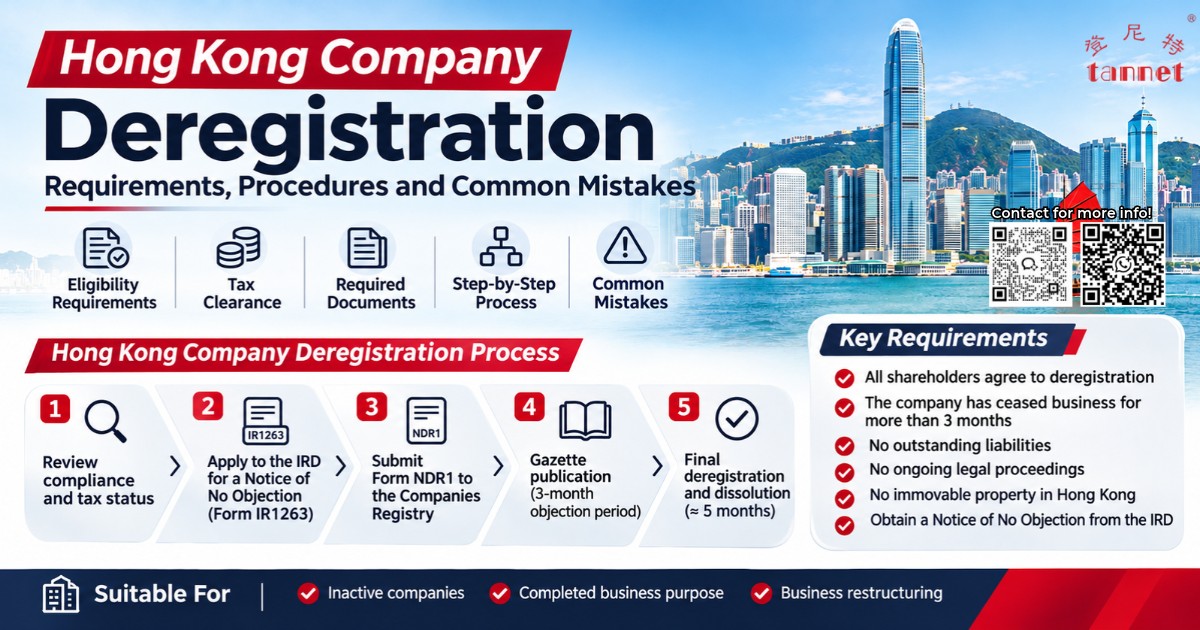
Closing a Hong Kong company involves more than simply stopping business operations or closing its bank account. Company owners must follow the statutory deregistration procedures, settle outstanding tax matters and ensure that all corporate compliance obligations are properly addressed before the company can be dissolved.
For overseas investors, Mainland Chinese entrepreneurs and international business owners who no longer require their Hong Kong entities, understanding the Hong Kong company deregistration process is essential to avoiding unnecessary compliance issues and potential legal consequences.
So, how can you deregister a Hong Kong company? What are the eligibility requirements, documents and procedures involved? This guide explains the key considerations for business owners planning to close an inactive Hong Kong company.
1. What Is Hong Kong Company Deregistration?
Hong Kong company deregistration is a formal legal process through which an eligible company applies to be removed from the Companies Register maintained by the Hong Kong Companies Registry.
Once the deregistration is completed, the company is dissolved and ceases to exist as a legal entity.
Under Section 750 of the Hong Kong Companies Ordinance (Cap. 622), eligible private companies and companies limited by guarantee may apply for deregistration if they satisfy the statutory requirements.
Deregistration is generally suitable for companies that:
- Have never commenced business operations.
- Have ceased business activities and no longer intend to operate.
- Have completed their original business purpose.
- Are no longer required as part of an overseas business structure.
- Have no outstanding debts, liabilities or unresolved legal matters.
It is important to distinguish deregistration from simply allowing a company to become inactive. A company remains subject to its statutory obligations until it is formally dissolved.
2. Hong Kong Company Deregistration Conditions
Before applying for deregistration, a company must satisfy all the eligibility requirements under Section 750 of the Companies Ordinance.
The main Hong Kong company deregistration conditions include:
1. All shareholders agree to deregistration
All members of the company must agree to the proposed deregistration. Shareholder approval should be obtained before proceeding with the application.
2. The company has ceased business operations
The company must either have never commenced business or have ceased carrying on business or operations for more than three months immediately before submitting the application.
A company that is temporarily inactive but intends to resume business may not satisfy this requirement.
3. No outstanding liabilities
The company must have no outstanding liabilities. This includes unpaid supplier invoices, employee-related payments, loans, taxes and other financial obligations.
Outstanding debts must be resolved before proceeding.
4. No ongoing legal proceedings
The company must not be involved in any ongoing legal proceedings. Existing disputes or litigation should be addressed before applying.
5. No immovable property in Hong Kong
The company must not own immovable property situated in Hong Kong.
If it is a holding company, none of its subsidiaries may own immovable property situated in Hong Kong.
6. Obtain a Notice of No Objection from the Inland Revenue Department
The company must obtain a written Notice of No Objection to Deregistration from the Commissioner of Inland Revenue.
Without this notice, the Companies Registry will not accept a valid deregistration application.
These requirements must all be satisfied. Simply having no revenue or no active business transactions does not automatically qualify a company for deregistration.
3. Hong Kong Company Deregistration Process: Step-by-Step Guide
The Hong Kong company deregistration process generally involves two government departments: the Inland Revenue Department (IRD) and the Companies Registry.
Step 1: Review the Company’s Financial and Compliance Status
Before submitting an application, review the company’s financial records, tax position and statutory filing history.
This includes checking:
- Outstanding profits tax returns and tax assessments.
- Unpaid business registration fees and levies.
- Outstanding annual returns.
- Unsettled company liabilities.
- Remaining bank balances and other company assets.
- Outstanding obligations to the Inland Revenue Department.
Any outstanding matters should be addressed before applying.
Step 2: Apply for a Notice of No Objection
The next step is to apply to the Inland Revenue Department for a Notice of No Objection to Company Deregistration.
The applicant must complete Form IR1263 and pay the applicable government application fee.
The IRD will review the company’s tax records and determine whether there are outstanding tax liabilities, unsubmitted tax returns, unanswered enquiries or unresolved tax disputes.
If all requirements are satisfied, the IRD will issue the Notice of No Objection.
The normal processing time is within 21 working days after receipt of a valid application and payment, although additional time may be required if outstanding matters arise.
Step 3: Submit Form NDR1 to the Companies Registry
After obtaining the Notice of No Objection, the company must submit Form NDR1 – Application for Deregistration of Private Company or Company Limited by Guarantee.
The application must be submitted to the Companies Registry within three months from the date of issue of the Notice of No Objection.
The required documents include:
- Completed Form NDR1.
- Notice of No Objection issued by the IRD.
- Prescribed government application fee.
Applications can be submitted electronically or in hard copy, subject to the applicable document certification requirements.
Step 4: Gazette Publication and Objection Period
After receiving the application, the Companies Registry will process the documents and arrange for the proposed deregistration notice to be published in the Hong Kong Government Gazette.
An objection period of three months follows the publication of the first notice.
If no valid objection is received during this period, the Registrar may proceed with the final deregistration notice.
Step 5: Final Deregistration and Dissolution
Once the final notice is published in the Gazette, the company is officially deregistered and dissolved.
At this stage, the company ceases to exist as a legal entity.
The entire process generally takes approximately five months, although the actual duration depends on the company’s compliance status, government processing and whether any objections or outstanding matters arise.
4. What Documents Are Required for Hong Kong Company Deregistration?
Preparing the necessary documents in advance can help reduce processing delays.
The documents and information commonly required include:
- Hong Kong Certificate of Incorporation.
- Business Registration Certificate.
- Company registration details and company number.
- Latest annual return and corporate records.
- Director and shareholder information.
- Latest financial statements and accounting records, where applicable.
- Profits tax returns and relevant tax correspondence.
- Details of outstanding liabilities, if any.
- Completed Form IR1263.
- Completed Form NDR1.
- Notice of No Objection issued by the IRD.
Additional supporting information may be requested depending on the company’s circumstances and filing history.
The exact document requirements should be assessed according to the company’s existing records and outstanding compliance obligations.
5. Hong Kong Company Deregistration Tax Requirements
Tax clearance is one of the most important parts of the deregistration process.
The Inland Revenue Department will not issue a Notice of No Objection if the company has unresolved tax matters or outstanding obligations.
Common tax matters that require attention include:
Outstanding profits tax returns: Any tax returns issued by the IRD must be submitted, even if the company has ceased operations or recorded no income.
Unpaid tax liabilities: Outstanding profits tax, property tax, business registration fees, penalties and other applicable liabilities must be settled.
Unreported chargeability: If the company is chargeable to tax for a particular year but has not received a tax return, it may still have an obligation to notify the IRD.
Unresolved tax enquiries: Any unanswered requests for information or unresolved objections and appeals must be addressed.
Disposal of company assets: Trading stock, landed property and securities must be properly dealt with before the IRD issues its notice.
Business owners should also review accounting records and ensure that the company’s financial position is properly documented before submitting the application.
6. Common Mistakes When Deregistering a Hong Kong Company
Although deregistration is generally simpler than a formal winding-up process, mistakes can cause unnecessary delays or complications.
Mistake 1: Assuming an inactive company can be automatically closed
A company that has stopped trading is not automatically dissolved. It must still complete the formal deregistration procedure.
Mistake 2: Ignoring outstanding annual returns
Annual return filing obligations continue until the company is officially deregistered. Failure to file outstanding returns may result in prosecution.
Mistake 3: Applying before resolving tax matters
Outstanding tax returns, penalties and unanswered IRD enquiries can prevent the issuance of a Notice of No Objection.
Mistake 4: Leaving money or assets in the company
Company assets, including bank account credit balances, vehicles and other property, must be properly disposed of before deregistration.
Upon dissolution, any remaining company property may vest in the Hong Kong SAR Government as bona vacantia.
Mistake 5: Missing the NDR1 submission deadline
The application to the Companies Registry must be submitted within three months from the date of issue of the Notice of No Objection.
Missing this deadline may require the applicant to obtain a new notice.
Mistake 6: Stopping compliance too early
A company must continue meeting its applicable statutory obligations until it is formally dissolved. Submitting an application does not immediately terminate its annual filing responsibilities.
7. Deregistration vs Winding Up: Which Is More Suitable?
Not every Hong Kong company can use the deregistration procedure.
Deregistration is generally suitable for a defunct, solvent company that meets all the statutory eligibility requirements.
By comparison, members’ voluntary winding up is a formal liquidation procedure that may be appropriate for a solvent company with assets or other circumstances requiring a structured liquidation process.
Companies with outstanding debts, complex assets, ongoing disputes or other complications may require a different closure approach.
Business owners should assess their company’s financial and legal position before deciding which procedure is appropriate.
8. Professional Assistance for Hong Kong Company Deregistration
Deregistering a Hong Kong company requires coordination between tax clearance, accounting records, statutory compliance and government applications.
For overseas business owners, handling these procedures independently can be challenging, particularly when the company has outstanding tax filings, historical compliance issues or incomplete financial records.
TANNET provides professional corporate services to support business owners throughout the Hong Kong company deregistration process.
Our services include company compliance reviews, accounting and tax documentation coordination, application preparation, tax clearance assistance and liaison with the relevant authorities.
Whether you are closing an inactive Hong Kong company, restructuring your international business operations or consolidating your overseas corporate structure, TANNET can help assess your company’s position and identify the appropriate next steps.
Planning to close your Hong Kong company? Contact TANNET for a preliminary assessment of your company’s deregistration eligibility, tax status and outstanding compliance requirements.
A proper assessment before applying can help reduce unnecessary delays and ensure that your company closure is handled in an orderly and compliant manner.
📞 Free 1-on-1 Consultation Now,
Official Service Hotline: +86-755-82148419
Cell: +86-13823131503;+60 19-309 2363
WeChat ID: 13823131503;
WhatsApp:+86-13823131503;+60 19-309 2363
Email: mytannet08@gmail.com; susiehu@citilinkia.com