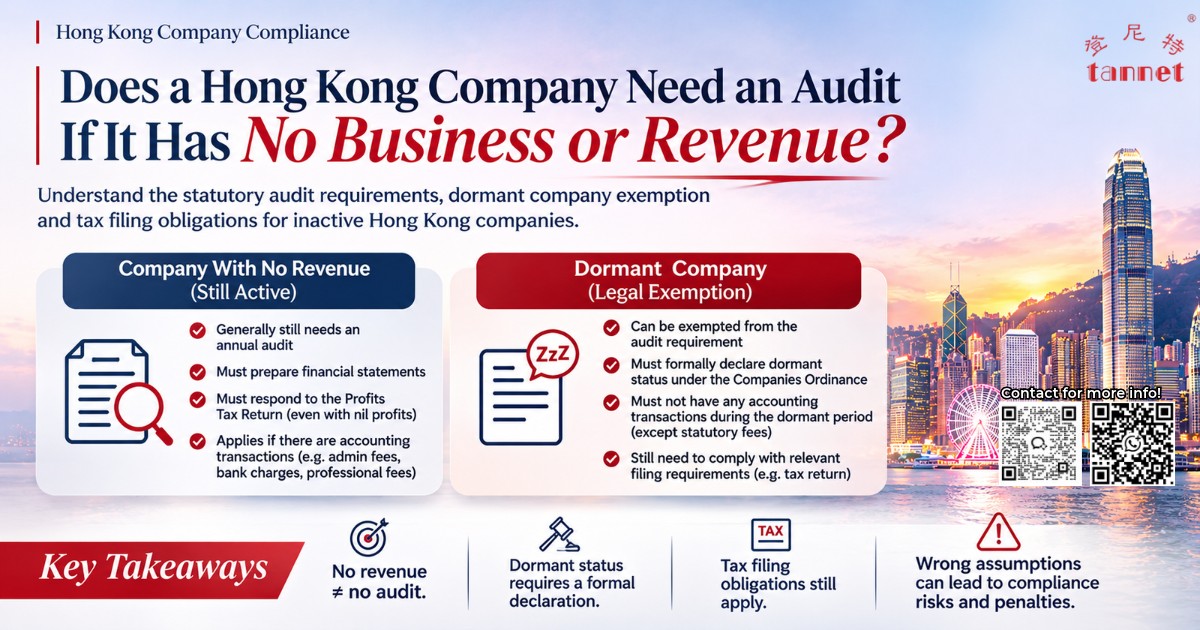
Does a Hong Kong Company Need an Audit If It Has No Business or Revenue?
Many foreign investors establish a Hong Kong company for international trade, cross-border investment, regional expansion or future business opportunities. However, not every newly incorporated company begins operating immediately.
Some companies remain inactive for months or even years. Others have no sales, no customers or no business income during a financial year.
This raises an important question: Does a Hong Kong company still need an audit if it has no business or revenue?
The short answer is yes, in most cases.
Under Hong Kong’s Companies Ordinance (Cap. 622), companies are generally required to prepare annual financial statements and have them audited, regardless of whether they generate revenue. However, an important exception applies to companies that have formally obtained dormant status under the law.
Understanding the distinction between a company with no revenue and a legally dormant company is essential for avoiding unnecessary compliance risks. Let’s understand Hong Kong company audit requirements.
1. Does a Hong Kong Company Need an Audit If It Has No Revenue?
Yes. A Hong Kong incorporated company is generally required to have its financial statements audited annually, even if it has not generated any revenue or commenced business operations.
The statutory audit requirement is not determined solely by the company’s turnover or profitability.
For example, consider a foreign investor who incorporates a Hong Kong private limited company to prepare for future expansion into the Asian market. During its first financial year, the company does not secure any customers, issue invoices or generate business income.
Although the company has no revenue, it may still have accounting transactions, such as:
-
Company registration and administrative expenses.
-
Professional fees for company secretarial services.
-
Bank charges and account maintenance fees.
-
Payments for business-related services.
-
Shareholder funding or capital-related transactions.
These activities may create accounting records that need to be maintained and reported.
If the company has not formally declared itself dormant, it generally remains subject to the statutory audit requirement.
Important: Having zero revenue, zero profit or no active customers does not automatically exempt a Hong Kong company from an audit.
2. What Is a Dormant Company Under Hong Kong Law?
A dormant company is not simply a company that has stopped trading or has never commenced business.
Under Section 5 of the Companies Ordinance (Cap. 622), a company can obtain dormant status by passing a special resolution declaring that it will become dormant and delivering the resolution to the Companies Registry for registration.
The company must also satisfy the relevant statutory conditions.
In particular, a dormant company must not have any accounting transactions during its dormant period, subject to the statutory exclusions.
An accounting transaction generally refers to a transaction that must be entered into the company’s accounting records under the Companies Ordinance. Certain statutory fees are excluded.
For example, a company that has no sales but continues paying professional service fees, maintaining business subscriptions or conducting other transactions may not qualify as dormant.
This distinction is particularly important for foreign shareholders who assume that leaving a company inactive is sufficient to avoid annual compliance obligations.
How Can a Hong Kong Company Become Dormant?
Generally, the process involves:
-
Reviewing the company’s existing financial and accounting activities to determine whether it qualifies.
-
Ensuring that the company satisfies the relevant dormancy conditions.
-
Passing a special resolution declaring the company’s dormant status.
-
Delivering the resolution to the Companies Registry for registration.
-
Maintaining the dormant status by avoiding accounting transactions during the dormant period.
Dormant status is not automatic. A company should not simply stop operating and assume that its audit obligations have been suspended.
3. What Happens If a Dormant Company Starts Conducting Business?
A company that has formally declared dormant status must continue satisfying the statutory requirements to retain its exemption.
If the company enters into an accounting transaction, its dormant status generally ceases from the date of that transaction.
For example, a Hong Kong company may have formally declared itself dormant after incorporation. Two years later, its shareholder decides to activate the company and begins paying suppliers, receiving customer payments or incurring business expenses.
These activities may cause the company to cease being dormant.
Once the company resumes accounting transactions, it must reassess its statutory compliance obligations, including the requirement to prepare financial statements and arrange an audit.
Therefore, investors planning to reactivate an existing Hong Kong company should review its dormant status before commencing operations.
4. Does a Hong Kong Company With No Income Still Need to File Tax Returns?
Yes. The audit requirement and profits tax filing obligation are two separate compliance matters.
A Hong Kong company may have no business income and no assessable profits during a particular year of assessment. However, this does not automatically eliminate its obligation to respond to tax returns issued by the Inland Revenue Department (IRD).
When the IRD issues a Profits Tax Return, the company must complete and submit the return within the applicable deadline, even if it has no assessable profits.
Depending on its circumstances, the company may need to provide supporting financial information, tax computations and relevant explanations.
For a company that qualifies as dormant under the Companies Ordinance, the IRD provides an exception to the general requirement to submit audited financial statements with the profits tax return.
However, dormant status does not mean that the company can ignore correspondence or filing requirements from the IRD.
Foreign investors should therefore distinguish between three separate matters:
-
Accounting: Maintaining appropriate financial and accounting records.
-
Auditing: Meeting statutory audit requirements unless a valid exemption applies.
-
Tax filing: Responding to profits tax returns and meeting applicable tax obligations.
These obligations should be reviewed independently rather than treated as one single annual filing requirement.
5. What Are the Compliance Risks of Ignoring Audit Requirements?
Some company owners assume that an inactive company does not need ongoing compliance. This misunderstanding can create problems when the company eventually resumes business, undergoes a corporate restructuring or prepares to close.
Potential consequences include:
Non-compliance with statutory obligations
Failing to arrange a required audit or prepare financial statements may place the company in breach of the Companies Ordinance.
Tax filing complications
Ignoring profits tax returns issued by the IRD may result in estimated assessments, penalties or further enquiries.
Difficulty reopening business operations
An inactive company may have accumulated outstanding compliance matters that need to be resolved before it can comfortably resume operations.
Additional professional costs
Delays in maintaining accounting records and completing statutory filings can make subsequent compliance work more complicated.
For foreign investors, maintaining proper corporate records is particularly important because these documents may also be required for banking reviews, investment transactions and corporate due diligence.
6. What Should Foreign Investors Do If Their Hong Kong Company Has No Business?
If your Hong Kong company has not started operating or has generated no revenue, the first step should be to review its actual accounting activities and legal status.
Do not assume that a nil-revenue company automatically qualifies for dormant status.
Consider the following:
-
Review whether the company has conducted any accounting transactions.
-
Check whether a dormant declaration was properly made and registered.
-
Identify any outstanding financial statements or audit requirements.
-
Review profits tax return filing obligations.
-
Confirm the status of annual returns and other statutory records.
-
Assess whether the company should remain active, become dormant or proceed with deregistration.
The appropriate compliance arrangement depends on the company’s incorporation structure, transaction history and future business plans.
7. How Can TANNET Assist With Hong Kong Company Audit and Tax Compliance?
Managing a Hong Kong company involves more than incorporation. Even companies with limited business activities need to understand their ongoing accounting, auditing and tax responsibilities.
TANNET provides corporate services to support foreign investors and Hong Kong company owners throughout their business operations.
Our Hong Kong accounting and compliance services include:
-
Bookkeeping and Accounting: Maintaining financial records and organising accounting transactions.
-
Statutory Audit Coordination: Assisting companies in arranging annual audit services and preparing the necessary supporting documents.
-
Profits Tax Filing: Supporting the preparation and submission of corporate profits tax returns.
-
Dormant Company Assessment: Reviewing company activities and assisting with the assessment of dormant status eligibility.
-
Annual Compliance: Supporting ongoing company secretarial and statutory compliance requirements.
Whether your Hong Kong company is newly incorporated, operating internationally or temporarily inactive, understanding its compliance obligations can help you avoid unnecessary complications.
Planning to keep your Hong Kong company inactive, or unsure whether it still needs an audit?
Contact TANNET to review your company’s current status and identify the appropriate accounting, auditing and tax compliance arrangements.
It is better to clarify your obligations before a filing deadline than to resolve compliance issues after they arise.
📞 Free 1-on-1 Consultation Now,
Official Service Hotline: +86-755-82148419
Cell: +86-13823131503;+60 19-309 2363
WeChat ID: 13823131503;
WhatsApp:+86-13823131503;+60 19-309 2363
Email: mytannet08@gmail.com; susiehu@citilinkia.com