Hong Kong Identity Applications: Main Applicants vs. Dependants
For families planning to move to Hong Kong, one of the first questions is who should apply as the main applicant and who can join as a dependant. This decision…

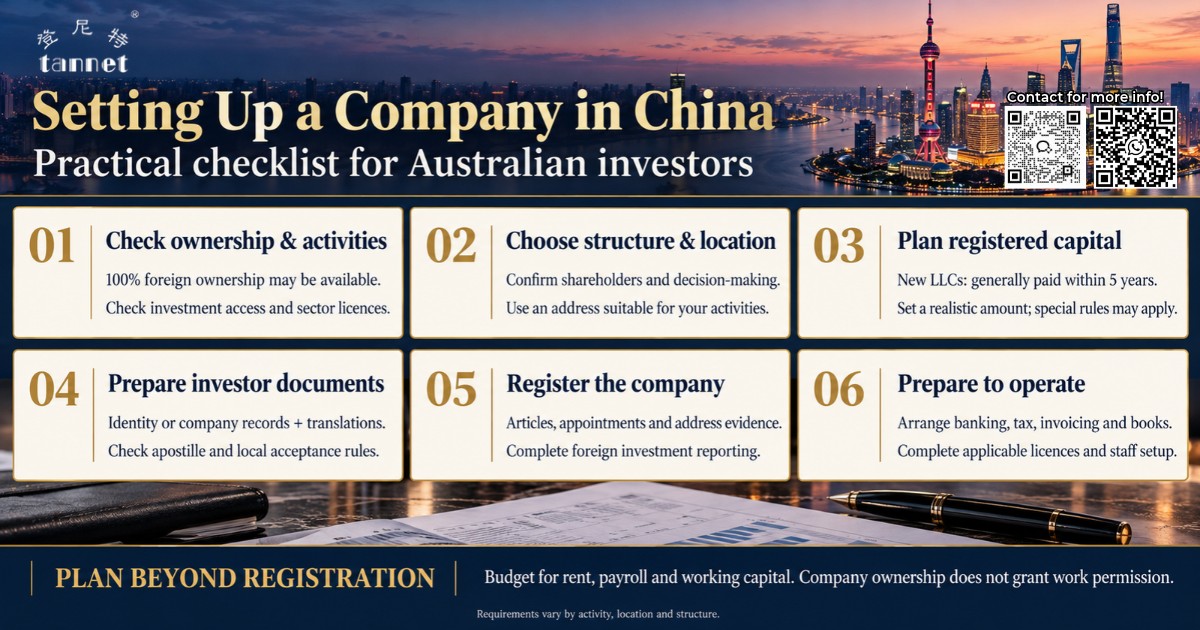
Setting up a company in China gives Australian investors a local platform for hiring employees, signing contracts, serving customers and managing operations. However, successful establishment requires more than submitting registration documents. The ownership structure, business activities, registered address, capital commitment and operating arrangements need to work together.
For Australian businesses entering mainland China, preparation should begin with a practical question: what will the company actually do? The answer helps determine which registration requirements, licences and ongoing responsibilities apply. This guide explains the main decisions involved in China company registration and how to prepare for operations.
Australian individuals and companies can establish foreign-invested enterprises in mainland China, subject to applicable investment access rules. In sectors permitting full foreign ownership, investors may establish a wholly foreign-owned company without a Chinese shareholder.
Commonly called a wholly foreign-owned enterprise, or WFOE, this business is often structured as a Chinese limited liability company. However, ownership eligibility depends on the proposed activities. Investors should check the applicable foreign investment negative list, general market access rules and industry requirements before committing funds. Permission for foreign ownership does not automatically remove operating licence requirements.
Start by describing your products, services, customers and revenue model. Will the company provide consulting, sell imported goods, coordinate production or operate physical premises?
Your proposed business scope should reflect these activities. A broad description chosen without reviewing the operating model can create problems when applying for licences, opening accounts or explaining transactions.
For example, an Australian food business needs to consider product and import requirements alongside incorporation. A consultancy will have different preparation needs. Map the intended activities first, then confirm the registration wording and permissions.
Decide whether an Australian individual, an Australian company or another suitable group entity will hold the investment. Consider governance, funding, future expansion and the relationship between the Australian and Chinese operations.
Where there are multiple shareholders, agree on ownership percentages, management appointments, voting rights, profit distribution and exit arrangements before registration.
A joint venture may be appropriate when a partner contributes valuable resources or where applicable rules require a particular arrangement. Evaluate the partner carefully and document responsibilities clearly. Commercial enthusiasm should be supported by agreements that explain how decisions and disagreements will be managed.
Choose a location based on customers, suppliers, employees and operational needs. Registration convenience alone should not decide where the business establishes its presence.
Compare premises costs, recruitment conditions, logistics and access to relevant commercial networks. Before signing a lease, confirm that the address is acceptable for the proposed registration and activities.
An office address may not suit warehousing, food preparation or manufacturing. Check the property documents and any licensing conditions associated with the premises. Ask about relocation procedures if the company expects to expand or move later.
Registered capital represents the shareholders’ subscribed contribution commitment. It should be supported by a realistic funding plan rather than selected purely for appearances.
For newly established Chinese limited liability companies, shareholders generally must contribute their subscribed capital within five years of establishment, according to the articles of association. Special rules may apply to particular businesses.
Prepare a budget covering rent, payroll, inventory, professional support and working capital. Assess how much funding the business needs and when shareholders can provide it. Separate registered capital from registration service fees and other establishment expenses when calculating your investment.
The document checklist depends on the shareholder structure, registration location and proposed activities. Common preparation areas include investor identification, corporate records, articles of association, appointment documents and registered address evidence.
Confirm the requirements before arranging certification, translation or authentication. Names, identification details and signatures should remain consistent throughout the application.
Australian public documents falling within the Apostille Convention’s scope can generally be used in mainland China with an Australian apostille instead of Chinese consular legalisation. However, document format, translation and acceptance requirements still need checking with the receiving authority. An apostille does not replace every document preparation requirement.
Submit the application through the relevant local registration channel with the required supporting information. Foreign investment information reporting forms part of the establishment process.
Review the complete file before submission. Confirm that the shareholder details, capital arrangements, registered address and business activities match the agreed plan. Address outstanding questions before they become application corrections.
Once registration is completed, check the business licence and retain the approved documents securely. Assign responsibility for maintaining company records so that future banking, licensing and administrative requests can be handled efficiently.
After receiving the business licence, complete the arrangements needed for the company’s planned activities. These may include company seals, bank accounts, tax setup, invoicing, bookkeeping and employee administration.
Businesses trading goods may also need relevant customs arrangements. Regulated activities can require additional licences or permissions before operations begin.
Contact the selected bank early to understand its verification requirements, supporting documents and attendance arrangements. Establish controls over company seals, online banking and payment approvals. Clear responsibilities help protect company assets and make daily administration easier as the business grows.
There is no universal setup price for Australian investors. Costs vary according to the city, premises, business activities, shareholder documents and professional support required.
Request a written quotation separating establishment services from recurring work. Check whether translation, document coordination, banking assistance, accounting and tax support are included.
Budget separately for registered capital, rent, payroll, inventory and working capital. Comparing the full scope gives a clearer picture than comparing headline registration fees.
The timeline depends on document readiness, local processing, banking verification and additional approvals. Ask for separate estimates for document preparation, business licence issuance and operational readiness.
Avoid scheduling customer deliveries or employee start dates solely around an incorporation estimate. Identify dependencies early and allow time for corrections or further information requests.
Company ownership and permission to work are separate matters. Australian investors planning to work in mainland China should assess the immigration requirements applicable to their circumstances and intended role before making relocation plans.
A practical establishment plan connects registration with funding, banking and ongoing administration. Tannet supports Australian investors with China company registration, document preparation coordination, accounting, tax and corporate compliance services.
Contact Tannet to discuss your proposed activities, preferred city, shareholder structure and launch schedule. These details help define a relevant service scope and identify matters requiring further review.
📞 Free 1-on-1 Consultation Now,
Official Service Hotline: +86-755-82148419
Cell: +86-13823131503;+60 19-309 2363
WeChat ID: 13823131503;
WhatsApp:+86-13823131503;+60 19-309 2363
Email: mytannet08@gmail.com; susiehu@citilinkia.com