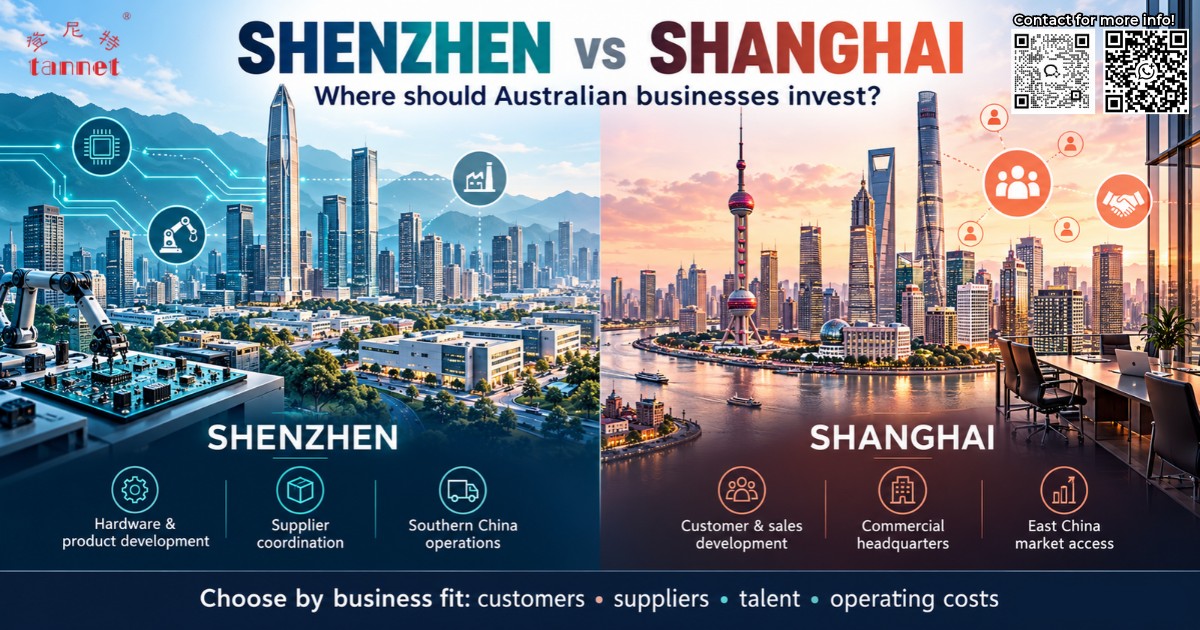
For Australian businesses planning to establish operations in China, Shenzhen and Shanghai deserve consideration for different reasons.
Shenzhen is a strong starting point for businesses whose success depends on hardware development, supplier coordination and connections across southern China. Shanghai deserves close consideration for businesses building a commercial headquarters, managing enterprise customers or developing an East China sales network.
These are starting hypotheses to test against your business model. The right location depends on where your customers, suppliers and employees need you to be—and whether your proposed activities can operate under the intended structure.
This guide focuses on establishing or expanding a business presence, rather than investing in listed shares or property. Here’s how you compare Shenzhen vs Shanghai for Australian businesses.
Shenzhen: When proximity to product development matters
An Australian business developing an electronic device has different location requirements from a consultancy selling to multinational clients.
For product businesses, frequent supplier meetings, prototype reviews and production troubleshooting can shape the city decision. Shenzhen’s official industry priorities include communications, semiconductors, software and industrial machinery, making it a relevant location to investigate for technology and manufacturing-related operations.
Consider Shenzhen if your China team will spend much of its time:
- Working with hardware developers and component suppliers.
- Coordinating samples, production schedules and quality inspections.
- Supporting manufacturing partners in southern China.
- Managing commercial relationships involving Shenzhen and Hong Kong.
For example, an Australian smart-device company may benefit from locating its product coordination team near the suppliers it visits most often. However, supplier addresses should drive the assessment: a Shenzhen office may still involve substantial travel if production takes place elsewhere.
Before committing, map your actual supplier network and estimate the number of site visits required each month.
Shanghai: When customers and commercial coordination matter
Shanghai is worth assessing when the China operation will focus on customer acquisition, account management, partnerships or regional management.
The city’s established multinational business presence supports that assessment. Shanghai reported 1,076 multinational regional headquarters and 636 foreign-funded research and development centres for 2025. These figures indicate an extensive international corporate ecosystem, although they do not establish demand for any individual business.
Consider Shanghai if your priorities include:
- Building relationships with enterprise customers.
- Establishing a China management or sales office.
- Recruiting staff who need to work closely with your East China accounts.
- Coordinating distributors and commercial partners across the surrounding region.
An Australian professional services firm, for example, should examine where its target clients make purchasing decisions. If key accounts and decision-makers are concentrated in Shanghai, customer proximity may outweigh savings available elsewhere.
The same reasoning applies to consumer brands: locate your prospective distributors, retail partners and operating team before choosing an address.
Compare operating costs using the same business plan
“Is Shenzhen cheaper than Shanghai?” is a useful question only when the comparison includes equivalent premises, staffing and operating requirements.
A small sales office and a product development operation will have very different budgets—even within the same city.
Build a 12-month operating model for each location that includes:
- Office rent, deposits and fit-out.
- Salaries, recruitment and employer obligations.
- Accounting, tax and administrative support.
- Travel to customers, factories and logistics partners.
- Warehousing, inspections and product testing where relevant.
- Licensing and other activity-specific requirements.
- Working capital before customer payments arrive.
Treat registered capital and operating expenditure separately in your planning, while assessing how the capital contribution schedule affects available funding.
A lower rent may offer little advantage if your team must travel frequently to the other side of China. Similarly, a prestigious address adds limited value if it places staff far from the relationships that generate revenue.
Request current, itemised quotations for both cities using the same assumptions.
Check market access before choosing the company structure
City selection and company registration should be assessed together.
Start by defining exactly what the China operation will do. Will it provide consulting, import products, sell domestically, perform research, coordinate procurement or manufacture goods?
Then check the applicable foreign investment access rules, business scope and sector-specific approvals. Do not assume that registering a company authorises every proposed activity.
The China–Australia Free Trade Agreement provides opportunities across goods, services and investment. Its benefits depend on the relevant sector and applicable conditions; it does not provide blanket permission to conduct any business activity in China.
- Define the intended activities and revenue model.
- Check market access and licensing requirements.
- Select an appropriate ownership and operating structure.
- Compare suitable districts and premises.
- Plan registration, banking, tax and ongoing administration.
This helps avoid selecting an office or incorporation package before confirming that it supports the intended operation.
Compare districts as carefully as cities
“Shenzhen” and “Shanghai” are broad location choices. Your district, building and actual operating address can materially affect day-to-day performance.
For each shortlisted address, ask:
- Is it suitable for the proposed business activity?
- Can the team reach priority customers or suppliers efficiently?
- Does the location support the intended staffing and premises needs?
- What evidence is required for any advertised incentive?
- Are application conditions, payment timing and ongoing obligations documented?
Assess incentives separately from the underlying business case. Include a benefit in the budget only after its eligibility and availability have been verified.
The strongest location should still make commercial sense without an uncertain subsidy.
Can an Australian business operate across both cities?
A business may have sound reasons to maintain relationships in both Shenzhen and Shanghai.
For example, product coordination could be concentrated in southern China while customer development focuses on Shanghai. That does not automatically mean two companies are required.
Before expanding across locations, assess whether the proposed arrangement requires a branch, another entity or additional registrations. Compare the administrative cost with the value of having employees and premises in both places.
For an early-stage market entry, it can be more practical to establish one operating base, validate demand and expand when the workload justifies it.
A practical decision framework
Use these five questions to narrow the choice.
Where will the first customers come from?
Identify named prospects and the people responsible for purchasing decisions.
Where must employees work in person?
Map recurring visits, rather than relying on a general impression of each city.
What activities will generate revenue?
Connect those activities to market access, licensing and company structure.
What will the first year actually cost?
Compare equivalent operating plans, including travel and working capital.
What would make the business expand or change location?
Set clear triggers, such as customer concentration, supplier workload or recruitment needs.
If supplier access and product coordination dominate the answers, investigate Shenzhen first. If customer access and commercial management dominate, investigate Shanghai first.
Frequently asked questions
Is Shenzhen or Shanghai better for Australian small businesses?
Business size alone does not determine the answer. A small hardware business may prioritise supplier proximity, while a small consultancy may prioritise access to particular clients. Choose according to the work your local team must perform.
Can an Australian investor establish a wholly foreign-owned business?
This may be possible for activities open to foreign investment, subject to applicable requirements. Confirm the proposed sector, business scope and approvals before selecting the structure.
Does a free trade zone remove licensing requirements?
Do not assume so. Assess the specific activity and applicable rules rather than treating a free trade zone address as automatic approval or a guaranteed tax benefit.
How much does company registration cost in Shenzhen or Shanghai?
A meaningful quotation requires details about ownership, activities, premises, staffing and any additional approvals. Request a breakdown that distinguishes incorporation support from ongoing accounting, tax, payroll and other services.
Planning your China business setup with Tannet
Before requesting company registration in Shenzhen or Shanghai, prepare a short brief covering your industry, intended activities, customer and supplier locations, ownership structure and first-year budget.
Contact Tannet with that brief to discuss a location and setup assessment, including the proposed scope, required approvals, implementation steps and ongoing support.
📞 Free 1-on-1 Consultation Now,
Official Service Hotline: +86-755-82148419
Cell: +86-13823131503;+60 19-309 2363
WeChat ID: 13823131503;
WhatsApp:+86-13823131503;+60 19-309 2363
Email: mytannet08@gmail.com; susiehu@citilinkia.com