Registering a Hong Kong company is an important milestone for entrepreneurs, international investors and businesses expanding into Asia. However, Hong Kong company registration is only the first step towards establishing a fully operational business.
After incorporation, business owners must organize corporate documents, arrange business banking, establish accounting procedures and understand their ongoing tax and compliance obligations.
Whether you plan to conduct international trade, provide professional services, operate an e-commerce business or manage regional operations, knowing what to do after registering a Hong Kong company can help you avoid unnecessary delays and prepare for long-term business growth.
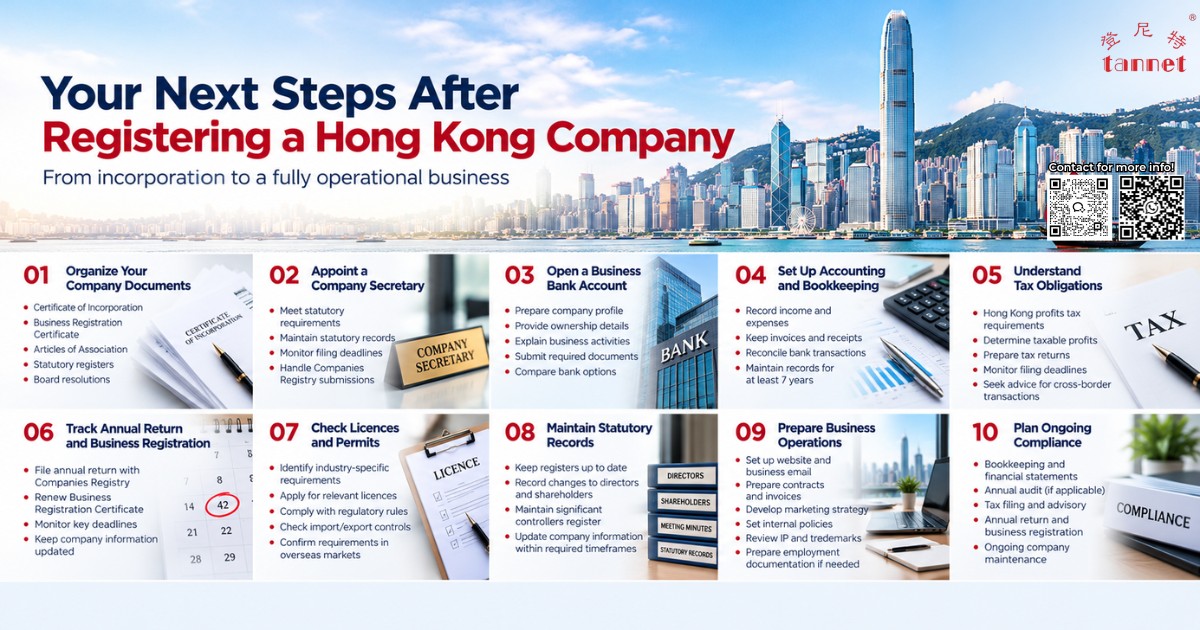
This guide outlines 10 essential steps to take after Hong Kong company incorporation.
1. Organize Your Hong Kong Company Registration Documents
After incorporation, organize your company’s official documents and keep them securely accessible.
These typically include:
- Certificate of Incorporation
- Business Registration Certificate
- Articles of Association
- Company particulars and incorporation records
- Register of members and register of directors
- Significant Controllers Register, where applicable
- Relevant board resolutions and corporate records
These documents may be required when opening a corporate bank account, entering commercial agreements, applying for licences or completing business due diligence.
Check that the company’s legal name and registration details are consistent across its records and business documents.
If your shareholders or directors are based overseas, determine whether certified copies, notarization or apostille certification may be required by the relevant bank, authority or business partner.
Keeping your incorporation documents organized makes future administrative procedures more efficient.
2. Appoint a Hong Kong Company Secretary
A Hong Kong company incorporated locally must appoint a company secretary who meets the applicable statutory requirements.
For a private company, an individual company secretary must ordinarily reside in Hong Kong. A corporate company secretary must have its registered office or place of business in Hong Kong.
The company secretary helps maintain statutory records, monitor filing deadlines, prepare corporate documents and handle relevant submissions to the Companies Registry.
Business owners should confirm the scope of the company secretary’s responsibilities and establish a process for reporting changes to directors, shareholders, registered office details and other company particulars.
Remember that company secretarial services do not automatically include bookkeeping, audit, tax filing or business licensing. These requirements should be assessed separately.
3. Explore Hong Kong Business Bank Account Options
A corporate bank account allows your company to manage business receipts, supplier payments and operating expenses more efficiently.
However, registering a Hong Kong company does not guarantee business bank account approval. Banks and financial institutions conduct their own due diligence and assess each application according to their internal requirements.
Prepare relevant documentation, which may include:
- Company incorporation documents
- Identification and address information for directors and beneficial owners
- Ownership structure and business profile
- Business plan and explanation of intended activities
- Expected transaction volumes, currencies and trading countries
- Contracts, invoices or other evidence supporting business activities
The exact requirements vary between institutions.
Consider whether your business needs international transfers, multi-currency services, online banking or payment collection facilities.
A clear business profile and consistent supporting documentation can help you prepare a more complete application.
4. Establish Accounting and Bookkeeping Procedures
Accounting should be organized from the beginning of your company’s operations, rather than postponed until the first tax filing deadline.
Establish a system for recording sales, purchases, invoices, receipts, bank transactions and operating expenses. Reconcile bank transactions regularly and retain supporting documents for business activities.
Accurate bookkeeping helps business owners understand cash flow, monitor profitability and make informed commercial decisions. It also supports financial reporting and tax compliance.
Hong Kong businesses generally need to maintain sufficient records to explain their transactions and financial position. Relevant business records are generally subject to a seven-year retention requirement under Hong Kong tax law.
Depending on your company’s needs, you may use accounting software, appoint an internal finance team or engage a professional accounting service provider.
The objective is to establish a consistent process that keeps financial information accurate, complete and ready for reporting.
5. Understand Hong Kong Corporate Tax Obligations
Understanding Hong Kong profits tax requirements is an essential part of post-incorporation planning.
Hong Kong operates a territorial profits tax system. Whether profits are taxable depends on the applicable tax rules and the facts surrounding how and where those profits arise. Incorporating a company in Hong Kong does not automatically mean every profit is taxable there, nor does it automatically exempt overseas profits.
Company owners should understand their obligations regarding profits tax returns, supporting financial information, provisional tax and relevant filing deadlines.
Do not assume that a company with no revenue or business activity has no tax reporting obligations. The applicable requirements depend on the company’s circumstances and notices issued by the Inland Revenue Department.
Businesses with overseas customers, cross-border transactions, foreign operations or complex ownership arrangements may require additional tax analysis.
Establishing proper accounting procedures early makes it easier to prepare financial information and assess the company’s tax position.
6. Track Annual Return and Business Registration Requirements
Hong Kong companies must distinguish between Companies Registry filings and business registration obligations.
A Hong Kong local private company generally needs to file an annual return with the Companies Registry within 42 days after the anniversary of its incorporation, except in its year of incorporation.
The annual return updates specified company information, including relevant details concerning its registered office, directors, company secretary and share capital.
Business registration is a separate requirement. Companies should monitor their Business Registration Certificate’s validity and comply with the applicable renewal arrangements.
An annual return is not the same as a profits tax return. Each serves a different purpose and has its own requirements.
Create a compliance calendar to monitor annual returns, business registration renewal, tax filings, financial reporting and other relevant deadlines.
7. Check Whether Your Business Requires Licences or Permits
Company incorporation does not automatically authorize every type of commercial activity.
Depending on your industry, products and operating model, additional licences, permits or regulatory approvals may be required before commencing business.
For example, certain financial services, employment agency operations, food-related businesses and other regulated activities are subject to sector-specific requirements. Importing or exporting particular goods may also trigger additional controls.
Before launching operations, identify the legal requirements applicable to your actual business activities.
If your company intends to serve customers or operate in multiple countries, review the relevant requirements in each jurisdiction. Hong Kong incorporation alone does not replace overseas registration, licensing or regulatory obligations.
Identifying these requirements early helps businesses plan their operations more effectively and avoid preventable compliance problems.
8. Maintain Statutory Records and Corporate Information
Good corporate governance is essential for maintaining a compliant Hong Kong company.
Keep statutory registers, corporate resolutions, meeting minutes and other required records updated. Hong Kong companies must also comply with applicable significant controller identification and record-keeping requirements, subject to relevant exemptions.
When directors, shareholders or other reportable company particulars change, inform the company secretary promptly so the necessary records and filings can be addressed within the applicable statutory periods.
Well-maintained corporate records are also useful when applying for financing, opening bank accounts, bringing in investors or completing due diligence with potential business partners.
Establishing these procedures early helps prevent administrative information from becoming outdated as the company grows.
9. Prepare Your Business Operations for Growth
Once your company’s administrative foundations are in place, focus on establishing its commercial operations.
Depending on your business model, the next steps may include:
- Creating a corporate website and professional business email address
- Preparing customer contracts and supplier agreements
- Establishing invoicing and payment collection procedures
- Developing sales and marketing strategies
- Setting internal expense and approval policies
- Reviewing trademark and intellectual property protection
- Preparing employment documentation if hiring staff
For businesses involved in international trade, consider how you will manage foreign currencies, customer onboarding, payment terms and cross-border contracts.
Your operating structure should reflect your actual business activities, target markets and commercial objectives.
10. Plan Ongoing Compliance and Professional Support
Hong Kong company compliance is an ongoing responsibility, not a one-time registration exercise.
Depending on the company’s circumstances, continuing obligations may include bookkeeping, financial statement preparation, annual audit, profits tax filing, annual returns, business registration renewal and employer reporting.
A Hong Kong company is generally required to prepare financial statements and arrange an annual audit unless a specific statutory exception applies. Any exemption should be assessed against the relevant legal requirements rather than assumed.
Working with suitable professional service providers can help you understand your obligations, maintain accurate records and manage important deadlines.
When engaging a provider, clarify the scope of services, filing responsibilities, required documents and any exclusions to ensure that the company’s administrative and compliance needs are adequately covered.
Conclusion: Set Up Your Hong Kong Company for Long-Term Success with TANNET
Registering a Hong Kong company opens the door to new business opportunities, but successful operations require careful planning beyond incorporation. From corporate secretarial services and business registration compliance to accounting, tax support and ongoing company maintenance, every aspect contributes to building a reliable business foundation.
TANNET provides professional business support services to help entrepreneurs, investors and international companies establish and manage their Hong Kong business presence. Whether you need assistance with company incorporation, company secretarial arrangements, accounting, audit coordination, tax compliance or ongoing corporate administration, TANNET can help you identify the services relevant to your business requirements.
Instead of navigating unfamiliar procedures alone, work with a professional team that understands the practical requirements of setting up and maintaining a Hong Kong company.
Contact TANNET to discuss your Hong Kong company setup and ongoing compliance needs, and take the next step towards building your international business with greater confidence.
📞 Free 1-on-1 Consultation Now,
Official Service Hotline: +86-755-82148419
Cell: +86-13823131503;+60 19-309 2363
WeChat ID: 13823131503;
WhatsApp:+86-13823131503;+60 19-309 2363
Email: mytannet08@gmail.com; susiehu@citilinkia.com