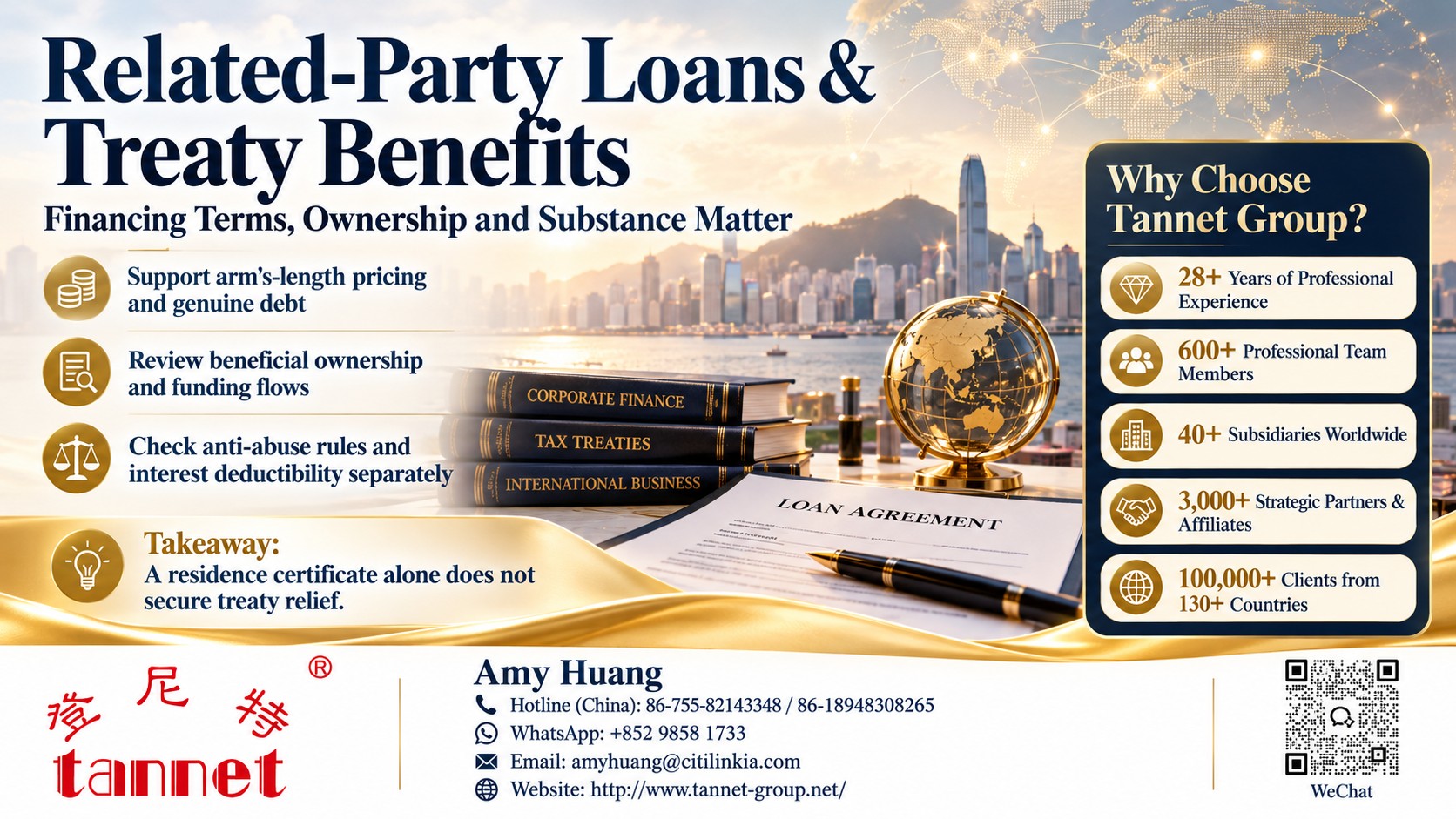
Key Takeaway
A related-party loan can qualify for treaty benefits, but group affiliation increases the level of tax review.
A Hong Kong lender or borrower must show that the financing is genuine, commercially rational, priced at arm’s length, and supported by actual conduct. This matters to holding companies, treasury entities, operating subsidiaries, and groups using cross-border shareholder or intercompany debt.
The main warning is that a residence certificate alone does not protect the interest payment. Tax authorities may examine debt capacity, beneficial ownership, funding flows, interest deductibility, permanent establishment links, transfer pricing, and treaty anti-abuse rules before accepting a reduced rate or corresponding adjustment.
Related-Party Status Does Not Automatically Deny Relief
Tax treaties commonly contain an interest article. It may limit source-country tax when the recipient is a resident and beneficial owner. Some agreements provide different rates for banks, long-term finance, government bodies, or particular debt instruments.
A related lender can still satisfy those rules. However, the relationship makes the arm’s-length proviso, associated-enterprises article, beneficial ownership test, and anti-abuse provisions especially relevant.
The Hong Kong Inland Revenue Department publishes treaty-specific maximum rates for interest. The schedule is only a starting point. Each agreement, protocol, and domestic procedure must be reviewed for the actual payment.
Five Ways a Loan Can Change the Treaty Outcome
- The rate may not be arm’s length. An excessive coupon can be adjusted for transfer pricing purposes. Treaty protection may apply only to the amount that independent parties would have agreed, while the excess may be taxed under domestic law.
- The instrument may not be respected as debt. A loan with no realistic repayment, extreme subordination, profit-linked returns, or inadequate borrower capacity may be recharacterized under the relevant law. Its treaty classification can then change.
- The Hong Kong recipient may not be the beneficial owner. If it must pass the interest to another group entity under a legal or practical obligation, the source authority may treat it as a conduit.
- The debt claim may be connected with a permanent establishment. In that case, the treaty’s business-profits article may replace the interest article, and net-basis taxation may apply in the source jurisdiction.
- An anti-abuse rule may deny the benefit. Under a principal purpose test, relief can be refused when obtaining the treaty benefit was one of the principal purposes of the arrangement and granting it would be inconsistent with the treaty’s object and purpose.
Arm’s-Length Pricing Is More Than Choosing a Percentage
Hong Kong’s transfer pricing rules require income or loss from controlled transactions to be computed on an arm’s-length basis where the statutory conditions apply. The Inland Revenue Department’s DIPN 59 emphasizes both form and substance.
A defensible analysis starts with the borrower. Review its business, cash flows, assets, credit rating, currency, loan term, security, seniority, covenants, repayment profile, and realistic alternatives. A parent guarantee can affect pricing and must be considered consistently.
Then review the lender. Identify the functions it performs, the people who approve and monitor the loan, the capital it controls, and its capacity to bear credit and market risk. A treasury company should not receive a full risk return if it lacks control over those risks.
Comparable uncontrolled loans or market data can support a range. Adjustments may be required for currency, tenor, collateral, industry, and date. A group policy or bank quote without comparability analysis is rarely sufficient on its own.
Beneficial Ownership and Funding Chains
Beneficial ownership asks whether the recipient can use and enjoy the interest without a contractual or legal obligation to pass it to another person. The analysis looks beyond the bank account receiving the payment.
Warning signs include matched terms, immediate onward payments, no retained margin, weak decisions, and late documents.
Substance should match the financing role. Board minutes, treasury policies, staff responsibilities, bank mandates, credit reviews, and monitoring records should show that the Hong Kong company performs the functions described in the agreement.
Interest Deductibility Is a Separate Question
A reduced treaty withholding rate for the lender does not guarantee an interest deduction for the borrower. The borrower must satisfy the domestic deduction rules in its jurisdiction, including purpose, tracing, thin-capitalization, earnings-stripping, related-party, or anti-avoidance provisions.
For a Hong Kong borrower, the Inland Revenue Ordinance contains specific conditions for interest deductions. The result depends on the use of borrowed money, the lender, the tax treatment of the interest, security arrangements, and other statutory restrictions.
Treaty relief, transfer pricing, and deductibility should therefore be computed separately. A payment may receive a treaty rate yet still face a partial deduction denial. Conversely, an arm’s-length expense does not prove that the recipient is entitled to treaty benefits.
Documentation Before and During the Loan
Before funding, approve a written business purpose and financing amount. Prepare cash-flow forecasts, debt-capacity analysis, alternatives considered, an arm’s-length pricing study, and board approvals from the entities that actually make the decisions.
Execute the loan agreement before funds move. State principal, currency, use of funds, interest basis, payment dates, maturity, security, covenants, default terms, prepayment rights, and governing law. Record any guarantee or subordination separately.
A Step-by-Step Treaty Review
- Identify the legal lender, borrower, guarantor, and ultimate funding source.
- Confirm the treaty is effective for the payment period and classify the return under the correct article.
- Test residence and beneficial ownership. Do not treat a Certificate of Resident Status as the final test.
- Delineate the actual financing transaction using contracts, conduct, functions, assets, risks, and options realistically available.
- Benchmark the interest rate and other terms. Separate pricing support from the treaty-rate analysis.
- Check whether the debt claim is effectively connected with a permanent establishment.
- Apply the principal purpose test and any specific anti-conduit, ownership, or special-relationship provision.
- Complete relief-at-source, withholding, refund, reporting, and Hong Kong profits tax procedures by their respective deadlines.
Common Mistakes
- Copying the group’s standard interest rate without testing the borrower’s credit position and loan terms.
- Signing an agreement after the funding date. Later paperwork may not reflect the transaction actually undertaken.
- Assuming related-party interest is automatically deductible because cash was transferred.
- Ignoring the special-relationship clause in the interest article. Excess interest may fall outside the treaty limit.
- Treating a Hong Kong bank account as proof of beneficial ownership. Control, obligations, functions, and cash use matter more.
- Failing to revisit the analysis after refinancing, maturity extensions, payment deferrals, guarantees, or ownership changes.
- Preparing transfer pricing support only after an audit begins. Contemporaneous evidence is more persuasive and helps meet filing deadlines.
Frequently Asked Questions
Q1. Does every related-party loan need a benchmarking study?
The level of analysis depends on materiality, risk, and applicable documentation thresholds. However, the rate and terms should always have a defensible arm’s-length basis, even when a formal local file is not required.
Q2. Can an interest-free loan create a tax issue?
Yes. A tax authority may consider whether independent parties would have charged interest or structured the funding as equity. The answer depends on the facts, domestic law, and transfer pricing rules.
Q3. Is a Certificate of Resident Status enough for the treaty rate?
No. It proves residence for treaty purposes but does not by itself establish beneficial ownership, arm’s-length terms, commercial purpose, or compliance with the source jurisdiction’s procedure.
Q4. What happens if the interest rate is too high?
The excessive amount may be adjusted, denied as a deduction, reclassified, or excluded from the treaty ceiling. The two jurisdictions may then need corresponding-adjustment or mutual-agreement procedures to resolve double taxation.
Q5. Can a Hong Kong treasury company receive the full interest spread?
Only if its functions, assets, risk control, and financial capacity support that return. A company performing limited coordination may be entitled to a more limited arm’s-length reward.
Q6. Must the loan be repaid on the original maturity date?
Not always, but any extension should be approved, documented, and repriced where appropriate. Repeated unexplained extensions can weaken the debt characterization and the original pricing analysis.
When Tannet May Assist
Tannet may assist with a related-party financing checklist, Hong Kong residency documents, contract and funds-flow reconciliation, coordination of transfer pricing support, treaty-rate procedures, and annual compliance records. Assistance is particularly relevant when a group changes lenders, refinances debt, uses a Hong Kong treasury entity, or faces questions from a payer or tax authority. Legal characterization, treaty entitlement, and pricing outcomes remain fact-dependent and subject to the relevant authorities.
Official Sources:OECD, Transfer Pricing Guidance on Financial Transactions and OECD Transfer Pricing Guidelines for Multinational Enterprises and Tax Administrations.
30th Anniversary Offer: Tannet has been established for 28 years, we are offering exclusive limited-time promotional pricing to celebrate Tannet’s 30th anniversary. Slots are limited and available on a first-come, first-served basis. Contact Consultant Amy Huang for details.
Written by: Tannet Business Services Team
Reviewed by: Consultant Amy Huang
First published: 29 Oct. 2026
Last reviewed: 29 Oct. 2026
————————————————Simplifying Business, Empowering Entrepreneurs————————————————