Key Takeaway
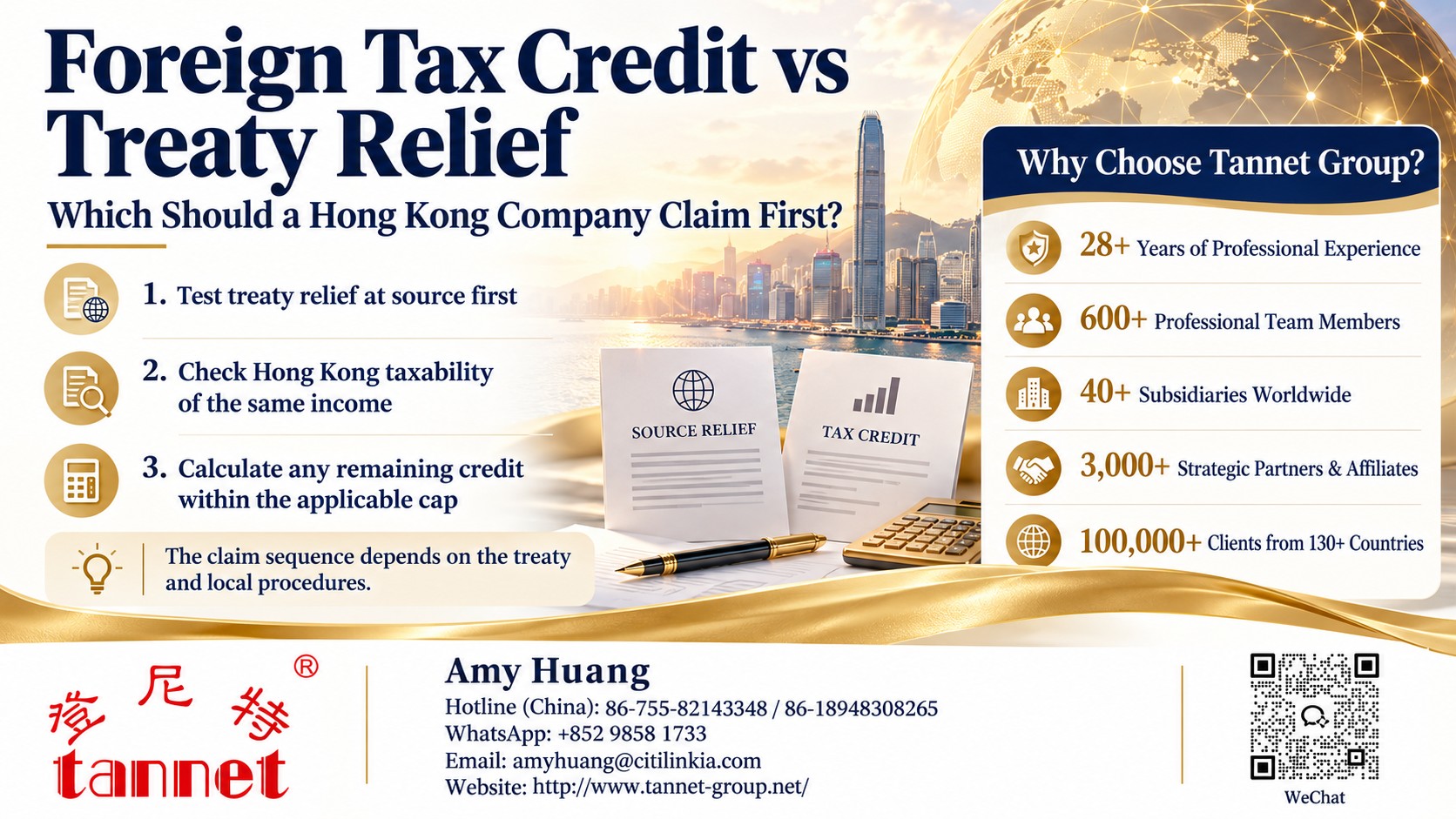
A Hong Kong company should normally test treaty relief at source before relying on a foreign tax credit. Treaty relief may reduce or remove overseas withholding when payment is made.
A foreign tax credit usually works later, after foreign tax has been paid and the same income is chargeable in Hong Kong. This analysis matters to companies receiving dividends, interest, royalties, service income, or other cross-border profits.
The main warning is that neither route is automatic. The company must confirm treaty residence, income classification, beneficial ownership, anti-abuse rules, filing deadlines, and Hong Kong taxability before choosing a claim sequence.
The Two Relief Mechanisms Solve Different Problems
Treaty relief changes the source jurisdiction’s taxing right. It may cap withholding, exempt income, or allocate business profits to the residence jurisdiction unless a permanent establishment exists. The exact result depends on the relevant agreement and income article.
A foreign tax credit does not normally change the foreign levy. It reduces Hong Kong tax on the same income, subject to statutory or treaty limits. It therefore addresses residual double taxation after foreign tax has already arisen.
The Hong Kong Inland Revenue Department states that comprehensive double taxation agreements allocate taxing rights, reduce overlapping taxation, and can lower foreign withholding rates. Its published rate schedule shows that outcomes vary by jurisdiction and income type.
Why Treaty Relief Usually Comes First
Relief at source protects cash flow. If a payer applies the treaty rate correctly, the Hong Kong recipient receives more cash immediately and avoids waiting for a foreign refund or a later Hong Kong assessment.
It also avoids an unusable credit. Hong Kong generally taxes profits on a territorial basis. If the receipt is not chargeable in Hong Kong, there may be no Hong Kong tax against which a credit can be used.
The credit is also capped. Under the foreign-sourced income exemption regime, the Inland Revenue Department explains that a credit for specified foreign-sourced income is limited to the lower of qualifying foreign tax and the Hong Kong profits tax attributable to that income.
This means excess foreign withholding can remain a real cost. Applying the correct treaty rate at payment is often more effective than paying the domestic rate and expecting Hong Kong to absorb the difference.
A Practical Claim Sequence
- Identify the payment. Decide whether the amount is a dividend, interest, royalty, technical fee, service fee, capital gain, or business profit. A commercial label is not decisive if the contract and conduct show a different character.
- Confirm that the treaty is effective. Check the agreement, protocol, effective date, and any modification made through the Multilateral Instrument. Do not rely on a general treaty summary.
- Test Hong Kong residence. A Certificate of Resident Status may prove residence for a particular agreement and year. The Inland Revenue Department warns that the certificate does not guarantee entitlement to benefits.
- Test substantive conditions. Review beneficial ownership, holding periods, ownership thresholds, permanent establishment exposure, limitation provisions, and the principal purpose test. The recipient must be more than a payment conduit.
- Follow the source jurisdiction’s procedure. Some systems allow relief at source. Others require full withholding followed by a refund. Forms, translations, certifications, and deadlines differ.
- Determine Hong Kong taxability. Consider the territorial source rules and, for an in-scope multinational enterprise entity, the foreign-sourced income exemption rules for specified foreign-sourced income received in Hong Kong.
- Compute any remaining credit. Match the foreign tax to the same income and period. Apply the relevant cap. Preserve the withholding certificate, assessment, payment proof, computation, and exchange-rate basis.
When a Foreign Tax Credit May Be the Main Route
A credit becomes important when the source jurisdiction correctly retains tax under the treaty. For example, an agreement may permit limited withholding on interest or royalties. If the same income is taxed in Hong Kong, a bilateral credit may relieve the overlap.
A credit may also be relevant when relief at source was procedurally unavailable. The company may have missed a pre-clearance window, received an unexpected payment, or faced a payer that could not apply the reduced rate without prior approval.
For specified foreign-sourced income under Hong Kong’s foreign-sourced income exemption regime, bilateral or unilateral credit rules may apply. The result depends on residence, the foreign jurisdiction, the nature of the foreign tax, and whether the income remains chargeable after exemptions are tested.
A credit should not replace a foreign refund claim where the foreign jurisdiction collected more than the treaty permits. The excess is usually a source-country issue. Claiming only a Hong Kong credit can waste treaty rights and exceed the Hong Kong limitation.
Evidence to Prepare Before Payment
Prepare a treaty file before the payment date. It should contain the executed agreement, invoice, ownership chart, tax residence evidence, commercial rationale, bank instructions, and analysis of the relevant treaty article.
For beneficial ownership, document who controls and enjoys the income. Record whether the Hong Kong company can retain, deploy, or reinvest the funds. Back-to-back obligations and immediate onward transfers require careful explanation.
For business profits, document where services are performed and whether personnel, premises, or agents create a permanent establishment. For dividends, verify ownership percentages and holding periods. For interest, identify the lender, debt terms, and funding chain.
Maintain proof of foreign tax actually paid. A gross payment statement alone may not be sufficient. Obtain official withholding certificates, tax receipts, assessments, and refund decisions. Reconcile them to the Hong Kong ledger.
Common Mistakes
- Assuming a Hong Kong incorporation certificate proves treaty residence. Incorporation and treaty residence are related concepts, but the foreign authority may request a Certificate of Resident Status and evidence of management or business activity.
- Applying a headline treaty rate without reading the conditions. Reduced rates may depend on beneficial ownership, ownership level, holding period, lender status, or payment type.
- Claiming a Hong Kong credit for tax collected above the treaty ceiling. The excess may need to be recovered from the foreign authority first.
- Ignoring the foreign filing deadline. Refund periods can be shorter than Hong Kong assessment cycles. Missing the source-country deadline can turn recoverable tax into a permanent cost.
- Treating all foreign taxes as creditable income taxes. Transaction taxes, penalties, interest charges, and levies of a different nature may not qualify.
- Using a credit when the income is exempt or not chargeable in Hong Kong. A credit requires Hong Kong tax on the same income and remains subject to limits.
- Failing to align contracts, invoices, accounting entries, and actual conduct. Inconsistent descriptions invite reclassification and can delay both treaty and credit claims.
Frequently Asked Questions
Q1. Must treaty relief always be claimed before a foreign tax credit?
Usually it should be tested first, but there is no universal procedural order. The foreign jurisdiction may require withholding and a later refund. The correct sequence follows the treaty, local procedure, and Hong Kong tax position.
Q2. Can the company claim both treaty relief and a foreign tax credit?
Yes, when treaty relief reduces foreign tax but does not eliminate it, and the same income is chargeable in Hong Kong. The credit is limited and should cover only qualifying foreign tax remaining after any refund.
Q3. Does a Certificate of Resident Status secure the reduced rate?
No. It supports residence, but the payer or foreign authority can still test beneficial ownership, income classification, holding requirements, permanent establishment exposure, and anti-abuse provisions.
Q4. What if tax was withheld at the full domestic rate?
Review the foreign refund procedure immediately. Claim the treaty excess there where possible. Then calculate any Hong Kong credit only for the qualifying foreign tax that remains.
Q5. Can unused foreign tax credit be carried forward?
Do not assume so. Availability depends on the governing Hong Kong provision and the relevant agreement. A company should calculate the credit for the correct income, period, and tax assessment.
Q6. Does the foreign-sourced income exemption regime change the analysis?
Yes. An in-scope multinational enterprise entity must first determine whether specified foreign-sourced income received in Hong Kong is exempt or chargeable. Credit rules matter only after that analysis.
When Tannet May Assist
Tannet may assist with treaty reviews, residence certificate files, withholding evidence, source-relief checklists, and Hong Kong credit computations. Support is relevant when contracts, ownership, and cash flows need reconciliation. Entitlement remains subject to the applicable agreement, domestic law, and tax authorities for each cross-border payment reviewed.
30th Anniversary Offer: Tannet has been established for 28 years, we are offering exclusive limited-time promotional pricing to celebrate Tannet’s 30th anniversary. Slots are limited and available on a first-come, first-served basis. Contact Consultant Amy Huang for details.
Written by: Tannet Business Services Team
Reviewed by: Consultant Amy Huang
First published: 29 Oct. 2026
Last reviewed: 29 Oct. 2026
————————————————Simplifying Business, Empowering Entrepreneurs————————————————