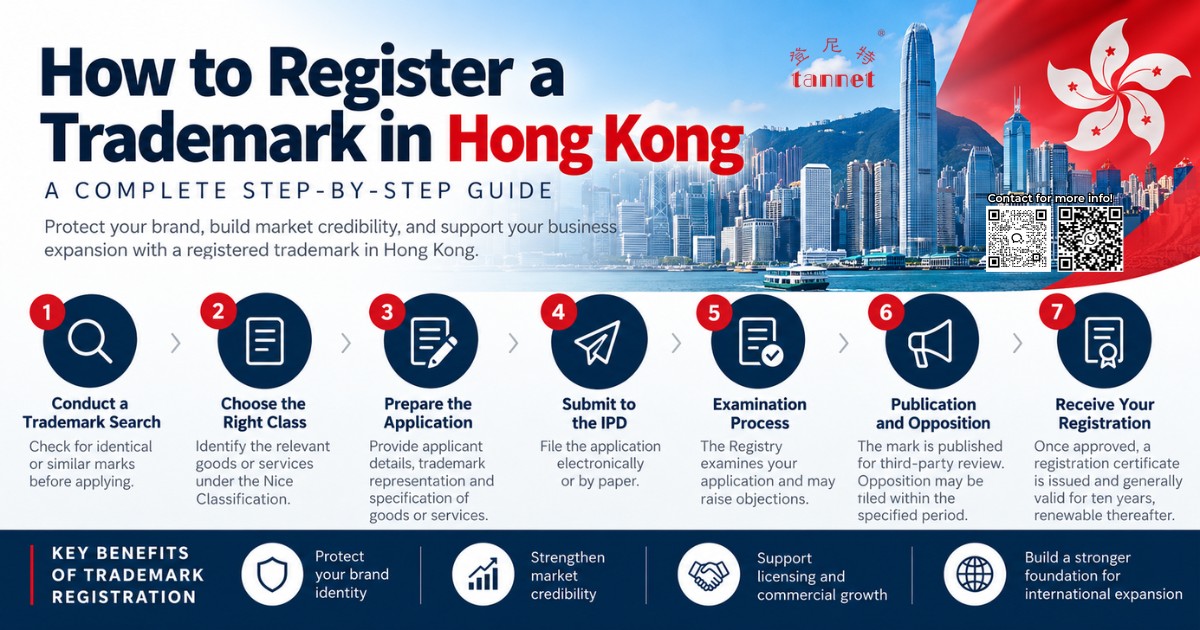
Registering a trademark in Hong Kong is an important step for businesses looking to protect their brand identity, establish market credibility, and expand internationally. Whether you are launching a new product, operating an e-commerce business, or entering Hong Kong through a newly established company, trademark protection should form part of your intellectual property strategy.
Hong Kong has a dedicated trademark registration system administered by the Intellectual Property Department (IPD). However, successfully registering a trademark requires more than submitting an application. Businesses must assess whether their proposed mark is distinctive, identify the correct goods and services, and understand the examination and opposition procedures.
This guide explains how to register a trademark in Hong Kong, the documents and information required, and the key considerations for protecting your brand.
1. Understand Trademark Registration in Hong Kong
A trademark is a sign that distinguishes the goods or services of one business from those of another. It may consist of a brand name, logo, word, letters, numbers, or a combination of elements.
For example, a company selling skincare products may want to protect its brand name and logo before entering the Hong Kong market. A technology business may seek protection for its software brand, while a manufacturer may register the name used on its products.
A registered trademark generally gives its owner exclusive rights to use the mark in Hong Kong for the goods and services covered by the registration, subject to applicable law.
Trademark registration can help businesses protect their brand identity, establish clearer ownership records, and support future commercial arrangements such as licensing, franchising, and distribution.
It is important to understand that company registration, business registration, domain name registration, and trademark registration are separate processes. Registering a Hong Kong company does not automatically protect its name as a trademark.
2. Conduct a Trademark Search Before Applying
Before submitting an application, check whether an identical or similar trademark has already been registered or applied for in Hong Kong.
A preliminary search should consider:
- Identical or similar brand names.
- Alternative spellings and pronunciations.
- Similar logos and visual elements.
- English and Chinese versions of the brand.
- Existing marks covering related goods or services.
A proposed trademark does not have to be identical to an existing mark to create a potential conflict. Similarity between marks and the relationship between their goods or services may affect whether an application can proceed.
You should also assess whether the proposed mark is distinctive. Invented words and terms that do not directly describe the relevant products or services may be more readily distinguishable than generic or descriptive expressions.
The Hong Kong IPD provides an online trademark search system. Applicants can also consider the department’s preliminary advice services to assess potential registration issues before filing.
Although a search cannot guarantee approval, it can help businesses identify risks early and make better-informed decisions about their brand strategy.
3. Choose the Correct Trademark Class
Hong Kong follows the Nice Classification system, which divides goods and services into 45 classes. Classes 1 to 34 cover goods, while Classes 35 to 45 cover services.
Selecting the appropriate class is essential because trademark protection is linked to the goods and services specified in the application.
Common examples include:
- Class 9: Certain electronic products, software, and downloadable digital products.
- Class 25: Clothing, footwear, and headwear.
- Class 30: Certain food products, including spices and seasonings.
- Class 35: Advertising, business management, and certain retail-related services.
- Class 42: Certain technology, software development, and IT services.
These examples are illustrative. The correct classification depends on the specific goods or services involved.
Businesses should prepare a clear list of their current products and services and consider their realistic expansion plans. A business selling physical products may require different classes from one providing consulting or technology services.
Choosing an unsuitable class or an overly narrow description may leave important business activities outside the intended scope of protection.
4. Prepare the Trademark Application
Once the preliminary search and classification are complete, prepare the application for submission to the Hong Kong IPD.
The standard application form is Trade Mark Form T2.
The application generally requires:
- The applicant’s legal name and address.
- A representation of the proposed trademark.
- A clear specification of the goods and services.
- The relevant trademark class or classes.
- Other information required for the particular application.
An applicant may be an individual or a legal entity, provided the applicant is legally capable of owning the trademark.
Before filing, verify that the applicant’s details are accurate and consistent with the intended ownership structure. Businesses should consider whether the trademark should be owned by the operating company, a parent company, or another appropriate entity.
The proposed mark and the goods and services specification should also be reviewed carefully. Significant changes to an application may not be permitted after submission, so correcting avoidable errors in advance is important.
5. Submit the Application to the Hong Kong IPD
Trademark applications can be submitted electronically through the IPD’s e-filing system or by paper application.
After submission, retain the application acknowledgement and reference number for future correspondence and monitoring.
The application will then enter the Registry’s examination process. Submission alone does not mean that the trademark has been approved or registered.
Businesses should monitor correspondence from the Registry and ensure that any requests for clarification or responses to objections are handled within the applicable deadlines.
Keeping an organised record of the application, the trademark representation, the selected classes, and relevant correspondence can make subsequent management easier.
6. Complete the Examination Process
During examination, the Registry assesses whether the application meets the legal requirements for registration.
The examination may consider whether the mark is distinctive, whether the goods and services are properly specified, and whether an earlier trademark presents a legal obstacle to registration.
For example, a proposed mark that directly describes the characteristics of a product may face a distinctiveness objection. An application that is confusingly similar to an earlier mark covering related goods or services may also encounter difficulties.
If the Registry raises an objection, the applicant may need to submit written representations, provide supporting evidence, or amend the application where legally permitted.
An objection does not automatically mean the application must be abandoned. The appropriate response depends on the grounds raised and the circumstances of the case.
Careful preparation and an understanding of potential conflicts can help applicants approach this stage more effectively.
7. Understand Publication and Trademark Opposition
If the application meets the relevant requirements, the proposed trademark proceeds to publication in the Hong Kong Intellectual Property Journal.
Publication allows third parties to review the application and oppose registration if they believe they have valid grounds to do so.
The opposition period is generally three months from the publication date, subject to the applicable rules.
A third party may oppose a trademark because it believes the proposed mark conflicts with its earlier rights. If an opposition is filed, the applicant may need to participate in formal proceedings, submit evidence, and present arguments.
An opposition can extend the registration process and create additional administrative and legal complexity.
If no opposition is filed, or the opposition is resolved in the applicant’s favour, the application can proceed towards registration.
8. Receive and Maintain Your Trademark Registration
Once the application satisfies the registration requirements and clears the relevant opposition stage, the Registry proceeds with registration and issues a registration certificate.
A Hong Kong trademark registration generally lasts ten years from its registration date and can be renewed for successive ten-year periods.
However, obtaining a certificate is not the end of brand protection. Businesses should maintain accurate ownership records, monitor potential infringement, and keep track of renewal dates.
Trademark owners should also understand the importance of genuine commercial use. A registered trademark may be vulnerable to revocation for non-use if it has not been genuinely used in Hong Kong for a continuous period of at least three years, subject to applicable legal requirements and exceptions.
Where a business changes ownership, licenses its trademark, or restructures its operations, it should also review whether the relevant trademark records and arrangements need to be updated.
9. Common Mistakes to Avoid
Businesses can reduce avoidable trademark risks by addressing several common mistakes.
Skipping the trademark search: An existing similar mark may create difficulties even if the proposed brand uses different spelling.
Choosing the wrong classes: Protection is connected to the goods and services specified in the registration.
Using a descriptive brand name: Generic or descriptive terms may encounter objections because they do not sufficiently distinguish one trader’s offerings from another’s.
Registering a company without protecting the brand: Company incorporation does not replace trademark registration.
Ignoring official correspondence: Failure to respond within the applicable period can jeopardise an application.
Assuming protection is international: A Hong Kong registration does not automatically protect a trademark in Mainland China or other overseas markets.
Addressing these issues early can help businesses develop a more effective intellectual property strategy.
Conclusion: Protect Your Brand in Hong Kong with TANNET
Trademark registration is an important part of building a sustainable business in Hong Kong. From conducting preliminary searches and selecting the appropriate classes to managing the application process, every step contributes to establishing a stronger foundation for brand protection.
For businesses entering Hong Kong or expanding across borders, trademark planning should also be considered alongside company incorporation, business operations, and future market-entry objectives.
TANNET supports businesses with trademark registration and intellectual property-related services, as well as company establishment and cross-border business solutions. Whether you are launching a new brand, establishing a Hong Kong company, or exploring opportunities in additional markets, TANNET can help you understand the relevant procedures and identify the next steps for your business.
Contact TANNET to discuss your Hong Kong trademark registration requirements and explore the appropriate support for your business expansion plans.
📞 Free 1-on-1 Consultation Now,
Official Service Hotline: +86-755-82148419
Cell: +86-13823131503;+60 19-309 2363
WeChat ID: 13823131503;
WhatsApp:+86-13823131503;+60 19-309 2363
Email: mytannet08@gmail.com; susiehu@citilinkia.com