China remains an important destination for international businesses seeking access to manufacturing capabilities, technology ecosystems, supply chains and a large domestic consumer market. For Australian investors, foreign SMEs and international trading companies, establishing a local presence can provide opportunities to develop supplier relationships, distribute products and expand commercial operations in mainland China.
However, choosing the right city is an important first step. Guangzhou and Shenzhen are two of the most attractive business destinations in Guangdong Province, both offering access to the Greater Bay Area (GBA), established industrial networks and international business connections.
Although the two cities are geographically close, their business environments and industrial strengths differ.
Should foreign investors establish a company in Guangzhou or Shenzhen? The answer depends on the company’s business model, target customers, supply chain requirements and long-term expansion strategy.
1. Understanding Guangzhou and Shenzhen as Business Destinations
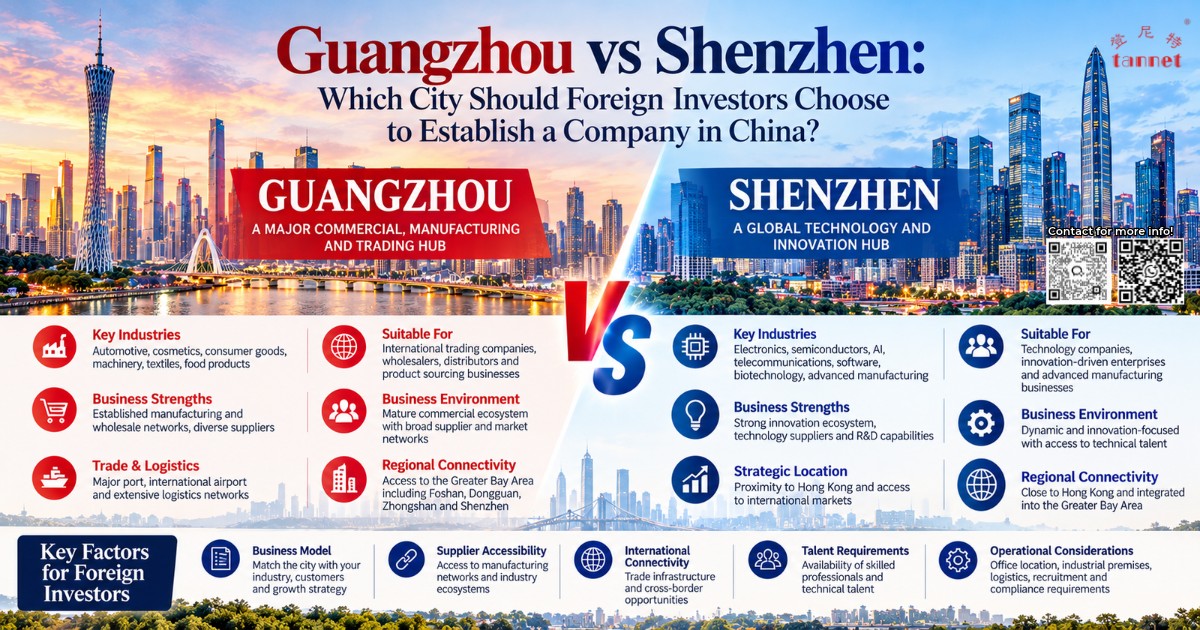
Guangzhou is the capital of Guangdong Province and one of southern China’s major commercial, manufacturing and trading centres. It has a long-established business ecosystem connecting manufacturers, wholesalers, distributors, logistics providers and international buyers.
The city is particularly recognised for its automotive industry, cosmetics, consumer goods, machinery, textiles, food products and wholesale trading activities. Its established wholesale markets and manufacturing networks make it attractive to businesses that need access to physical products and suppliers.
Shenzhen, on the other hand, is internationally recognised as a technology and innovation hub. Located next to Hong Kong, the city has developed a strong ecosystem covering electronics, telecommunications, artificial intelligence, software, biotechnology, advanced manufacturing and financial technology.
For foreign investors, the distinction is relatively straightforward:
- Guangzhou is particularly suitable for businesses focused on trading, manufacturing, distribution and traditional industrial supply chains.
- Shenzhen is particularly suitable for technology-driven companies, electronics businesses, innovation-focused enterprises and companies seeking access to advanced manufacturing networks.
Both cities offer international connectivity and access to China’s domestic market. The decision should therefore be based on operational requirements rather than reputation alone.
2. Why Foreign Investors Should Consider Guangzhou
Guangzhou offers a mature commercial environment supported by extensive manufacturing and wholesale networks.
A. Strong Manufacturing and Wholesale Networks
One of Guangzhou’s greatest advantages is its established supply chain ecosystem. Businesses involved in consumer products, apparel, cosmetics, furniture, machinery and general merchandise can benefit from proximity to manufacturers, wholesalers and trading partners.
For Australian importers and international trading companies, this can simplify supplier sourcing, product inspections, procurement coordination and logistics arrangements.
Investors who intend to purchase products from multiple Chinese suppliers may also find Guangzhou convenient because of its broad commercial networks.
B. Established International Trade Infrastructure
Guangzhou has developed extensive international trade connections through its port, airport and regional transportation networks.
The city’s position within the Greater Bay Area also provides access to neighbouring manufacturing and commercial centres, including Foshan, Dongguan, Zhongshan and Shenzhen.
This regional connectivity is valuable for foreign businesses that require multiple suppliers, warehousing arrangements and distribution partners.
C. Diverse Industrial Opportunities
Guangzhou has opportunities across several established industries, including:
- Automotive manufacturing and automotive components
- Cosmetics, skincare and personal care products
- Consumer goods and household products
- Food processing and trading
- Machinery and industrial equipment
- Textiles, garments and fashion products
- International wholesale and distribution
The Guangzhou Development District and other industrial zones also support businesses operating in advanced manufacturing, biotechnology and emerging industries.
For SMEs entering China, Guangzhou can be a practical choice when their operations depend on established supplier relationships, product sourcing and commercial distribution.
3. Why Foreign Investors Should Consider Shenzhen
Shenzhen offers a different business proposition, with a strong focus on technology, innovation and advanced manufacturing.
A. Access to China’s Technology Ecosystem
Shenzhen is home to a highly developed technology ecosystem, with businesses operating across electronics, semiconductors, telecommunications, artificial intelligence, robotics and software development.
For foreign investors developing technology products or sourcing electronic components, the city offers access to suppliers, engineering talent, research capabilities and technology-related business networks.
Its electronics ecosystem is particularly attractive to international companies involved in product development, hardware manufacturing and technology distribution.
B. Proximity to Hong Kong and International Markets
Shenzhen’s geographical proximity to Hong Kong is another significant advantage.
The two cities have strong commercial connections, allowing businesses to explore cross-border operations, international financing relationships, professional services and regional business development opportunities.
For Australian companies using Hong Kong as part of their regional business structure, Shenzhen may offer a convenient mainland China operating base.
However, establishing a Hong Kong company and a Shenzhen company involves separate legal entities, regulatory obligations and tax considerations. Investors should determine how each entity will function before implementing a cross-border structure.
C. Innovation and Emerging Industry Opportunities
Shenzhen has developed strategic industries in areas such as:
- Electronics and semiconductor technology
- Artificial intelligence and robotics
- Telecommunications and network equipment
- New energy and electric vehicles
- Biotechnology and medical technology
- Software and digital services
- Advanced manufacturing and automation
These industries provide opportunities for companies looking to participate in China’s technology and innovation supply chains.
For technology companies, Shenzhen may offer a stronger environment for product development, technical collaboration and access to specialised suppliers.
4. Guangzhou vs Shenzhen: Key Factors for Foreign Investors
When comparing the two cities, investors should consider more than the industry profile.
Business model: Guangzhou is often more suitable for international trading, wholesale distribution, consumer products and businesses requiring broad manufacturing networks. Shenzhen is generally more suitable for technology companies, electronics, innovation-driven enterprises and advanced manufacturing operations.
Supplier accessibility: Both cities provide access to extensive manufacturing networks. Guangzhou offers broad connections across traditional manufacturing and wholesale industries, while Shenzhen has particularly strong electronics and technology-related supply chains.
International connectivity: Guangzhou benefits from established international trade infrastructure, while Shenzhen’s proximity to Hong Kong offers additional cross-border business opportunities.
Talent requirements: Shenzhen may be attractive to businesses requiring technology specialists, engineers and research-oriented talent. Guangzhou offers a diverse workforce across manufacturing, trading, logistics and commercial services.
Operational considerations: Office location, industrial premises, employee recruitment, transportation, warehousing and access to business partners should all be evaluated before incorporation. Costs vary considerably by district, business activity and facility requirements in both cities.
Neither city is universally cheaper or better. Investors should compare the actual operating costs of their proposed business location rather than relying on general assumptions.
5. Can Australian Investors Establish a Wholly Foreign-Owned Company in Guangzhou or Shenzhen?
Yes. Foreign investors can generally establish a wholly foreign-owned enterprise (WFOE) in mainland China, subject to applicable foreign investment regulations and industry-specific requirements.
Under China’s Foreign Investment Law, foreign investors can establish enterprises independently or jointly with other investors. The 2024 Foreign Investment Negative List, effective from 1 November 2024, reduced nationwide restricted measures from 31 to 29 and removed remaining foreign investment restrictions in the manufacturing sector.
However, businesses operating in restricted or regulated industries must still satisfy the relevant requirements. Certain activities may require additional licences, approvals, qualifications or specific ownership arrangements.
For Australian investors, the appropriate company structure should be determined according to the intended business activities, ownership arrangements and operational requirements.
A foreign-invested limited liability company is commonly considered by overseas SMEs seeking to establish a local operating entity in China.
6. What Are the Requirements for China Company Registration?
Although Guangzhou and Shenzhen have different local administrative procedures, the fundamental requirements for establishing a foreign-invested company are broadly governed by China’s national laws and regulations.
Investors should generally prepare the following:
1. Shareholder information
Foreign corporate shareholders may need to provide company registration documents, constitutional documents and relevant corporate authorisations. Individual shareholders generally need to provide identification documents.
2. Company name
The proposed Chinese company name must comply with applicable naming and registration requirements.
3. Registered business address
The company must have a legally acceptable registered address. Depending on the proposed business activities, additional premises or industry-specific requirements may apply.
4. Business scope
The registered business scope must accurately reflect the company’s intended activities. Some activities require additional administrative approvals or operating licences.
5. Registered capital
Investors must determine an appropriate registered capital amount and contribution schedule. Under China’s revised Company Law, shareholders of newly established limited liability companies generally need to fully contribute their subscribed capital within five years of incorporation, subject to applicable exceptions.
6. Directors and legal representative
The company must establish its required governance structure and appoint the relevant responsible personnel in accordance with Chinese regulations.
Following registration, the company may also need to complete tax registration-related procedures, arrange corporate bank account opening, establish accounting and bookkeeping arrangements, and fulfil ongoing tax and annual reporting obligations.
The specific documents and procedures should be confirmed with the relevant registration authority before submission.
7. Which City Should Your Business Choose?
The best location depends on your company’s commercial priorities.
Choose Guangzhou if:
- Your business involves international trading and wholesale distribution.
- You need access to consumer goods and traditional manufacturing suppliers.
- Your operations involve cosmetics, apparel, furniture, food products or automotive components.
- You require an established commercial and logistics network.
- Your business depends on sourcing products from multiple suppliers.
Choose Shenzhen if:
- Your company operates in electronics, technology or software.
- You are developing hardware products or sourcing electronic components.
- Your business requires access to innovation-driven suppliers and technical talent.
- You intend to build cross-border business connections with Hong Kong.
- Your long-term strategy involves advanced manufacturing or emerging technologies.
For companies with more complex operations, it may also be possible to establish a company in one city and work with suppliers, distributors or business partners in the other. The appropriate structure should reflect actual business activities and regulatory requirements.
8. Establish Your China Business with the Right Market-Entry Strategy
Choosing between Guangzhou and Shenzhen is not simply a company registration decision. It is a strategic decision that affects supplier accessibility, operating costs, recruitment, logistics and future business expansion.
For Australian investors and international SMEs, the right approach is to evaluate the intended business activities, target market, supply chain requirements and investment structure before selecting a registration location.
TANNET provides China company registration and business market-entry support for foreign investors, including company structure consultation, incorporation coordination, business scope planning and related corporate services.
Whether you are considering Guangzhou, Shenzhen or another Chinese business destination, our team can help assess your requirements and identify a suitable company establishment approach.
Planning to establish a company in China? Contact TANNET for a consultation on China company registration and market-entry arrangements.