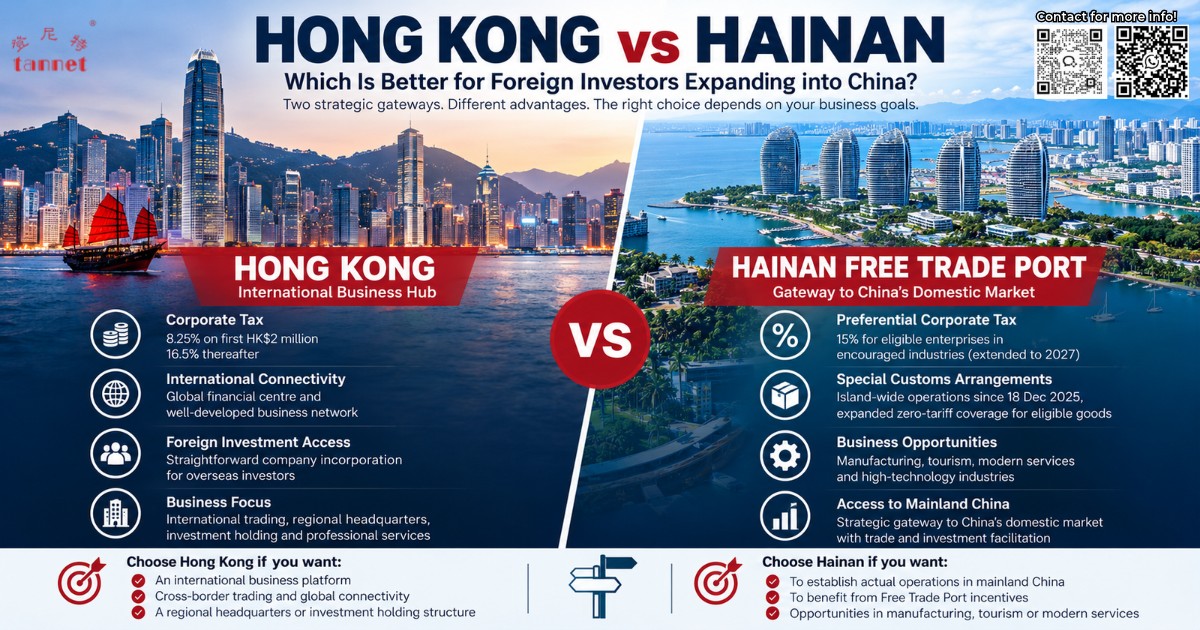
For international businesses planning to enter the Chinese market, choosing the right business location is an important strategic decision. Hong Kong and the Hainan Free Trade Port (FTP) are two increasingly attractive destinations for overseas investors, offering different advantages in taxation, foreign investment access, international trade and business operations.
However, Hong Kong and Hainan are not interchangeable investment destinations. Hong Kong operates as an international financial and commercial hub with an independent legal and tax system, while Hainan is a special economic and customs zone within mainland China, designed to facilitate international trade and investment.
With Hainan officially launching island-wide special customs operations on 18 December 2025, its investment framework has entered a new stage of development.
So, Hong Kong vs Hainan Free Trade Port: Which Is Better for Foreign Investors Expanding into China? The answer depends on their business objectives, target markets and operational requirements.
1. Understanding the Difference Between Hong Kong and Hainan
Before comparing their investment advantages, investors should understand the fundamental difference between these two locations.
Hong Kong is a Special Administrative Region of China. It maintains its own legal system, currency, taxation framework, financial infrastructure and customs territory. Its international connectivity makes it particularly suitable for companies conducting cross-border trade, international investment, financial activities and regional business management.
Hainan, on the other hand, is a province of mainland China and operates under the Hainan Free Trade Port framework. Its development strategy focuses on trade liberalisation, investment facilitation, tourism, modern services, high technology and international cooperation.
The implementation of island-wide special customs operations introduced a more distinctive customs arrangement. Under the framework, goods entering Hainan from overseas benefit from more liberalised customs arrangements, while movements of goods between Hainan and other mainland Chinese regions are subject to second-line customs supervision.
For investors, this distinction is important: Hong Kong offers an established international business environment, whereas Hainan offers preferential access to specific business opportunities within China’s domestic economic system.
2. Tax Advantages: Hong Kong vs Hainan
Taxation is often one of the first considerations when selecting an investment destination.
However, investors should evaluate not only the headline corporate tax rate but also eligibility requirements, business substance and the nature of their income.
Hong Kong’s Corporate Tax Framework
Hong Kong operates a territorial source principle of taxation. Generally, profits arising in or derived from Hong Kong are subject to profits tax, regardless of whether the company is incorporated locally or overseas.
Under the two-tiered profits tax regime, corporations are subject to:
- 8.25% on the first HK$2 million of assessable profits.
- 16.5% on assessable profits exceeding HK$2 million.
Hong Kong also does not impose VAT or general sales tax, capital gains tax, dividend tax or withholding tax under its ordinary tax framework.
These features make Hong Kong attractive for international trading companies, holding companies and businesses managing cross-border commercial activities.
Nevertheless, foreign-sourced income is not automatically exempt in every situation. The Foreign-Sourced Income Exemption (FSIE) regime introduces specific requirements for certain foreign-sourced dividends, interest, disposal gains and intellectual property income received in Hong Kong by multinational enterprise entities.
Companies should therefore assess their income sources and applicable exemption conditions before establishing their tax structure.
Hainan’s Corporate Tax Incentives
Hainan offers a different tax incentive framework designed to encourage businesses to establish genuine operations in the Free Trade Port.
Eligible enterprises operating in encouraged industries may qualify for a reduced corporate income tax rate of 15%, compared with the standard mainland China corporate income tax rate of 25%.
However, the preferential rate is not automatically available to every company registered in Hainan.
Businesses generally need to satisfy requirements including:
- Registration in the Hainan Free Trade Port.
- Substantive business operations in Hainan.
- Engagement in industries included in the encouraged industry catalogue.
- More than 60% of revenue derived from the qualifying main business.
The preferential corporate income tax policy has been extended through 31 December 2027.
Hainan also provides preferential treatment for certain overseas investment income earned by qualifying enterprises in tourism, modern services and high-technology industries.
For investors, Hainan may offer significant tax advantages when their business activities align with the government’s encouraged industries and substantive operating requirements.
The key distinction is that Hong Kong offers a relatively straightforward territorial tax framework, while Hainan provides targeted incentives tied to qualifying business activities and local substance.
3. Foreign Investment Access and Business Establishment
Another important consideration is how easily overseas investors can establish and operate a business.
Establishing a Business in Hong Kong
Hong Kong is generally recognised for its accessible company incorporation process.
Foreign investors can establish a Hong Kong private limited company without necessarily being Hong Kong residents. A company must meet the applicable requirements, including having at least one natural-person director, a company secretary and a registered office address in Hong Kong.
Hong Kong companies are commonly used for:
- International trading and distribution.
- Regional headquarters.
- Overseas investment holding.
- Cross-border consulting and professional services.
- Intellectual property and brand management.
The legal and administrative framework is familiar to many international businesses, making Hong Kong a practical choice for companies seeking an international corporate presence.
Establishing a Foreign-Invested Enterprise in Hainan
Foreign investors can establish businesses in Hainan through appropriate foreign-invested enterprise structures, subject to applicable mainland Chinese laws and industry requirements.
China generally applies a pre-establishment national treatment and negative list approach to foreign investment. Sectors outside the applicable negative list are generally open to foreign investment, subject to relevant registration, licensing and regulatory requirements.
Hainan also has its own foreign investment facilitation framework.
This makes Hainan attractive to businesses looking to establish actual operations in China, including production, distribution, tourism, modern services and selected high-technology activities.
However, investors should carefully examine whether their intended business falls under any restricted or regulated sector before proceeding with company registration.
Unlike Hong Kong incorporation, establishing a company in Hainan involves operating within mainland China’s corporate, tax, employment, foreign exchange and regulatory systems.
4. International Connectivity and Trade Opportunities
Hong Kong has a long-established position as an international financial and commercial centre.
Its advantages include an internationally connected banking system, extensive professional services networks, a convertible currency and strong connections with global trading partners.
For companies working with overseas suppliers, international customers and financial institutions, Hong Kong can serve as a central platform for managing international transactions and regional operations.
Hainan is developing its position as an international trade and investment gateway, particularly for businesses targeting Southeast Asia and other international markets.
The island-wide customs operations introduced in December 2025 expanded zero-tariff coverage. Under the new framework, the proportion of imported goods eligible for zero-tariff treatment increased significantly.
Additionally, qualifying goods processed in Hainan with at least 30% value-added content may be eligible to enter mainland China tariff-free, subject to applicable customs rules and conditions.
This creates opportunities for manufacturers, importers, exporters and businesses involved in processing and distribution.
However, investors must understand that Hainan’s special customs arrangements do not mean that all goods can move freely into mainland China without customs supervision or applicable taxes.
5. Which Industries Are Better Suited to Hong Kong and Hainan?
The most suitable investment destination depends heavily on the nature of the business.
Hong Kong is particularly suitable for:
International trading businesses: Companies importing and exporting goods across multiple countries can use Hong Kong as a central trading and commercial platform.
Financial and investment businesses: Businesses involved in investment holding, financial services and international capital management may benefit from Hong Kong’s established financial ecosystem, subject to licensing requirements.
Regional headquarters: Multinational companies can use Hong Kong to coordinate business activities, manage regional relationships and oversee international operations.
Consulting and professional services: International service providers may find Hong Kong attractive due to its professional services infrastructure and international business environment.
Hainan may be more suitable for:
Manufacturing and processing: Businesses seeking to establish production or processing operations may benefit from qualifying customs and tax incentives.
Tourism and hospitality: Hainan has a strategic focus on tourism, international consumption and related services.
Modern services: Businesses operating in qualifying professional, commercial and service industries may benefit from preferential policies.
High-technology enterprises: Eligible businesses in encouraged technology-related industries may find Hainan’s tax incentives and investment policies attractive.
The important consideration is whether the company’s actual operations match the advantages offered by the location.
6. Hong Kong or Hainan: Which Should Foreign Investors Choose?
There is no universal answer because the two locations serve different commercial purposes.
If your priority is establishing an international business presence, managing overseas transactions, coordinating regional operations or holding investments, Hong Kong is generally a more practical starting point.
If your objective is to establish production facilities, develop a presence in mainland China, participate in Hainan’s encouraged industries or benefit from qualifying Free Trade Port incentives, Hainan deserves closer consideration.
For some multinational companies, establishing operations in both locations may provide a more comprehensive structure.
For example, a foreign trading company could use a Hong Kong entity to manage international commercial relationships while establishing a qualifying operating subsidiary in Hainan to handle local production, processing or distribution.
However, such arrangements require careful consideration of transfer pricing, taxation, customs, foreign exchange, ownership structures and regulatory compliance. Establishing two companies does not automatically create tax savings or eliminate mainland Chinese regulatory obligations.
7. How TANNET Supports Your Hong Kong and China Market Entry
Choosing between Hong Kong and Hainan requires more than comparing corporate tax rates. Investors need to understand the legal framework, business registration requirements, operational substance, industry restrictions and long-term compliance obligations.
TANNET provides corporate and business advisory support to international investors exploring opportunities in Hong Kong and mainland China.
Our services include:
- Hong Kong company incorporation and corporate secretarial services.
- Business structure and investment planning.
- China market-entry and foreign-invested enterprise advisory.
- Accounting, taxation and annual compliance coordination.
- Business licensing and regulatory requirement assessment.
- Cross-border corporate structuring support.
Whether you are considering Hong Kong as an international business platform or Hainan as your entry point into China’s domestic market, selecting the right structure at the beginning can help reduce unnecessary administrative and operational complications.
Planning to expand into Hong Kong or China? TANNET can help you evaluate the available business structures, understand the relevant regulatory requirements and identify a suitable market-entry approach based on your investment objectives.
📞 Free 1-on-1 Consultation Now,
Official Service Hotline: +86-755-82148419
Cell: +86-13823131503;+60 19-309 2363
WeChat ID: 13823131503;
WhatsApp:+86-13823131503;+60 19-309 2363
Email: mytannet08@gmail.com; susiehu@citilinkia.com