Key Takeaway
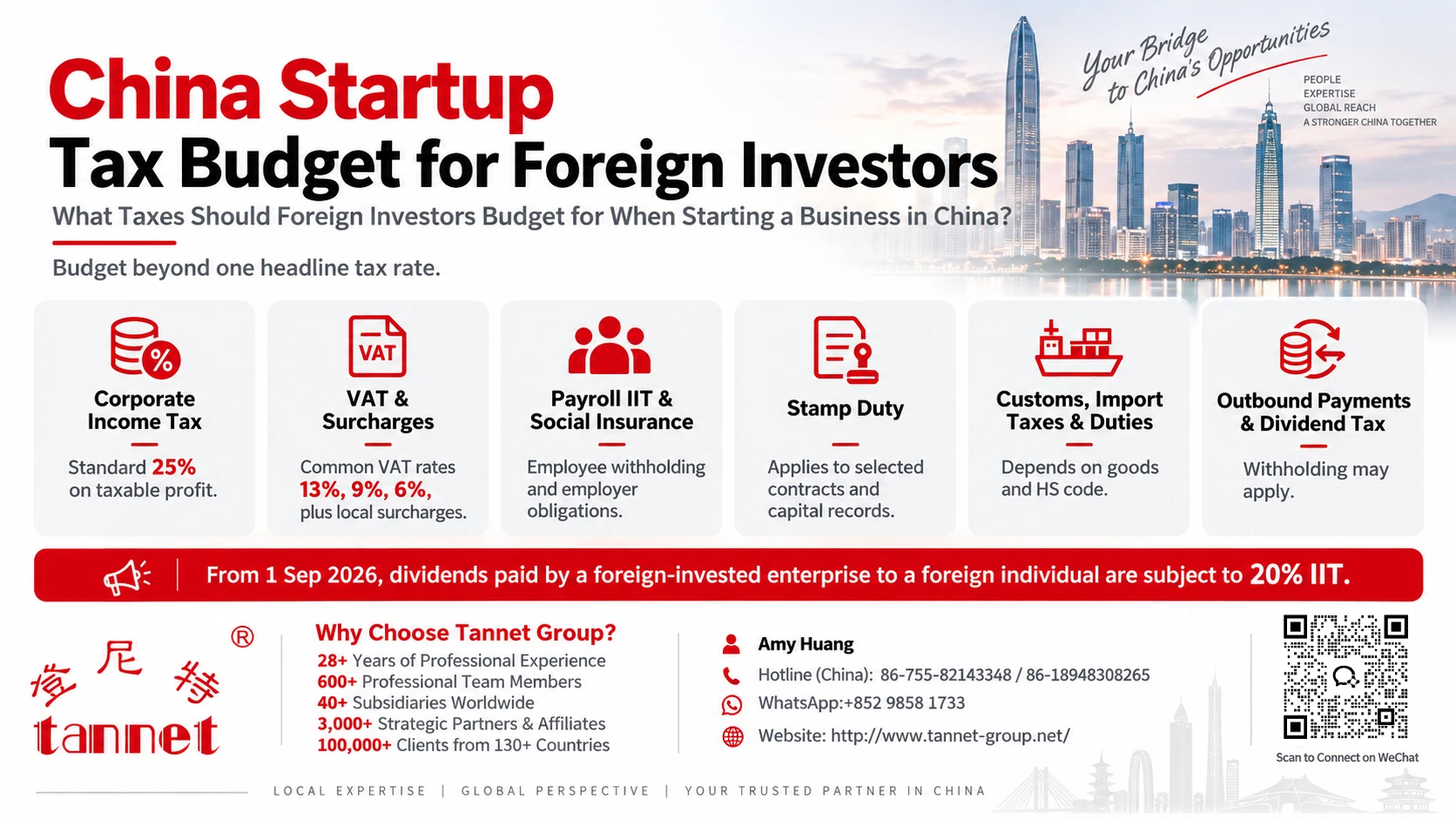
Foreign investors starting a business in China should budget for more than corporate income tax. The practical tax stack may include value-added tax, local surcharges, employee individual income tax withholding, social insurance, stamp duty, customs duties, import taxes and withholding tax on outbound payments.
This applies to a China WFOE, a joint venture and many other operating structures. The most important cautions are to model tax by transaction, choose the VAT status deliberately, separate company and personal costs, and plan shareholder distributions before incorporation.
From 1 September 2026, dividends paid by a foreign-invested enterprise to a foreign individual are subject to 20% individual income tax.
Start with the Business Events, Not One Headline Rate
China does not apply one special startup tax rate to foreign-invested enterprises. The budget should follow actual events. Capital may trigger stamp duty. Sales create VAT. Profit creates corporate income tax. Hiring creates payroll obligations. Imports and overseas payments add other taxes.
This event-based method gives a better cash-flow forecast. It also prevents the mistake of treating the 25% corporate income tax rate as the whole budget.
Corporate Income Tax: Usually 25% of Taxable Profit
The standard enterprise income tax rate is 25%. Taxable income is not the same as revenue or accounting profit. It is calculated under tax rules after allowable deductions, adjustments and carried-forward losses.
A startup with an accounting loss may have no current corporate income tax. It can still have VAT, payroll and reporting obligations. A “no profit” year is not a “no filing” year.
Qualifying small and low-profit enterprises may receive an effective 5% corporate income tax burden through 31 December 2027. The official criteria include annual taxable income not exceeding RMB3 million, no more than 300 employees and total assets not exceeding RMB50 million. The business must also avoid restricted or prohibited industries.
VAT: Model the Rate, Input Credits and Cash Timing
China’s Value-Added Tax Law took effect on 1 January 2026. General taxpayer rates are commonly 13% for goods, 9% for transportation and construction, and 6% for many services and intangible assets. Some exports and cross-border supplies may be zero-rated.
For a general taxpayer, VAT payable is broadly output VAT less creditable input VAT. The invoice rate is not always the final cost, but timing can create a working-capital gap.
A small-scale VAT taxpayer generally uses the simplified method. The statutory levy rate is 3%. For many transactions otherwise subject to the 3% rate, a reduced 1% rate applies from 1 January 2026 through 31 December 2027, subject to exclusions and current implementing rules.
Small-scale status is not automatically cheaper. Customers may want deductible VAT invoices. Import-heavy companies may value input credits. The choice depends on margins, customers, procurement and growth.
VAT-Linked Taxes and Surcharges
Urban maintenance and construction tax is calculated using VAT and consumption tax actually paid as its base. The statutory rate is 7% in urban areas, 5% in counties or towns and 1% elsewhere.
Education and other local surcharges may also apply. They are smaller than VAT, but recurring, and should appear separately in the monthly forecast.
Payroll: Individual Income Tax and Social Insurance
A China employer withholds individual income tax from taxable pay. Comprehensive income uses rates from 3% to 45%. Residence, source, deductions and treaties may change a foreign employee’s result.
An individual without China domicile generally becomes tax resident for a year after spending 183 days or more in China. Detailed multi-year rules also apply.
Social insurance is not a tax, but it is a material employment cost. Foreign employees generally enter the system. Rates vary by city, while bilateral agreements may exempt specified coverage when conditions are met.
Stamp Duty: Small Rate, Frequent Trigger
Stamp duty may apply to specified contracts, transfers and business records. The rate depends on the category.
For business accounting records, the tax base is paid-in capital or share capital plus capital reserve. The stated rate is 0.025%. Registered capital that has only been promised is not automatically the same as recorded paid-in capital.
Map leases, loans, purchases, capital entries and equity transfers before signing. Small rates matter on large values.
Imports: Customs Duty, Import VAT and Possible Consumption Tax
An importer may face customs duty, import VAT and, for specified products, consumption tax. The result depends on HS code, origin, customs value, trade agreement and special measures.
Equipment deserves early review. A wrong HS classification can change tax, licensing and clearance. Use the China Customs inquiry tool for the actual product code.
Outbound Payments and Profit Repatriation
Payments to overseas parties have different treatments. Dividends, interest, royalties and service fees require a commercial basis, contract, tax analysis and evidence.
A nonresident enterprise receiving China-source dividends is generally subject to 10% tax under domestic rules. A treaty may reduce the rate if its conditions are met. Beneficial ownership and substance are central. A holding company does not create an automatic treaty rate.
From 1 September 2026, dividends and bonuses paid by a foreign-invested enterprise to a foreign individual are subject to 20% individual income tax. The company withholds and generally pays it by the fifteenth day of the next month.
This makes ownership part of the startup tax budget. Consider dividends, succession, governance and future investment before registration.
Reinvestment Can Change the Cash-Flow Result
Foreign investors using distributed profits for qualifying China direct investment may claim a 2025–2028 tax credit. It is generally 10% of qualifying investment, or the lower treaty rate. Unused credit may carry forward.
This is not a blanket exemption. The investment method, evidence and industry conditions matter. Compare distribution, reinvestment and group financing before moving cash.
A Practical Tax Budget for the First 12 Months
Build the forecast in five steps.
- Map revenue by product, service, customer and invoice. Assign VAT treatment.
- Separate deductible, non-deductible and invoice-dependent costs. Time input VAT credits.
- Model payroll by city, including salary, withholding and employer social insurance.
- List capital, contracts, imports and related-party transactions. Add stamp, customs and withholding tax.
- Compare profit retention, reinvestment and distribution under the actual shareholder structure.
Use a base, growth and collection-delay case. VAT and payroll may be due before customers pay. Liquidity matters as much as the annual tax rate.
Common Mistakes
- Budgeting only for 25% corporate income tax.
- Treating the VAT invoice rate as a permanent cost without modelling input credits and timing.
- Choosing small-scale VAT status only because the temporary 1% rate looks lower.
- Assuming a loss-making company has no filing, VAT or payroll obligations.
- Paying personal expenses through the company without a business basis or valid invoice.
- Claiming a treaty dividend rate without beneficial ownership, substance or documentation.
- Ignoring the 20% tax on dividends paid to foreign individuals from 1 September 2026.
- Using an unverified HS code for imported equipment or inventory.
Frequently Asked Questions
Q1. Is a China WFOE automatically taxed at 25%?
No. The 25% rate applies to taxable enterprise profit. VAT, surcharges, payroll withholding, social insurance, stamp duty, customs taxes and outbound-payment taxes may arise separately. Incentive rates require eligibility.
Q2. Do we pay VAT before the company becomes profitable?
Possibly. VAT is transaction-based, not profit-based. A company can owe VAT while reporting an accounting or tax loss. Input credits and filing status affect the amount and timing.
Q3. Is small-scale VAT taxpayer status always cheaper?
No. The reduced 1% levy can help some small businesses, but general taxpayer status may be more suitable when customers need deductible VAT invoices or the company has material input VAT.
Q4. What changed for foreign individual shareholders in September 2026?
Dividends and bonuses received from foreign-invested enterprises became subject to 20% individual income tax from 1 September 2026. The foreign-invested enterprise has withholding and filing duties.
Q5. Does a Hong Kong holding company automatically reduce China dividend tax?
No. China’s domestic rate for dividends paid to a nonresident enterprise is generally 10%. Treaty relief depends on ownership, beneficial ownership, substance, documentation and other conditions. Home-jurisdiction taxes also matter.
Q6. Is registered capital itself taxed?
Not simply because an amount appears in the articles. Stamp duty on business accounting records generally follows paid-in capital or share capital plus capital reserve recorded in the books. Capital timing should still be planned.
Q7. Must foreign founders pay China individual income tax and social insurance?
It depends on their work, residence and compensation facts. Foreign employees may be subject to China individual income tax and generally participate in social insurance, subject to local rules and applicable bilateral agreements.
Q8. Which import taxes apply to machinery?
Customs duty and import VAT may apply. Consumption tax applies only to specified products. The exact result depends on HS code, origin, customs value, trade agreement and any special measure.
When Tannet Can Assist
Tannet can assist foreign investors that need a pre-incorporation tax map, entity and shareholder-structure coordination, VAT-status assessment, accounting setup, payroll compliance, import-tax review or a profit-repatriation workflow. The work should be coordinated with licensed legal and tax advisers where an opinion, treaty claim or regulated service is required.
Sources:
PRC Value-Added Tax Law and rates, State Taxation Administration;
Enterprise Income Tax Law, State Taxation Administration; Small and low-profit enterprise policy, State Taxation Administration;
Foreign individual dividend tax announcement, State Taxation Administration;
Individual Income Tax Law, State Taxation Administration; 2026 customs tariff adjustment, General Administration of Customs
Written by: Tannet Business Services Team
Reviewed by: Consultant Amy Huang
First published: 9 Sep. 2026
Last reviewed: 9 Sep. 2026
————————————————Simplifying Business, Empowering Entrepreneurs————————————————