Hong Kong is widely used by international entrepreneurs as a base for trading, consulting, technology, investment and regional operations.
But establishing a Hong Kong company does not automatically answer an important personal question:
Are you also a Hong Kong tax resident?
For business owners operating across multiple jurisdictions, misunderstanding tax residency can create unnecessary complications. So how to work on Hong Kong tax residency for business owners? Here are several common misconceptions.
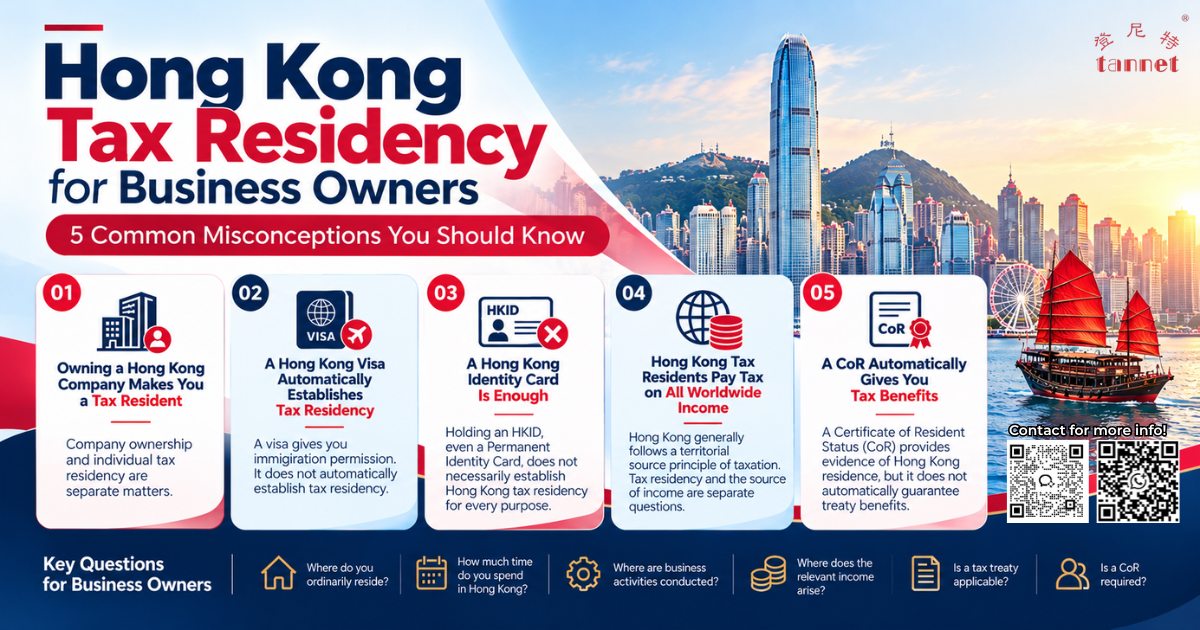
Misconception 1: Owning a Hong Kong Company Makes You a Tax Resident
Company ownership and individual tax residency are separate matters.
An entrepreneur can own 100% of a Hong Kong company while personally living primarily outside Hong Kong.
For individuals, Hong Kong tax residency generally depends on factors such as ordinary residence and physical presence—not simply shareholding in a Hong Kong company.
Therefore:
Hong Kong company shareholder ≠ automatic Hong Kong tax resident.
Misconception 2: A Hong Kong Visa Automatically Establishes Tax Residency
Hong Kong offers several immigration routes, including the Top Talent Pass Scheme, Quality Migrant Admission Scheme and employment-related visas.
These visas determine immigration permission.
They do not automatically establish tax residency.
An entrepreneur who obtains a Hong Kong visa but continues living and conducting most activities overseas may have different tax-residence circumstances from someone who genuinely relocates and establishes substantial personal and business connections with Hong Kong.
What Are the General Tax-Residency Criteria?
According to the Hong Kong Inland Revenue Department (IRD), an individual may generally be considered a Hong Kong tax resident where the person ordinarily resides in Hong Kong.
Physical-presence tests can also apply where an individual stays in Hong Kong for:
- more than 180 days during a year of assessment; or
- more than 300 days across two consecutive years of assessment, one being the relevant year.
Where a Double Taxation Agreement or Arrangement is involved, the specific treaty provisions must also be considered.
Misconception 3: A Hong Kong Identity Card Is Enough
Holding a Hong Kong Identity Card should not automatically be treated as proof of tax residency for every purpose.
The IRD has specifically indicated in guidance concerning the Mainland-Hong Kong tax arrangement that even holding a Hong Kong Permanent Identity Card does not necessarily establish Hong Kong residence for purposes of that arrangement.
Actual circumstances remain relevant.
Misconception 4: Hong Kong Tax Residents Pay Tax on All Worldwide Income
Hong Kong generally operates under a territorial source principle of taxation.
For business profits, tax liability generally focuses on whether profits arise in or are derived from Hong Kong from a trade, profession or business carried on in Hong Kong.
This means tax residency and source of income are separate questions.
An entrepreneur should therefore avoid assuming either that all overseas income is automatically taxable in Hong Kong or that all income received through an overseas transaction is automatically outside Hong Kong taxation.
The facts surrounding how and where the income is generated remain important.
Misconception 5: A CoR Automatically Gives You Tax Benefits
A Certificate of Resident Status (CoR) provides evidence of Hong Kong residence when claiming benefits under an applicable DTA.
It does not automatically create a tax exemption.
The relevant treaty must apply to the income or transaction concerned, and the applicant must satisfy the applicable requirements.
The IRD also states that issuance of a CoR does not guarantee that the treaty partner will grant the requested benefit.
Why Business Owners Should Plan Early
Consider an entrepreneur who owns a Hong Kong company, lives partly in Hong Kong and partly overseas, receives income from several countries and manages customers throughout Asia.
The correct tax analysis may require several separate questions:
Where does the entrepreneur ordinarily reside?
Where are the company’s profit-generating activities conducted?
Where does the relevant income arise?
Is a DTA available?
Does the individual qualify as a Hong Kong resident under that treaty?
Is a CoR required?
These questions become increasingly important as a business expands internationally.
Build Substance, Not Just Documentation
For cross-border business owners, a strong Hong Kong structure should reflect genuine commercial circumstances.
Company incorporation, banking, immigration, accounting, tax compliance and tax residency should therefore be considered as connected parts of a wider structure rather than independent administrative procedures.
TANNET can assist foreign entrepreneurs with Hong Kong company incorporation, corporate secretarial services, bank account assistance, immigration applications, accounting and tax compliance, and Certificate of Resident Status application support. Reviewing the corporate and personal structure together can help entrepreneurs establish a more coherent Hong Kong base for international operations.
📞 Free 1-on-1 Consultation Now,
Official Service Hotline: +86-755-82148419
Cell: +86-13823131503;+60 19-309 2363
WeChat ID: 13823131503;
WhatsApp:+86-13823131503;+60 19-309 2363
Email: mytannet08@gmail.com; susiehu@citilinkia.com