Key Takeaway
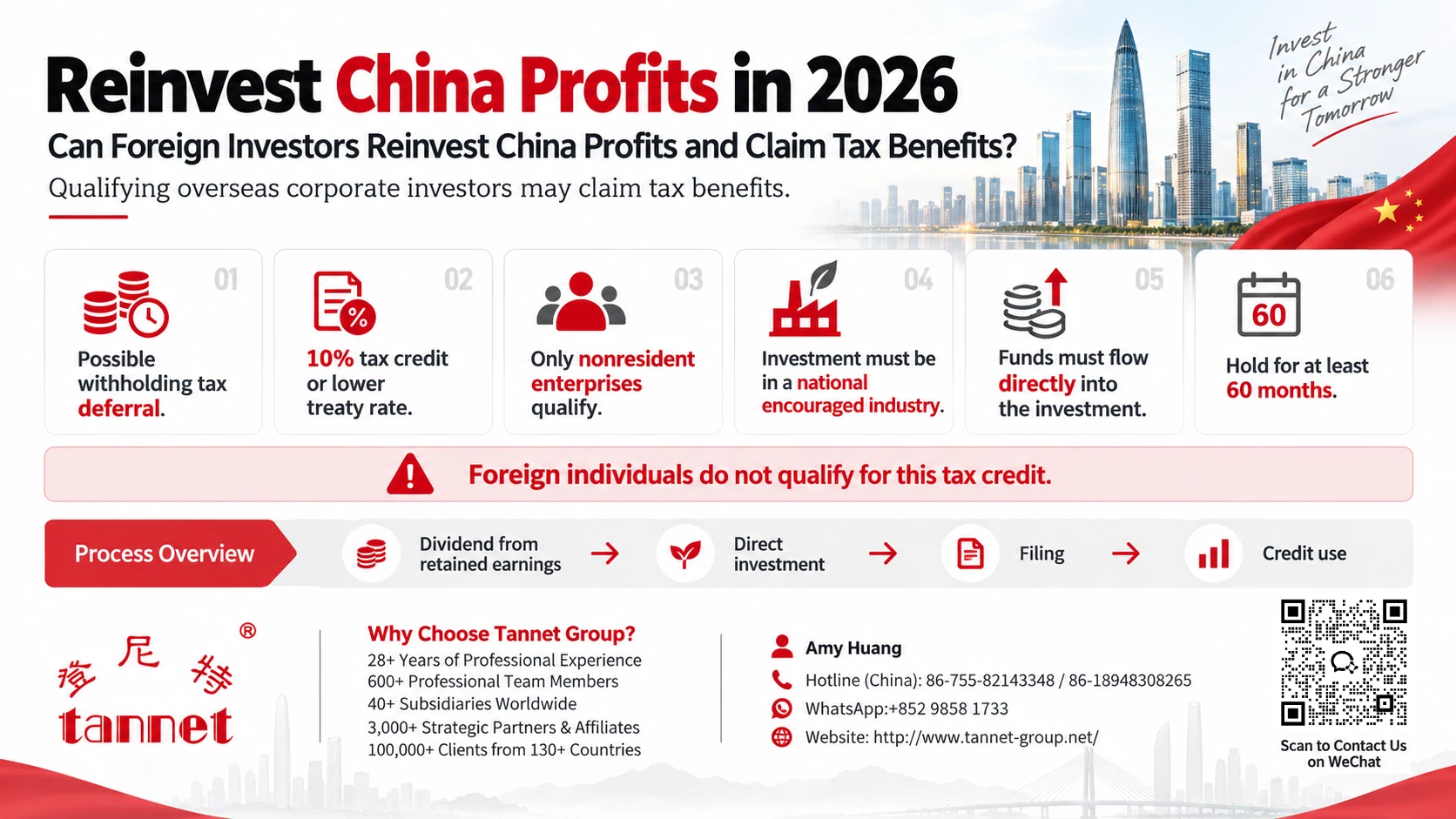
Yes. A qualifying overseas corporate investor can reinvest profits distributed by a China resident enterprise and use two linked tax benefits in 2026. The reinvested dividend may receive deferred withholding tax treatment.
A separate tax credit can equal 10% of the qualifying reinvestment, or a lower applicable treaty dividend rate. This is relevant to nonresident companies expanding an existing China business, funding a new China company or acquiring an unrelated China company.
The main cautions are strict.
Foreign individuals do not qualify for this tax credit. The investment must enter an eligible national encouraged industry, follow a direct fund route and remain invested for at least 60 months.
The 2026 Benefit Has Two Separate Parts
China allows qualifying overseas corporate investors to defer withholding tax when distributed China profits fund direct investment. The 2025 policy adds a credit for qualifying investments made through 31 December 2028.
Under deferral, the profit-distributing enterprise may temporarily refrain from withholding enterprise income tax on the reinvested dividend. The tax normally becomes payable when the investment is recovered.
The separate credit is calculated on the reinvestment amount and can offset specified China enterprise income tax arising later.
Neither benefit is a permanent exemption. The investor must satisfy the deferral rules and the narrower credit conditions.
The two eligibility tests are not identical. Official tax guidance states that the deferral framework can cover direct investment in non-prohibited projects, while the 2025 credit requires the invested activity to fall within the national encouraged-industry catalogue.
The credit applies to qualifying reinvestments made from 1 January 2025 through 31 December 2028. A qualifying investment made before the June 2025 announcement but after 1 January 2025 may be claimed retrospectively, although its credit can only offset eligible tax arising after the announcement.
Only a Nonresident Enterprise Can Claim the Credit
The eligible overseas investor is a nonresident enterprise under China’s Enterprise Income Tax Law. A qualifying foreign parent or holding company may meet that definition.
A foreign individual is outside the definition and cannot claim this corporate tax credit.
Review this before incorporation. A corporate shareholder also brings substance, governance, treaty and overseas tax issues.
The Profit Must Come from Retained Earnings
The investor must receive an actual dividend from the retained earnings of a China resident enterprise.
Fees, loans and capital reductions are not qualifying profit distributions. Corporate approvals, accounts and tax records should support the dividend.
The China company must have distributable after-tax profit. Cash on hand alone is not enough.
Three Direct Investment Routes Qualify
The 2025 policy recognizes three main equity investment routes.
- Increase paid-in capital or capital reserve in a China resident enterprise. Paying already subscribed capital can qualify.
- Establish a new China resident enterprise.
- Acquire a China resident enterprise’s equity from an unrelated seller.
Listed shares are generally excluded, apart from qualifying strategic investment. A shareholder loan is not a listed route.
The Invested Business Must Be in a National Encouraged Industry
During the holding period, the invested enterprise must operate in the national section of the encouraged foreign investment catalogue.
The 2025 edition took effect on 1 February 2026. Its regional section is separate. The credit rule refers to the national section.
Match the real revenue-generating activity to the entry. A broad business scope may not be enough.
The Investment Must Be Held for 60 Months
The investor must hold the reinvestment for at least 60 months. The period begins in the reinvestment month shown on the commerce authority’s status form.
A reduction, withdrawal or transfer stops the period for the recovered portion under detailed timing rules.
Five years preserves the credit. It does not erase the deferred dividend tax automatically.
The Fund Flow Must Be Direct
Cash must move directly from the profit-distributing enterprise to the invested enterprise or seller. It cannot pass through another account first.
For non-cash investment, the asset must also transfer directly without temporary holding by another party.
Design the bank instructions before payment. Sending funds overseas and then returning them can break eligibility.
How the Credit Is Calculated
The credit can equal 10% of the reinvestment or a lower applicable treaty dividend rate.
If the investor selects 10%, it cannot switch to a lower treaty rate when recovering the investment after 60 months. Model credit use and exit tax together.
Foreign currency is converted at the central parity rate on the payment date.
Which Tax Can the Credit Offset
The credit belongs to the overseas investor. It does not offset the WFOE’s corporate income tax, VAT, payroll tax or customs duty.
It can offset tax on later China-source dividends, interest or royalties from the same profit-distributing enterprise.
Credit pools are separate. Company A’s credit generally cannot offset tax on income from Company B.
Unused credit carries forward, including after 2028 until exhausted.
A Simplified Example
An overseas company directly reinvests a RMB10 million dividend into a qualifying project and selects 10%. The potential credit is RMB1 million, while the dividend tax is deferred.
If the same China company later pays a royalty creating RMB600,000 of eligible tax, that amount may be credited. RMB400,000 remains. Treaty, pricing and transfer pricing require separate review.
The Filing Process
- Confirm that the investor, retained earnings, investment route, industry and 60-month plan satisfy the policy.
- Complete the corporate approvals and arrange the direct transfer of cash or assets.
- The invested enterprise reports the investment and supporting evidence through the Ministry of Commerce business system.
- The competent commerce authority verifies the information and issues the Profit Reinvestment Status Form.
- The investor gives its Reinvestment Tax Credit Information Report and the status form to the distributing enterprise.
- When using the credit, the distributing enterprise files the withholding tax report and supporting documents.
Confirm the local sequence before transfer. Reconstructing approvals, bank evidence or industry support later may fail.
Maintain a transaction file containing the dividend resolution, profit evidence, investment agreement, bank or asset-transfer records, commerce-authority form, tax credit report and industry analysis. The records should identify the distributing enterprise, invested enterprise, reinvestment date, amount and selected credit rate.
What Happens When the Investment Is Recovered
After 60 months, recovering the investment makes the related deferred dividend tax reportable, generally within seven days. Remaining credit may offset it.
Early recovery reduces the credit proportionally. Excess credit already used must be repaid, with possible late-payment amounts from the original use date.
Credit-benefited investments may be treated as recovered first. Track every reinvestment separately.
Common Mistakes
- Assuming the policy applies to a foreign individual shareholder.
- Treating the benefit as a permanent dividend tax exemption.
- Reinvesting into an industry found only in the regional catalogue.
- Routing cash through the overseas investor or another group account.
- Using a shareholder loan instead of a qualifying equity investment.
- Applying Company A’s credit to tax arising from Company B.
- Choosing the 10% rate without considering the later treaty-rate restriction.
- Recovering the investment before 60 months without modelling clawback and late-payment exposure.
Frequently Asked Questions
Q1. Can a foreign individual claim the 2026 reinvestment tax credit?
No. The policy defines the eligible overseas investor as a nonresident enterprise. A foreign individual is outside that definition.
Q2. Can an overseas parent reinvest profits into the same WFOE?
Yes, an increase to paid-in capital or capital reserve can qualify if all other conditions are met. The invested business must satisfy the national encouraged-industry condition.
Q3. Can the profit fund a new China subsidiary?
Yes. Establishing a new China resident enterprise is one of the listed investment forms. The fund route and industry test still apply.
Q4. Can the investor acquire an existing China company?
It may acquire equity from an unrelated party. Related-party acquisitions and ordinary purchases of listed shares are outside the stated routes, subject to the strategic-investment exception.
Q5. Does the tax credit reduce the WFOE’s 25% corporate income tax?
No. The credit offsets specified enterprise income tax payable by the overseas investor on later China-source income from the same profit-distributing enterprise.
Q6. Must the investor keep the investment forever?
No, but it must hold the qualifying reinvestment continuously for at least 60 months to retain the full credit. Deferred dividend tax is addressed when the investment is recovered.
Q7. Can unused credit be used after 2028?
Yes. A qualifying balance existing after 31 December 2028 may continue until fully used.
Q8. Is a Hong Kong holding company automatically eligible?
No. It must be a qualifying nonresident enterprise and satisfy every profit, investment, industry, holding, fund-flow and filing condition. Any treaty or arrangement position also needs support.
When Tannet Can Assist
Tannet can assist when an overseas group needs the reinvestment workstream coordinated with China company registration, capital changes, corporate records, accounting, tax filings and cross-border payment documentation. Legal opinions, treaty entitlement, transfer pricing and regulated tax advice should be handled with the relevant qualified advisers.
Sources:
Reinvestment tax credit policy, Ministry of Finance, State Taxation Administration and Ministry of Commerce;
Tax administration procedures, State Taxation Administration; Implementation process, Ministry of Commerce;
Catalogue of Encouraged Industries for Foreign Investment 2025 Edition, National Development and Reform Commission
Written by: Tannet Business Services Team
Reviewed by: Consultant Amy Huang
First published: 9 Sep. 2026
Last reviewed: 9 Sep. 2026
————————————————Simplifying Business, Empowering Entrepreneurs————————————————