Key Takeaway
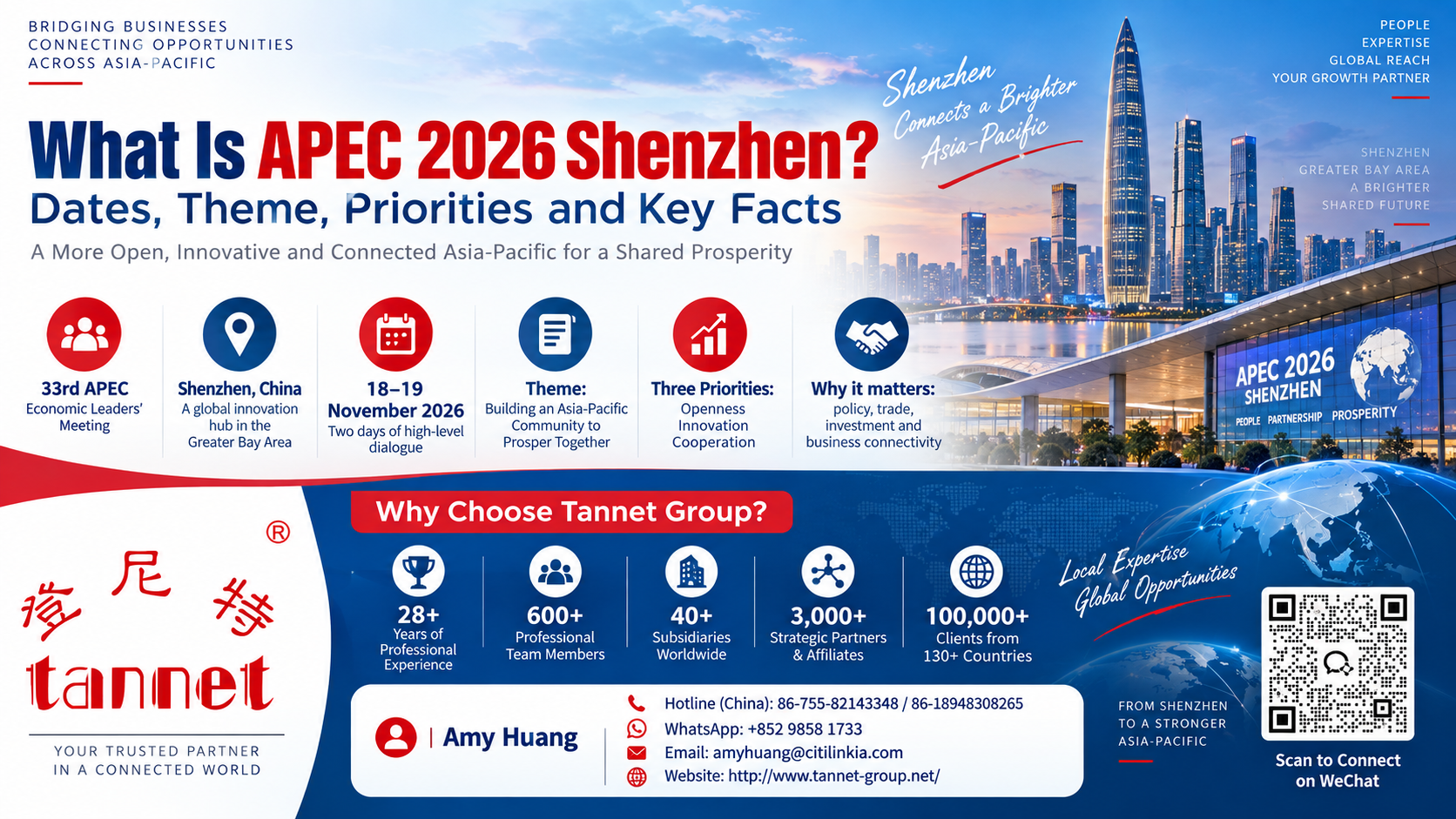
APEC 2026 Shenzhen is the 2026 host-year program of the Asia-Pacific Economic Cooperation forum, culminating in the 33rd APEC Economic Leaders’ Meeting in Shenzhen on November 18 and 19, 2026. It matters to policymakers, business leaders, investors, exporters, technology companies, and organizations tracking Asia-Pacific trade.
The official theme is “Building an Asia-Pacific Community to Prosper Together,” supported by three priorities: openness, innovation, and cooperation. The key caution is simple: APEC is a policy forum, not a trade fair or automatic investment channel. Visitors should verify official schedules, access rules, travel arrangements, and commercial requirements before acting.
What is APEC?
Asia-Pacific Economic Cooperation, or APEC, is a regional economic forum established in 1989. It brings together 21 member economies to promote economic cooperation, trade, investment, and shared prosperity across the Asia-Pacific.
APEC uses the term “economies” because participants engage mainly on economic and trade issues. According to the APEC Secretariat, cooperation is voluntary, decisions are reached by consensus, and commitments are generally non-binding. This flexible model allows economies with different legal systems and development levels to work on practical regional problems.
APEC activity continues throughout the year. Senior officials, ministers, working groups, business representatives, and technical experts develop proposals before leaders meet. The November event is therefore the most visible part of a much larger policy process.
When and where is APEC 2026?
China is the host economy for APEC 2026. Shenzhen, Guangdong Province, will host the 33rd APEC Economic Leaders’ Meeting on November 18 and 19, 2026. Shenzhen Government Online states that the APEC CEO Summit and the Joint Ministerial Meeting of Foreign and Trade Ministers will accompany the leaders’ meeting.
The APEC China Year is broader than two November dates. China’s Ministry of Foreign Affairs has said that about 300 meetings and activities are expected across several Chinese cities during 2026. Senior officials’ meetings and specialist events prepare ideas, texts, and potential outcomes for consideration later in the year.
Readers should use the APEC Secretariat, the APEC China 2026 platform, China’s Ministry of Foreign Affairs, and Shenzhen Government Online for current information. Program details, accreditation, transport controls, and venue arrangements can change as the leaders’ week approaches.
What is the official theme?
The official theme is “Building an Asia-Pacific Community to Prosper Together.” It links APEC 2026 with the longer-term Putrajaya Vision 2040, which describes an open, dynamic, resilient, and peaceful Asia-Pacific community.
The theme is not a promise that every proposed measure will become binding law. It provides a common direction for meetings, ministerial discussions, technical cooperation, and the leaders’ process. Individual economies retain their own legislation, licensing rules, tax systems, and investment controls.
What are the three priorities?
1. Openness
Openness concerns trade, investment, regional economic integration, connectivity, and an enabling business environment. Discussions may address practical barriers, supply chains, customs processes, services trade, and cooperation on regional and global trade issues.
For companies, openness does not mean unrestricted market access. A foreign business entering China must still examine the applicable negative list, industry licensing, company registration, customs, foreign exchange, employment, tax, and data obligations.
2. Innovation
Innovation covers digital technologies, artificial intelligence, productivity, new growth drivers, and the use of technology to support inclusive development. It is especially relevant to Shenzhen because the city has a large technology, advanced manufacturing, electronics, and digital-business ecosystem.
Companies should avoid reading policy language as a direct subsidy or approval. Commercial benefits depend on sector rules, customer demand, intellectual-property protection, data compliance, financing, and the ability to operate locally.
3. Cooperation
Cooperation focuses on common regional challenges that no economy can solve alone. These include connectivity, sustainable growth, resilience, capacity building, demographic change, and coordination across public and private stakeholders.
For international businesses, cooperation can create useful policy signals and professional networks. It does not replace contracts, due diligence, partner verification, or jurisdiction-specific advice.
Why was Shenzhen selected?
Shenzhen is one of China’s first special economic zones and a major center for foreign trade, technology, advanced manufacturing, logistics, and entrepreneurship. The APEC Secretariat reported that Shenzhen’s GDP reached RMB3.68 trillion in 2024 and total trade reached about RMB4.5 trillion.
More recent Shenzhen government data reported GDP above RMB3.87 trillion and foreign trade of approximately RMB4.55 trillion in 2025. These figures help explain the city’s relevance to discussions about openness, innovation, supply chains, and Asia-Pacific connectivity.
Its location also matters. Shenzhen borders Hong Kong and forms part of the Guangdong-Hong Kong-Macao Greater Bay Area. A regional business may use Hong Kong for international finance or holding functions, Shenzhen for technology or mainland operations, and Guangzhou for manufacturing, trade, or broader South China access. The appropriate structure depends on actual activities.
What does APEC 2026 mean for businesses?
APEC 2026 will increase global attention on Shenzhen and on Asia-Pacific economic cooperation. Companies may find more public information, industry dialogue, delegation visits, and professional events connected with the host year.
However, APEC participation is not generally open like a public exhibition. Some meetings are governmental, invitation-only, or subject to accreditation. Businesses should confirm whether an event is official, public, commercial, or independently organized before paying fees or making travel plans.
The wider business value lies in understanding policy direction. Exporters can monitor trade facilitation. Technology companies can follow digital and AI discussions. Manufacturers can track supply-chain and sustainability priorities. Professional services firms can assess where clients may need cross-border implementation support.
Common mistakes
- Treating the leaders’ meeting as a public trade show that anyone can enter.
- Assuming APEC announcements automatically change Chinese laws or tax rules.
- Using the APEC name or logo in a way that implies official sponsorship.
- Booking travel before checking accreditation, invitation, visa, and venue requirements.
- Confusing media attention with confirmed demand for a product or service.
- Creating a Shenzhen or Hong Kong company before testing the operating model.
Frequently asked questions
Q1. What are the confirmed dates for the leaders’ meeting?
The 33rd APEC Economic Leaders’ Meeting is scheduled for November 18 and 19, 2026, in Shenzhen. Check official channels before travel because supporting-event schedules may change.
Q2. Is APEC 2026 only taking place in Shenzhen?
No. Shenzhen hosts the leaders’ meeting, while meetings and activities take place in several Chinese cities throughout the host year.
Q3. Can any business attend APEC meetings?
No. Access depends on the specific meeting. Some events require government, media, business, or organizer accreditation. Others may be public or independently organized.
Q4. Does APEC make binding trade law?
APEC works through voluntary cooperation and consensus. Its decisions are generally non-binding. Domestic implementation remains subject to each economy’s laws and procedures.
Q5. Will APEC 2026 make it easier to register a company in Shenzhen?
Not automatically. Company registration, foreign-investment access, licensing, tax, banking, employment, and compliance rules continue to apply.
Q6. Is Hong Kong part of APEC?
Yes. Hong Kong, China is one of APEC’s 21 member economies. APEC uses the term “economy” for all participants.
Q7. Where should companies verify updates?
Use APEC.org, official APEC China 2026 information, China’s Ministry of Foreign Affairs, and Shenzhen Government Online. Avoid relying only on commercial event advertisements.
Conclusion
Official details can change quickly. Official updates should guide all final travel and business decisions. Readers should separate confirmed facts from commercial interpretation. Meeting access rules may differ across individual events and venues. Businesses should check eligibility before arranging any event-related travel. Public attention does not remove ordinary market-entry or compliance requirements.
A company should test demand before committing substantial resources. Travel planning and investment planning remain two separate exercises. Current official notices remain the primary reference for scheduling. Commercial decisions still require independent legal, tax, and market analysis.
The host year covers more than the November leaders meeting. Business visitors should retain clear records of meetings and follow-up actions. Sector opportunities will vary by company, market, and regulatory position.
No conference announcement replaces formal approval from the competent authority.
Companies should document assumptions used in their expansion decisions. A practical plan should include timing, budget, ownership, staffing, and compliance. Official websites should be checked again immediately before publication or travel.
APEC 2026 places Shenzhen at the center of Asia-Pacific economic discussion, but businesses still need careful market-entry analysis.
Tannet can assist companies that need coordinated support for business visits, market research, company formation, tax registration, accounting, corporate compliance, or cross-border structuring in Shenzhen, Guangzhou, and Hong Kong. The appropriate scope should be determined from the company’s industry, ownership, activities, and timetable.
Official Sources
Written by: Tannet Business Services Team
Reviewed by: Consultant Amy Huang
First published: 22 Sep. 2026
Last reviewed: 22 Sep. 2026
————————————————Simplifying Business, Empowering Entrepreneurs————————————————