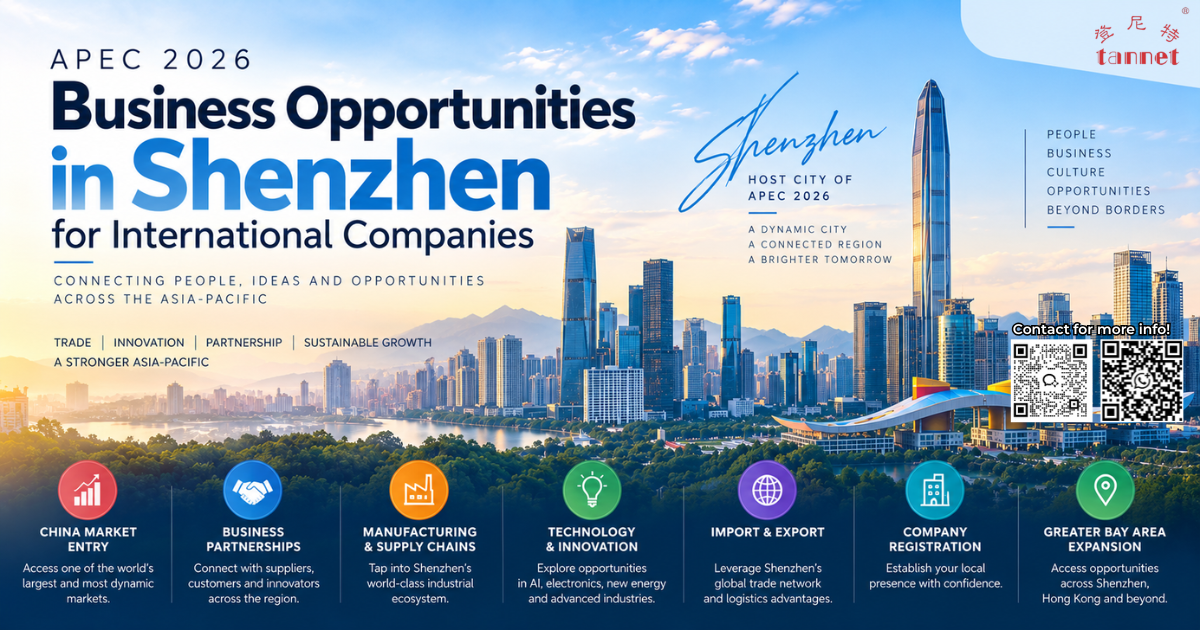
Shenzhen is set to become one of the key international business focal points in Asia in 2026.
China is hosting APEC 2026 under the theme “Building an Asia-Pacific Community to Prosper Together,” and Shenzhen will host the APEC Economic Leaders’ Week in November 2026.
For international companies, however, APEC 2026 is about more than attending meetings or business events.
It creates an opportunity to take a closer look at Shenzhen as a location for China market entry, company registration, technology cooperation, sourcing, import and export, cross-border trade and Greater Bay Area expansion.
For businesses already considering China, the question is therefore not simply “What is happening during APEC 2026?” but:
What can Shenzhen offer an international company after APEC is over?
Why Shenzhen Matters During APEC 2026 Shenzhen
APEC brings together 21 member economies and serves as a major forum for economic cooperation across the Asia-Pacific.
Shenzhen’s selection as the host city for the 2026 Economic Leaders’ Week also places greater attention on the city’s role in international trade and investment.
The scale of Shenzhen’s economy helps explain its significance.
According to Shenzhen’s official 2025 statistics, the city’s total merchandise imports and exports reached approximately RMB 4.55 trillion in 2025. Shenzhen’s exports have ranked first among large and medium-sized Mainland Chinese cities for 33 consecutive years.
The city also recorded 15,906 newly established foreign-invested enterprises in 2025, an increase of 63.3% from the previous year.
For international investors, these figures show that Shenzhen is not simply a technology centre. It is also a major gateway for companies participating in China’s international trade and investment ecosystem.
What Is Shenzhen Doing for International Business in 2026?
APEC 2026 coincides with a wider effort by Shenzhen to strengthen its international business environment.
Under the city’s 2026 Action Plan for Optimizing the International Business Environment, Shenzhen has identified measures covering foreign investment, services, international trade, professional services and cross-border business activities.
Among the areas highlighted are further opening of selected service industries, encouraging multinational companies to establish headquarters and attracting foreign-invested R&D centres, innovation centres and other international investment projects.
The city is also promoting greater cooperation with APEC member economies.
For international companies considering China market entry, this means 2026 can be used not only to attend APEC-related activities but also to evaluate whether Shenzhen fits into a longer-term Asia or China strategy.
1. Establishing a Company in Shenzhen
One of the most direct ways to enter the Shenzhen market is by establishing a local company.
Depending on the business model and applicable regulations, foreign investors may consider a foreign-invested enterprise for activities such as:
- International and domestic trade
- Import and export
- Technology development
- Consulting
- Supply-chain management
- Cross-border e-commerce
- Professional services
- Business services
- Other permitted commercial activities
However, foreign investors should avoid treating company registration as an isolated administrative task.
Before registration, it is important to determine:
Shareholder structure
Will the Shenzhen company be held by an overseas individual, an overseas company or another corporate structure?
Business scope
What will the company actually do in China?
Registered location
Where should the company be established and what address requirements apply?
Foreign investment restrictions
Is the proposed sector open to foreign investment, restricted or subject to additional conditions?
Licensing
Does the business require additional permits after company registration?
The correct structure depends on the company’s actual operating model.
2. Shenzhen as a Trading and Import-Export Base
International trade remains one of Shenzhen’s major strengths.
In 2025, Shenzhen recorded approximately RMB 4.55 trillion in merchandise trade, including around RMB 2.74 trillion in exports and RMB 1.81 trillion in imports.
Mechanical and electrical products represented a major portion of exports, while exports of high-tech products reached approximately RMB 1.28 trillion.
This makes Shenzhen particularly relevant for companies involved in:
Electronics | Technology | Machinery | Consumer Products | Manufacturing | Supply Chains | Cross-Border E-Commerce | Import & Export
For international companies sourcing from China, establishing a Shenzhen entity may also support a broader strategy involving supplier management, local contracts, staffing and business development.
However, companies planning import-export activities should review customs, tax, invoicing, product certification and licensing requirements relevant to their products.
Company registration alone does not automatically resolve every operational requirement.
3. Access Shenzhen’s Technology and Manufacturing Ecosystem
Shenzhen is widely associated with technology, but international companies should look at the broader commercial ecosystem surrounding it.
The city has developed strong clusters around areas such as advanced manufacturing, telecommunications, electronics, artificial intelligence, new energy and other technology-driven industries.
This can create opportunities for different types of overseas companies.
A technology company may look for a local R&D or commercial partner.
A consumer brand may look for manufacturers and supply-chain partners.
An overseas manufacturer may use Shenzhen to identify component suppliers.
A professional services company may establish a local operation to serve companies doing business across China and the Greater Bay Area.
Rather than registering immediately, businesses visiting Shenzhen around APEC 2026 can use the trip for market validation.
A practical sequence can be:
Market Research → Shenzhen Visit → Supplier/Partner Meetings → Business Model Validation → Company Structure → Registration → Local Operations
This reduces the risk of establishing a company before understanding how the business will actually operate.
4. Shenzhen and Hong Kong: A Greater Bay Area Strategy
Another important consideration is Shenzhen’s relationship with Hong Kong.
The two cities are part of the Guangdong–Hong Kong–Macao Greater Bay Area (GBA) but operate under different legal, tax, banking and corporate systems.
For some international companies, this creates the possibility of considering both jurisdictions within a wider business structure.
For example, depending on the company’s business model:
Hong Kong company
↓
International contracts / international business / regional activities
↓
Shenzhen company
↓
Mainland China operations / local customers / suppliers / employees
This is not a universal structure, and it should not be adopted simply because a company operates internationally.
The appropriate arrangement depends on where customers are located, where contracts are signed, where employees work, where revenue is generated and how the business will operate in practice.
International companies should therefore compare Hong Kong company registration and Shenzhen company registration based on their actual commercial needs.
5. Why International Companies Should Look at Qianhai
Companies considering Shenzhen may also encounter Qianhai Shenzhen-Hong Kong Modern Service Industry Cooperation Zone.
Qianhai has been developed as an important platform for Shenzhen-Hong Kong cooperation and modern service industries.
It may be particularly relevant to companies involved in areas such as professional services, technology, modern logistics and other cross-border activities.
Qianhai also continues to attract substantial foreign and Hong Kong investment. In the first half of 2026, the area reported RMB 25.01 billion in utilized foreign investment and 1,335 newly added foreign-invested enterprises.
However, registering in Qianhai should be a commercial decision rather than a branding decision.
Companies should assess their industry, operational requirements, available policies, registered address, staffing needs and eligibility before selecting the district.
6. APEC 2026 as a Business Development Opportunity
Companies do not necessarily need to establish an entity before visiting Shenzhen.
For businesses attending events, exhibitions or meetings during the APEC 2026 period, a business visit can be used to conduct preliminary market research.
Possible objectives include:
- Meeting potential Chinese suppliers
- Identifying distributors or commercial partners
- Visiting manufacturers
- Evaluating Shenzhen office locations
- Meeting professional service providers
- Understanding local business costs
- Reviewing market-entry requirements
- Exploring opportunities in Shenzhen and Hong Kong
- Evaluating potential Greater Bay Area structures
This can turn an APEC-related trip into a practical China market-entry exercise.
7. What Should Foreign Investors Prepare Before Registering?
Before starting Shenzhen company registration, international investors should clarify several important points.
Proposed Company Name
Prepare possible company names while considering China’s company naming requirements and availability.
Shareholders and Directors
Determine who will own and manage the company and prepare the relevant identification or corporate documents.
If a corporate shareholder is used, additional corporate documentation may be required.
Business Scope
The business scope should accurately reflect the activities the company intends to conduct.
This is particularly important where additional licences or regulatory approvals may apply.
Registered Address
The company will require a compliant registered address. Address requirements should be checked before the registration process begins.
Registered Capital
The capital arrangement should be considered based on the company’s business requirements and applicable company law rather than selecting an arbitrary figure.
Tax and Accounting
A registered company will have ongoing tax, accounting and reporting obligations.
Businesses should therefore consider ongoing compliance costs before incorporation rather than focusing only on the initial registration fee.
Corporate Bank Account
Companies should also plan their banking requirements, including expected transactions, currencies, customers, suppliers and supporting business documents.
Additional Licences
Depending on the activity, registration may only be the first step.
Import-export activities, food businesses, regulated professional services and other industries may involve additional registrations, permits or approvals.
8. Common Mistake: Registering Before Planning the Business
One of the most common mistakes in international expansion is asking:
“How much does it cost to register a Shenzhen company?”
before answering:
“What exactly will this company do?”
The cheapest or fastest company structure is not necessarily the right one.
An international company should first determine:
Market → Customers → Business Model → Location → Corporate Structure → Licences → Tax & Banking → Registration
This is particularly important for companies entering China for the first time.
A poorly planned structure can result in later changes to the business scope, address, licences, shareholder arrangements or operational setup.
From APEC 2026 to a Long-Term Shenzhen Presence
APEC 2026 will put Shenzhen in front of business leaders and companies from across the Asia-Pacific.
But the commercial opportunity does not end when the meetings finish.
For international companies, Shenzhen can be evaluated as a location for sourcing, technology cooperation, manufacturing partnerships, trade, professional services and a permanent Mainland China operation.
Businesses already planning to attend APEC-related activities can use the opportunity to take a more structured approach:
Visit Shenzhen → Understand the Market → Meet Partners → Evaluate the Structure → Register → Establish Operations
For companies considering Shenzhen company registration, China market entry, foreign-invested company formation, Shenzhen business setup or Greater Bay Area expansion, professional planning at the beginning can help identify the appropriate structure and compliance requirements before significant investment is made.
Planning to Do Business in Shenzhen?
TANNET provides corporate and business services for international companies entering China, Hong Kong and other markets.
Our services can support businesses with Shenzhen company registration, China market-entry planning, corporate services, business registration and related ongoing compliance requirements.
Whether you are visiting Shenzhen around APEC 2026 or planning a longer-term China presence, the first step is to understand what structure your actual business requires.
📞 Free 1-on-1 Consultation Now,
Official Service Hotline: +86-755-82148419
Cell: +86-13823131503;+60 19-309 2363
WeChat ID: 13823131503;
WhatsApp:+86-13823131503;+60 19-309 2363
Email: mytannet08@gmail.com; susiehu@citilinkia.com