Key Takeaway
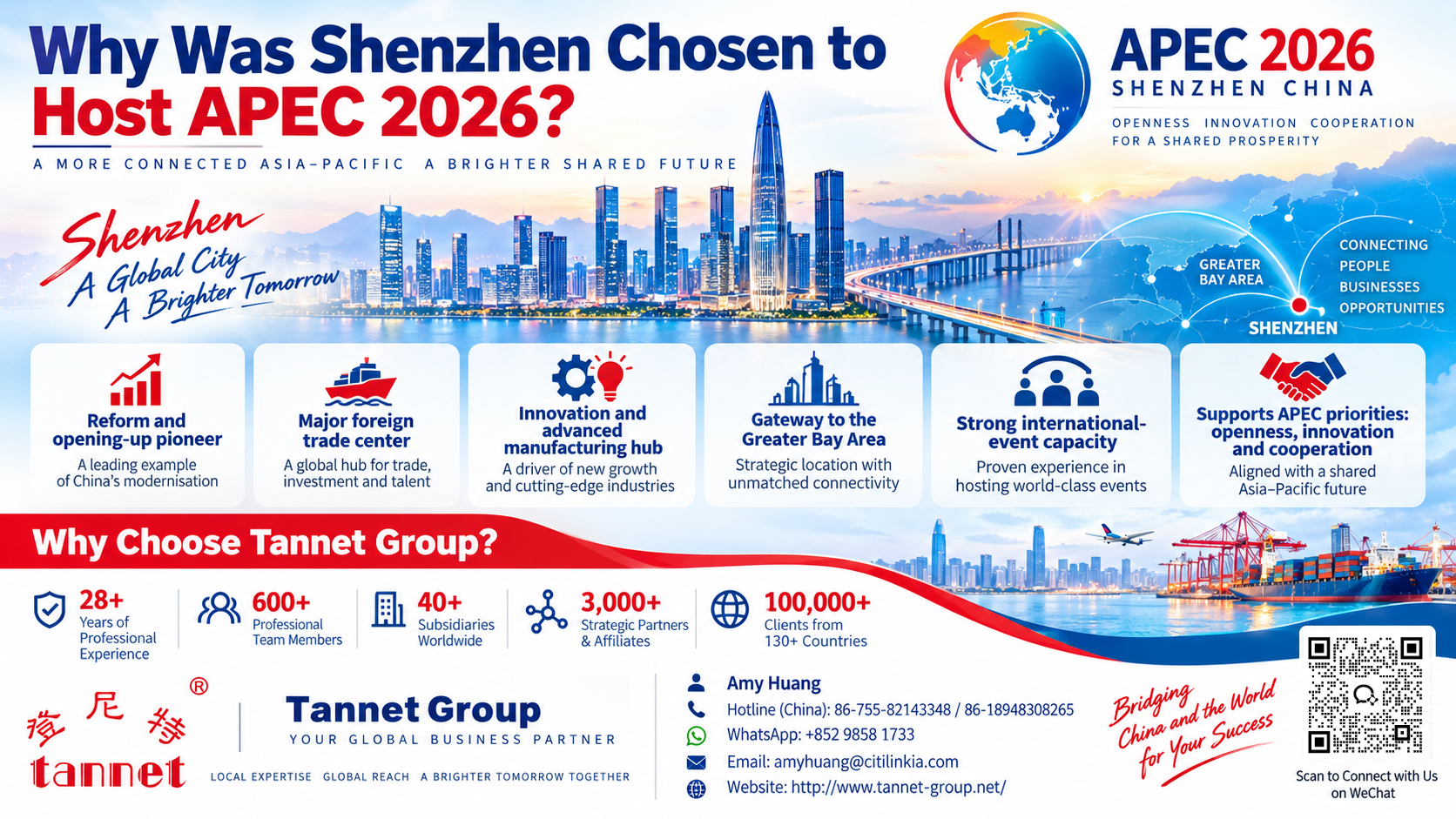
Shenzhen was chosen to host the 2026 APEC Economic Leaders’ Meeting because it is an official showcase of China’s reform and opening-up, a major foreign-trade center, an innovation hub, and a gateway within the Guangdong-Hong Kong-Macao Greater Bay Area.
This matters to policymakers, exporters, technology companies, manufacturers, investors, and professional advisers following Asia-Pacific cooperation. The main caution is that no public competitive scoring sheet has been released.
Official statements explain the policy logic, but businesses should not treat the city’s selection as an investment incentive, public-event invitation, regulatory approval, or guarantee of demand.
The official answer in brief
China announced in November 2025 that Shenzhen would host the 33rd APEC Economic Leaders’ Meeting in November 2026. The Ministry of Foreign Affairs was then asked directly about the consideration behind the host-city decision.
The ministry described Shenzhen as a pilot ground for reform and opening-up, a notable development achievement, and an important window for China’s mutually beneficial opening strategy. This is the clearest official explanation of the choice.
Later official statements added two related ideas. Shenzhen is a frontier of innovation in the Greater Bay Area. It is also a practical setting for the 2026 priorities of openness, innovation, and cooperation.
What is confirmed, and what is interpretation?
The host city, meeting dates, theme, and priorities are confirmed. The leaders’ meeting is scheduled for November 18–19, 2026. The theme is “Building an Asia-Pacific Community to Prosper Together.” China has identified openness, innovation, and cooperation as the three priorities.
Official sources cite Shenzhen’s reform history, trade scale, and innovation capacity. They publish no tender score or complete selection formula.
Therefore, any list of reasons should be framed as an evidence-based explanation drawn from official statements, not as a confidential record of the decision process.
Reason 1: Shenzhen represents reform and opening-up
Shenzhen became one of China’s first special economic zones in 1980. Its growth is closely associated with market-oriented experimentation, foreign investment, export development, entrepreneurship, and integration with international supply chains.
That history aligns directly with APEC’s economic purpose. APEC brings together 21 member economies to advance regional economic cooperation, trade, and shared prosperity. A host city identified with opening-up provides a clear policy narrative.
Reason 2: Shenzhen gives the openness priority measurable scale
Shenzhen is not presented only as a symbol. It operates at substantial economic scale. The APEC Secretariat reported that the city’s GDP rose from RMB270 million in 1980 to RMB3.68 trillion in 2024.
The same APEC release reported total trade of about RMB4.5 trillion in 2024. Shenzhen Government Online states that the city ranked first among mainland Chinese cities for foreign trade that year. Exports reached RMB2.81 trillion.
Those figures make trade facilitation, customs modernization, supply-chain connectivity, and services for international business tangible subjects rather than abstract summit language.
Reason 3: Shenzhen is a working innovation ecosystem
Innovation is one of the three official APEC 2026 priorities. Shenzhen offers a dense operating environment for electronics, telecommunications, electric vehicles, drones, software, digital services, advanced manufacturing, and emerging industries.
Shenzhen Government Online reports more than 25,000 state-level high-tech companies. It also reports 2024 research and development expenditure of RMB223.661 billion, equal to 6.46 percent of city GDP.
The point is not that every technology company succeeds in Shenzhen. The relevant point is that the city can support policy discussions with visible firms, supply chains, laboratories, manufacturing capacity, and commercialization experience.
Reason 4: The city connects innovation with manufacturing
Many cities are strong in research. Shenzhen is distinctive because product design, engineering, component sourcing, prototyping, manufacturing, logistics, and export channels can operate within one regional ecosystem.
That combination is relevant to APEC members seeking productivity growth and practical technology adoption. It helps connect discussion about artificial intelligence or digitalization with factories, ports, small businesses, and consumers.
Companies should still avoid copying a local model without analysis. Product regulation, intellectual property, cybersecurity, data transfers, employment, and sector access must be reviewed independently.
Reason 5: Shenzhen is a Greater Bay Area gateway
Shenzhen borders Hong Kong and sits within the Guangdong-Hong Kong-Macao Greater Bay Area. This gives the host city immediate links to an international financial center, major ports, airports, research institutions, and South China manufacturing networks.
In an official interview, the APEC Secretariat’s executive director described Shenzhen as a meeting point for physical, institutional, and people-to-people connectivity. He cited cross-border ferries and the region’s high-speed rail network.
For APEC, this supports the cooperation priority. For businesses, it encourages regional planning across Shenzhen, Hong Kong, and Guangzhou. It does not mean that one entity can perform every function without separate legal, tax, banking, and substance analysis.
Reason 6: Shenzhen has the capacity to receive an international meeting
A leaders’ meeting requires more than a compelling story. It needs air, rail, port, hotel, venue, security, communications, medical, translation, and protocol capacity.
Shenzhen Government Online reports 61.48 million airport passenger trips in 2024, container throughput of 33.399 million TEUs, and extensive domestic and cross-border transport connections. These indicators support the city’s operational suitability.
They do not prove that every visitor will experience unrestricted access. Leaders’ week may involve accreditation requirements, transport controls, venue restrictions, and schedule changes.
Reason 7: Shenzhen fits the story APEC wants to discuss
The 2026 agenda links openness with innovation and cooperation. Shenzhen combines all three in one location: international trade, technology-led growth, and regional connectivity.
Foreign Minister Wang Yi said China hopes to find practical answers in Shenzhen that produce broad consensus, clear priorities, and workable steps. That wording presents the city as a policy laboratory, not merely a backdrop.
The selection also helps move the conversation from declarations to implementation. Delegates can examine how infrastructure, enterprises, digital systems, and manufacturing networks interact in a large urban economy.
What the choice means for international businesses
The immediate effect is visibility. Shenzhen will receive more attention from governments, media, trade bodies, technology firms, and professional networks before and during the meeting.
The strategic effect is information. Companies can monitor discussions on trade, AI, digital rules, connectivity, sustainable growth, resilience, and small-business participation. These signals may influence future policy, but they are not binding law by themselves.
The practical response is disciplined preparation. A business should verify event access, define its China objective, test demand, review sector restrictions, and choose an operating structure based on real functions.
Common mistakes
- Claiming that Shenzhen won a published global competition when no official scoring process is public.
- Treating APEC priorities as immediate changes to Chinese investment or tax law.
- Assuming the leaders’ meeting is a public trade exhibition.
- Using the APEC name or logo in a way that suggests sponsorship or endorsement.
- Forming a Shenzhen or Hong Kong company before defining customers, contracts, staff, and management.
- Confusing increased city visibility with guaranteed demand or easier licensing.
Frequently asked questions
Q1. Did APEC itself publish a ranking that placed Shenzhen first?
No public ranking or scorecard has been identified. China selected Shenzhen as host city, and APEC members supported China’s 2026 host-year arrangements.
Q2. What is the strongest official reason for the choice?
China’s Foreign Ministry emphasizes Shenzhen’s role as a pilot ground and window for reform and opening-up. Innovation and Greater Bay Area connectivity reinforce that explanation.
Q3. When will the leaders’ meeting take place?
The 33rd APEC Economic Leaders’ Meeting is scheduled for November 18–19, 2026, in Shenzhen.
Q4. Can overseas companies attend?
Access depends on the event. Official meetings may require invitation or accreditation. Related commercial events can have separate organizers and rules.
Q5. Does hosting APEC create new tax incentives in Shenzhen?
Not automatically. Any incentive must have its own legal basis, eligibility conditions, authority, and effective period.
Q6. Should a foreign company register in Shenzhen because of APEC?
Only if Shenzhen fits the company’s customers, sector, staffing, supply chain, cost, and compliance needs. An event alone is not a sufficient reason.
Q7. How should Hong Kong fit into the plan?
Hong Kong may support international finance, contracting, holding, or regional management. The arrangement should reflect genuine functions and separate legal and tax requirements.
Conclusion
Shenzhen’s selection reflects a credible combination of reform history, trade scale, innovation capacity, regional connectivity, and international-event readiness. Tannet can assist overseas companies that need coordinated research, business-visit planning, company formation, tax registration, accounting, or corporate compliance across Shenzhen, Guangzhou, and Hong Kong. The appropriate scope should follow the company’s actual activities, ownership, and timetable.
Official Sources
Written by: Tannet Business Services Team
Reviewed by: Consultant Amy Huang
First published: 22 Sep. 2026
Last reviewed: 22 Sep. 2026
————————————————Simplifying Business, Empowering Entrepreneurs————————————————