Key Takeaway
A shell holding company is not automatically illegal or disqualified from tax treaty relief.
The risk arises when the entity claims tax advantages but cannot show commercial purpose, control over income, real decision-making, relevant functions, or reliable records. This matters most to foreign groups using Hong Kong, Singapore, or another jurisdiction to hold a China WFOE.
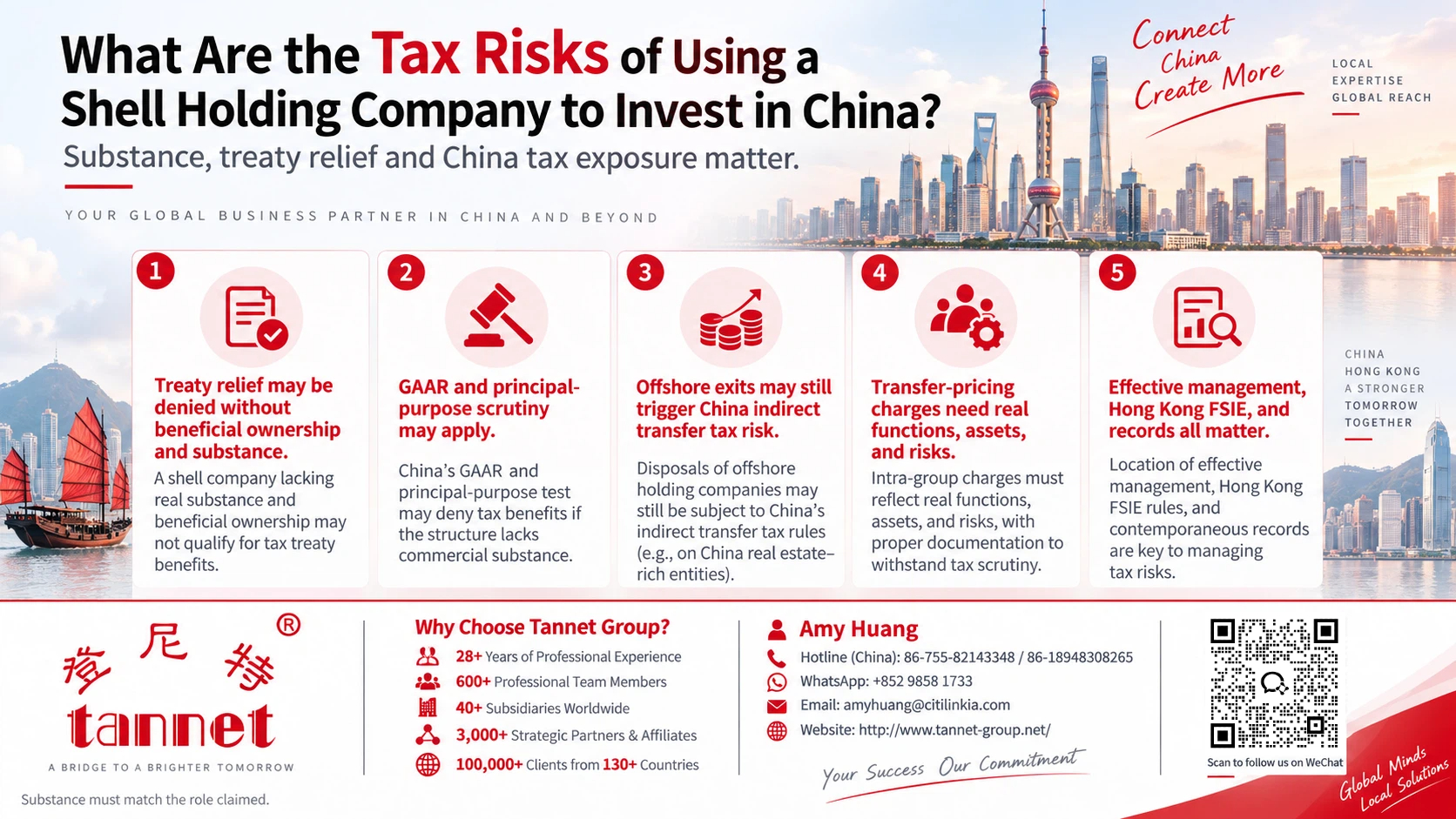
The main exposures are denial of a reduced withholding rate, anti-avoidance adjustment, taxation of an offshore share sale, transfer-pricing challenges, and penalties or late-payment consequences.
The critical point is substance in context. A holding company should be able to explain what it does, why it exists, who makes decisions, and how evidence supports each material transaction.
What a Shell Holding Company Means in This Context
“Shell company” is not a single statutory tax category. It usually describes an entity with legal ownership but little independent activity.
A passive holder can still serve governance, financing, co-investment, risk separation, or exit purposes. The key question is whether its functions, risks, authority, and records support its claimed role.
Risk One: Denial of Treaty Relief on China-Source Income
China taxes specified China-source income paid to non-residents. A treaty or the Mainland–Hong Kong tax arrangement may reduce the burden when all conditions are met.
Residence alone is insufficient. For dividends, interest, and royalties, the recipient may need to be the beneficial owner: the person owning and controlling the income or the underlying rights and property.
STA Announcement No. 9 of 2018 requires a facts-and-circumstances review. Adverse factors include an obligation to pass at least 50% of the income to a third-country resident within 12 months, activities that are not substantial, and low or exempt taxation of the income in the recipient’s jurisdiction.
Investment holding can be substantial when genuine management functions and risks exist. Registration, a bank account, and annual filings alone may not establish that role. Failure can mean domestic withholding, tax recovery, and follow-up review.
Risk Two: Principal Purpose and General Anti-Avoidance Challenges
Beneficial-owner status does not end the analysis. A principal purpose test or China’s general anti-avoidance rules may still apply.
Commercial purpose should be specific. Financing, investor governance, regional oversight, legal risk separation, or an acquisition pathway are clearer than “international expansion.” The explanation must match timely decisions, bank authority, budgets, contracts, and oversight.
Risk Three: China Tax on an Offshore Exit
A sale of an offshore holding company is not automatically outside China tax. STA Announcement No. 7 of 2015 permits recharacterization when an indirect transfer lacks reasonable commercial purpose and avoids enterprise income tax.
The STA considers several factors. These include how much of the offshore entity’s value, assets, and income come from China; the functions and risks of the offshore entity; the structure’s duration; foreign tax paid; and whether a direct transfer could have achieved a similar result.
Risk rises when the offshore entity is only a wrapper around the WFOE and has limited functions or risks. Listed-market transactions, qualifying treaty outcomes, and qualifying internal restructurings may be treated differently. Conditions should be reviewed before signing.
Risk Four: Transfer-Pricing Adjustments
A holding company may charge management fees, interest, royalties, or service fees. China’s related-party rules apply the arm’s-length principle. The WFOE should show value received and connect the charge to functions, assets, and risks.
A holding company with no capable personnel may struggle to support a management fee. A lender with no control over funding or credit risk may struggle to support its financing return. An entity that does not develop, enhance, maintain, protect, or exploit intellectual property may struggle to retain a royalty margin.
Possible outcomes include denied deductions, income adjustments, document requests, and delayed remittance reviews.
Risk Five: Tax Residence and Management Location
Foreign incorporation does not always settle tax residence. China may treat a foreign-incorporated enterprise as resident when effective management is in China and the statutory conditions are met.
Review where senior management makes decisions, controls finance and personnel, keeps records, and exercises authority. Board practice, bank mandates, accounting records, and actual behavior should align.
Risk Six: Hong Kong FSIE and Home-Jurisdiction Exposure
A Hong Kong holder also faces Hong Kong rules. Its FSIE regime can affect specified foreign-sourced dividends and disposal gains received in Hong Kong by an in-scope multinational group entity.
Economic substance, participation exemption, nexus, and anti-abuse conditions depend on the income and entity. A pure equity-holding entity may face reduced substance requirements, but it still needs to satisfy applicable registration, filing, and management conditions.
China treaty eligibility and Hong Kong FSIE status require separate tests. The ultimate owner’s residence-country rules may add another layer.
Evidence That Supports a Holding Company’s Position
Evidence should arise from real operations, not be assembled only when a payment or sale occurs.
Useful records commonly include:
- Written rationale for the holding location and legal chain.
- Board records showing informed approvals.
- Directors with knowledge and actual authority.
- Bank mandates and proof of cash control.
- Financials, budgets, filings, and expenses.
- Contracts and documented outsourcing.
- Investment, financing, and risk records.
- Residence certificates and treaty claim files.
There is no universal employee or office threshold for every holding company. The resources should be adequate for the functions claimed. A pure holding entity may need less operational capacity than a regional management company, but it still needs credible governance and records.
A Practical Review Before Money Moves
Step 1: Map Each Expected Income Stream
List dividends, interest, royalties, fees, and gains. Identify the parties, contract, tax rule, treaty article, and evidence.
Step 2: Define the Holding Company’s Real Role
State the decisions it will make and risks it will control. Use functions it can actually perform.
Step 3: Test Treaty Eligibility
Confirm residence, beneficial ownership, ownership, holding period, and anti-abuse conditions. Announcement No. 35 uses self-assessment and record retention, subject to follow-up review.
Step 4: Test the Exit
Model direct and offshore sales. Review Announcement No. 7 before the term sheet fixes structure, price, and reporting duties.
Step 5: Align Transfer Pricing
Confirm that related-party charges match real activity and provider capability. Set pricing and documentation before charges begin.
Step 6: Build an Annual Evidence File
Maintain the structure chart, residence certificate, board and bank records, agreements, financials, and functional analysis. Update them after material changes.
Common Mistakes
- Treating a Hong Kong business registration certificate as proof of beneficial ownership.
- Routing dividends through the holding company under an automatic onward-payment arrangement.
- Using nominee directors who do not review information or control decisions.
- Charging management fees without deliverables, capable personnel, or an allocation method.
- Waiting until an exit to review China’s indirect transfer rule.
- Using identical board minutes for every transaction and year.
- Assuming outsourced administration alone creates commercial substance.
- Reviewing China tax while ignoring Hong Kong FSIE and the owner’s home-country rules.
Frequently Asked Questions
Q1. Is a Hong Kong company with no employees automatically denied treaty benefits?
No. There is no automatic rule that every holding company must employ staff. The STA examines all facts, including functions, risks, authority, expenditure, outsourcing, and control over income. The resources must be adequate for the role claimed.
Q2. Is a tax residence certificate enough to obtain a reduced dividend withholding rate?
No. It proves residence for treaty procedures, but it does not by itself prove beneficial ownership, principal purpose, ownership conditions, or holding period requirements.
Q3. Can the holding company distribute the dividend immediately?
It can make a genuine distribution decision. However, a legal or factual obligation to pass a substantial portion onward soon after receipt is an adverse beneficial-owner factor. The surrounding agreements and cash control matter.
Q4. Can directors live outside Hong Kong?
Corporate law may permit it, but tax substance is factual. Directors should receive information, evaluate material matters, and exercise authority. The location of effective management also requires separate review.
Q5. Will China tax an offshore sale of the holding company?
It may. Announcement No. 7 can apply when the transaction indirectly transfers China taxable property through an arrangement without reasonable commercial purpose. The asset, income, function, risk, and foreign-tax profile are relevant.
Q6. Can substance be created after receiving a tax enquiry?
Missing documents may sometimes be supplemented, but later paperwork cannot reliably replace earlier conduct. Contemporaneous decisions and operational evidence are more persuasive.
Q7. Does using a service provider solve the substance issue?
It can support administration and specified functions. The holding company must still retain oversight, make relevant decisions, and document what was outsourced, by whom, and at whose cost.
Q8. Should every China WFOE have an overseas holding company?
No. A direct individual or corporate shareholder may be simpler for some owners. A holding company is more relevant when governance, financing, co-investment, regional expansion, succession, or a future exit justifies the added cost and compliance.
When Tannet Can Assist
Tannet can assist groups that need to compare direct and holding-company structures, establish or maintain a Hong Kong entity, coordinate company secretarial work, accounting, tax filings, capital changes, and transaction records, or prepare an operational document workflow. Treaty, anti-avoidance, valuation, and dispute positions should also be reviewed with qualified tax and legal advisers in the relevant jurisdictions.
Sources
Written by: Tannet Business Services Team
Reviewed by: Consultant Amy Huang
First published: 10 Sep. 2026
Last reviewed: 10 Sep. 2026
————————————————Simplifying Business, Empowering Entrepreneurs————————————————