Key Takeaway
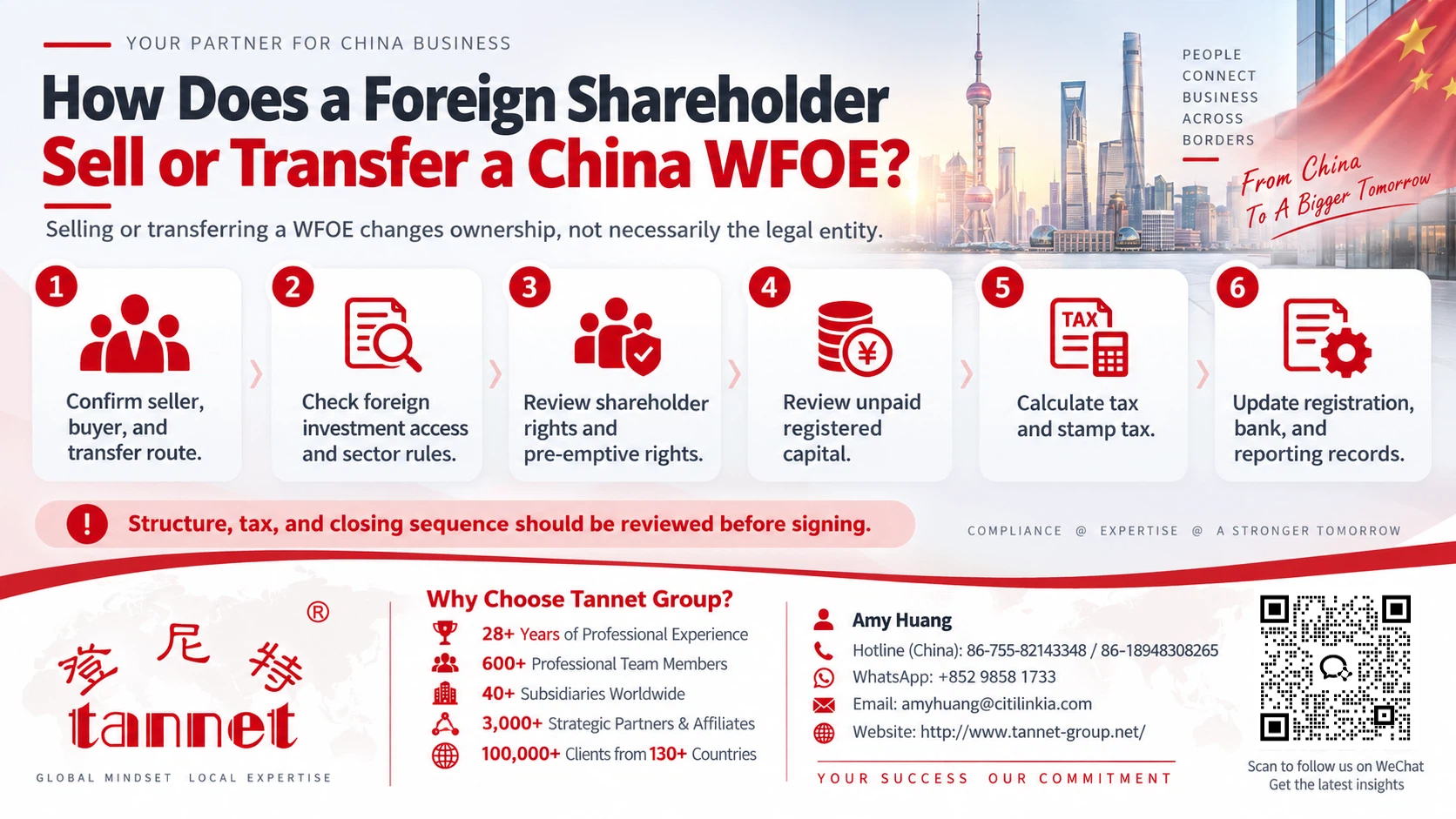
A foreign shareholder normally exits a China WFOE by transferring its equity interest to another eligible investor.
The WFOE remains the same Chinese legal entity, but its shareholder register, articles, market registration, foreign investment information, tax records, bank information, and sector licences may need updating. This route suits investors selling all or part of an operating company without liquidating it.
The main cautions are other shareholders’ pre-emptive rights, unpaid registered capital, foreign investment access limits, tax withholding, valuation support, and payment remittance.
Direct transfers and offshore holding-company sales follow different rules. Review the structure before signing, because the buyer, price, payment route, and closing sequence affect both tax and registration.
What Is Being Transferred
WFOE remains common business shorthand for a wholly foreign-owned enterprise. Under China’s Foreign Investment Law, the entity is a foreign-invested enterprise governed mainly by the Company Law and other generally applicable rules.
A direct equity transfer changes the registered shareholder of the Chinese company. The WFOE keeps its unified social credit code, assets, employees, contracts, tax history, and liabilities unless a contract or law produces a separate change.
An offshore transfer is different. The seller transfers shares in an overseas holding company while the WFOE’s immediate shareholder remains unchanged. China’s indirect transfer and anti-avoidance rules may still apply.
Step 1: Confirm the Seller Buyer and Transfer Route
Identify whether the seller and buyer are foreign enterprises, foreign individuals, Chinese enterprises, or Chinese individuals. Their status affects tax, foreign exchange, document authentication, and investment access.
Confirm whether the deal is a direct WFOE equity transfer, an offshore holding-company sale, an intragroup reorganisation, a gift, or an exit through capital reduction. These routes are not interchangeable.
Step 2: Check Foreign Investment Access and Regulatory Conditions
The buyer must be eligible to hold the equity. Article 28 of the Foreign Investment Law requires foreign investors to comply with the foreign investment negative list.
The 2024 national negative list took effect on 1 November 2024. Activities outside it generally receive national treatment, but sector rules still apply.
Merger control or national security review may apply where the statutory tests are met.
Review operating permits for change-of-control clauses. Regulated activities may have separate investor or approval requirements.
Step 3: Deal with Existing Shareholder Rights
For a single-shareholder WFOE, there is no other shareholder exercising a pre-emptive right. For a multi-shareholder limited liability company, Article 84 of the 2023 revised Company Law is important.
A shareholder transferring equity to a third party must notify the other shareholders in writing of the amount, price, payment method, and deadline. Other shareholders have a pre-emptive right on the same conditions and generally have 30 days to exercise it after receiving notice.
The articles of association may set different transfer arrangements. Joint venture agreements may also contain consent rights, rights of first offer, tag-along rights, drag-along rights, or transfer restrictions.
Step 4: Review Unpaid Registered Capital
The buyer should verify the subscribed capital, paid-in capital, contribution deadline, and any defective contribution. A transfer does not automatically erase capital obligations.
Under Article 88 of the revised Company Law, the transferee generally assumes an undued capital contribution obligation. If it later fails to contribute on time, the transferor may bear supplementary liability.
Where a contribution is already overdue or materially deficient, the transferor and transferee may face joint liability, subject to the statutory knowledge exception. The share purchase agreement should allocate the economic risk, but contractual allocation does not necessarily remove statutory exposure to the company or creditors.
Step 5: Complete Legal Financial and Tax Due Diligence
The buyer should review the business licence, articles, shareholder register, capital evidence, licences, contracts, employment, tax filings, customs, foreign exchange, litigation, intellectual property, data compliance, and related-party balances.
The records should support the price. Tax authorities may question a non-arm’s-length or unreasonably low price, especially between related parties. A valuation may be prudent for complex or regulated assets.
Step 6: Calculate and Arrange the Taxes
Equity in a Chinese enterprise is China-situs property for enterprise income tax sourcing. A non-resident enterprise without a relevant China establishment is generally taxed on the gain, calculated as transfer proceeds minus the net value or tax basis of the equity.
The domestic enterprise income tax rate commonly applied to that gain is 10%. A tax treaty may change the result, but the seller must test the treaty’s capital-gains article and complete the applicable claim procedure.
The payer is generally the withholding agent under Article 37 of the Enterprise Income Tax Law. Tax is withheld when payment is made or becomes due. If withholding is not completed, the non-resident seller can retain a direct payment obligation.
A foreign individual seller follows China’s individual income tax rules rather than the enterprise income tax rules. The taxable gain, rate, payer obligations, and treaty position should be reviewed separately.
The equity transfer instrument is generally subject to China stamp tax as a property-rights transfer document. The Stamp Tax Law applies tax separately to parties executing the taxable instrument. Confirm the current rate, basis, filing location, and any restructuring relief for the actual facts.
Step 7: Sign a Transaction Document That Matches the Process
The agreement should identify the interest, price, currency, payment route, tax allocation, conditions, completion documents, warranties, and indemnities.
Conditions may include shareholder waivers, regulatory clearance, tax filing, change registration, bank acceptance, and third-party consent.
Define when economic risk transfers and when the buyer may exercise shareholder rights. Article 86 of the revised Company Law links the exercise of shareholder rights against the company to entry in the shareholder register.
Step 8: Update Corporate and Government Records
After the required conditions are satisfied, the company should update its shareholder register, cancel the seller’s capital contribution certificate, issue a new certificate, and amend the articles or relevant records.
The WFOE must apply to the market regulation authority for registrable changes. The filing set varies by locality and transaction.
Foreign investment information is reported through the enterprise registration and enterprise credit information systems.
Changes to management, beneficial-owner, licence, customs, tax, or bank records require separate updates where applicable.
Step 9: Settle the Price and Repatriate Proceeds
Payment mechanics depend on the parties and transfer route. Confirm the account, currency, timing, and evidence with the handling bank before signing.
Article 21 of the Foreign Investment Law protects lawful outward transfer of capital gains and asset-disposal income. The bank may review the agreement, registration, tax position, identities, and funds source.
Do not assume the purchase price can be remitted immediately after contract signature. Align tax withholding, registration, bank review, and completion conditions in a workable sequence.
Common Mistakes
- Treating a share transfer as a simple business licence amendment.
- Signing before checking the negative list and sector licence conditions.
- Ignoring pre-emptive rights in the articles or shareholder agreement.
- Failing to review unpaid or defective registered capital.
- Using a nominal price without valuation or commercial support.
- Assuming an offshore payment removes China tax obligations.
- Leaving tax withholding and filing responsibility unclear in the agreement.
- Updating market registration but not the bank, licences, customs, tax, or beneficial owner records.
Frequently Asked Questions
Q1: Can a foreign shareholder sell a WFOE to another foreign company
Yes, if the buyer is eligible under the negative list and sector rules. Corporate approvals, tax, registration, reporting, and payment requirements still apply.
Q2: Does the WFOE need to close and reopen
Normally no. A direct equity transfer changes ownership of the existing entity. Its liabilities and operating history remain with it.
Q3: Do other shareholders have to approve the buyer
The revised Company Law generally uses written notice and a pre-emptive right rather than a default majority-consent rule. The articles and shareholders’ agreement may impose different conditions.
Q4: Who pays China tax on the gain
The seller is the taxpayer. For a non-resident enterprise seller, the payer generally acts as withholding agent. The agreement should allocate filing, cooperation, and recovery obligations clearly.
Q5: Is the tax charged on the full sale price
Enterprise income tax generally applies to the gain, not the full proceeds. The gain is the consideration less the supported net value or tax basis of the equity.
Q6: Can the parties use a one-dollar transfer price
Only when the price is commercially supportable. Tax authorities may adjust an unreasonably low price, particularly in related-party transactions.
Q7: Can the sale price be paid outside China
It may be possible in some cross-border structures, but offshore settlement does not remove China tax, corporate registration, or reporting requirements. Confirm the route with tax, legal, and banking advisers.
Q8: How long does a WFOE share transfer take
There is no single national timeline. Timing depends on diligence, shareholder rights, approvals, tax review, document authentication, local registration practice, and the bank’s payment review.
When Tannet Can Assist
Tannet can assist when a foreign shareholder needs a preliminary structure comparison, company record review, WFOE registration change coordination, foreign investment information reporting support, tax and accounting document preparation, or cross-border payment document workflow. Transaction-specific legal opinions, valuations, tax treaty claims, merger control, and security review should be handled or confirmed by qualified professionals in the relevant jurisdictions.
Sources
Written by: Tannet Business Services Team
Reviewed by: Consultant Amy Huang
First published: 10 Sep. 2026
Last reviewed: 10 Sep. 2026
————————————————Simplifying Business, Empowering Entrepreneurs————————————————