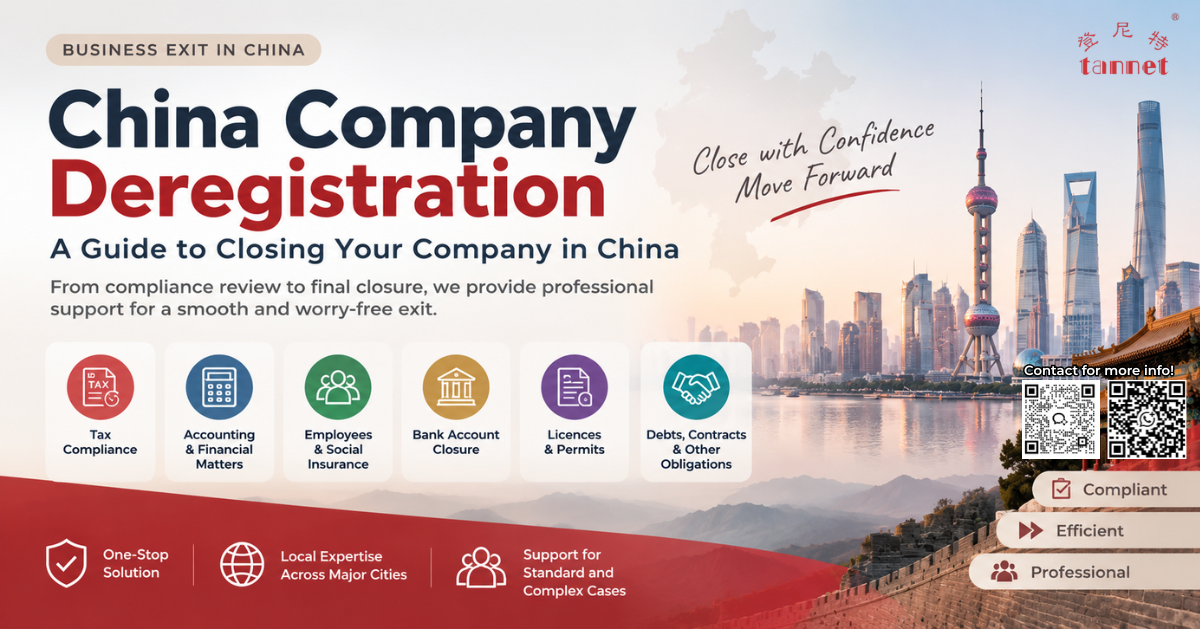
Where a Chinese company ceases operation or its shareholders decide not to continue the business, formal company deregistration constitutes a key component of the market exit procedure.
Simply ceasing business activities will not automatically discharge a company’s legal and compliance liabilities. Even an inactive company remains subject to obligations covering tax returns, annual filings, accounting records, employment & social insurance, bank accounts, licences and other regulatory requirements.
Leaving a dormant company unresolved may create additional compliance issues and make the eventual closure process more complicated.
China company deregistration provides a formal process for winding up the company’s affairs and bringing its legal and administrative obligations to an appropriate conclusion. Before starting, however, the company’s registration, tax, financial and compliance status should first be reviewed to determine the appropriate deregistration procedure.
When Should a China Company Be Deregistered?
Company deregistration may be considered when:
The company has stopped operating with no plans to resume business.
The original business plan or investment strategy has changed.
Shareholders intend to restructure or consolidate their China operations.
The entity is no longer required within the group’s corporate structure.
The shareholders are preparing to exit the China market.
Before proceeding, it is advisable to review the company’s existing tax, accounting, registration and compliance position. Any unresolved matters may need to be handled before deregistration can be completed.
Why Deregister an Inactive China Company?
Keeping an inactive company registered may continue to generate administrative and compliance responsibilities even when there is little or no business activity.
Formal deregistration can help a company:
- Properly terminate its legal existence.
- Conclude ongoing tax and reporting obligations.
- Identify and resolve outstanding compliance matters.
- Simplify its corporate structure.
- Complete a more orderly market exit or restructuring.
For this reason, shareholders should generally avoid simply abandoning an inactive company without first assessing its compliance status and available closure options.
What Should Be Checked Before China Company Deregistration?
Company closure may involve several different areas rather than only cancellation of the business registration.
Tax Compliance
Outstanding tax filings, taxes, invoices and other tax-related matters should be reviewed. Historical tax issues may need to be resolved before the relevant deregistration procedures can proceed.
Accounting and Financial Matters
The company should review its accounting records together with its assets, liabilities, receivables and payables. Outstanding financial matters may need to be settled or appropriately handled as part of the closure process.
Employees and Social Insurance
Where employees remain with the company, employment arrangements and related social insurance matters should be properly addressed before closure.
Bank Accounts
The company’s RMB, foreign currency, capital and other corporate bank accounts should be reviewed and closed where required as part of the deregistration process.
Licences and Permits
Companies operating in regulated industries may hold additional licences, approvals or permits that require separate cancellation or handling.
Debts, Contracts and Other Obligations
Outstanding debts, contracts, disputes and other obligations should also be identified before the company is formally closed.
Simplified vs. Standard Company Deregistration in China
Not every company follows exactly the same deregistration procedure.
Companies with relatively straightforward operating histories and clear compliance records may be eligible for a simplified deregistration procedure, subject to the applicable requirements.
Companies with more complicated circumstances may require additional procedures. These may include companies with:
- Outstanding tax matters.
- Abnormal registration status.
- Existing employees.
- Outstanding debts or contractual obligations.
- Historical accounting or compliance issues.
- Other unresolved corporate matters.
A preliminary assessment is therefore useful before starting the deregistration process. It can help determine which procedure is appropriate and identify issues that should be resolved in advance.
Tannet China Company Deregistration Services
Tannet provides professional support to foreign-invested and other companies that need to close or deregister their entities in China.
Our services cover both straightforward deregistration cases and more complicated situations involving historical compliance issues or other corporate matters.
Depending on the circumstances of the company, our services may include:
- Company deregistration assessment.
- Tax compliance review and tax deregistration.
- Liquidation support.
- Business registration deregistration.
- Corporate bank account closure.
- Employee-related matters.
- Licence and permit cancellation.
- Corporate document handling.
- Accounting and related compliance services.
Rather than treating deregistration as a single administrative filing, Tannet can coordinate the relevant corporate, tax, accounting and compliance procedures based on the company’s specific circumstances.
China Company Deregistration Services Across Major Cities
Tannet has an extensive service network across major Chinese business centres, including Shenzhen, Guangzhou, Shanghai, Beijing, Dongguan, Chengdu, Nanchang, Yiwu, Quanzhou, Xiamen, Hainan and other locations.
Through our local service network, we support companies registered across China with coordinated corporate, tax and compliance services.
Whether your company has stopped operating, is undergoing restructuring or is preparing to exit the China market, Tannet can first assess its existing status and determine an appropriate deregistration approach.
Closing a Company in China Requires More Than Cancelling a Business Licence
China company deregistration is not simply a matter of cancelling a business licence.
Depending on the company’s circumstances, tax, accounting, banking, employment, licensing, contractual and other compliance matters may need to be addressed before the entity can be properly closed.
A structured review at the beginning of the process can help identify outstanding issues early and establish a clearer path towards deregistration.
From company establishment and ongoing operations to restructuring and business exit, Tannet provides coordinated corporate services throughout the China business lifecycle, supported by local expertise across major Chinese cities.
Contact Us
Tannet Group Limited is in its sixth five-year development plan stage, and setting the upcoming two five-year plans. Tannet has been always devoted to providing with business solutions for investors all across the world. Should you have further inquiry, pls feel free to contact Tannet at 86-755-82148419, 13823131503,email to susiehu@citilinkia.com, visit our website https://tannet-group.net/.