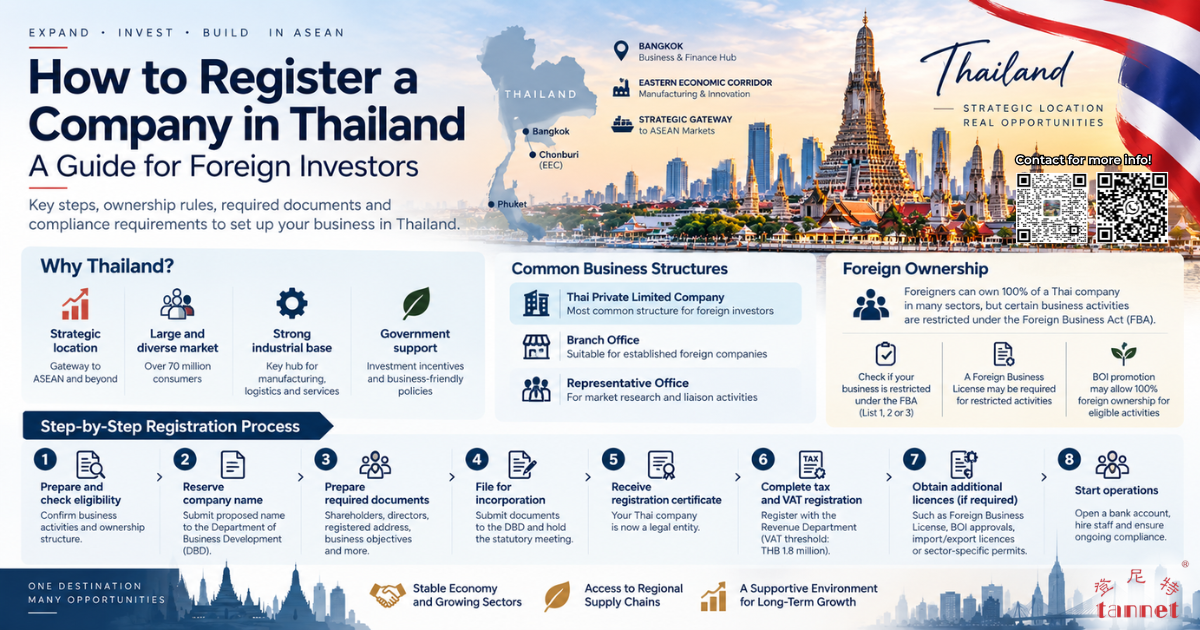
Thailand is one of Southeast Asia’s major business and manufacturing hubs, offering access to regional supply chains, established industrial infrastructure and a large domestic market. For foreign investors looking to enter Thailand, setting up a local company can provide a legal structure for conducting business, hiring employees, entering contracts and developing long-term operations.
However, Thailand company registration involves an important consideration that investors should address before incorporation: foreign ownership restrictions. Whether a foreign investor can own 100% of a Thai company depends largely on the proposed business activities and applicable regulations.
This guide explains how to register a company in Thailand, including the basic requirements, registration process and key issues foreign investors should consider.
1. Choose the Appropriate Company Structure
One of the most commonly used structures for doing business in Thailand is a Thai Private Limited Company.
A private limited company is a separate legal entity with shareholders and directors. Liability of shareholders is generally limited to the unpaid amount, if any, on their shares.
Foreign companies may also consider other structures, such as a branch office or representative office, depending on their activities and commercial objectives.
Before proceeding with incorporation, investors should determine which structure is appropriate for their intended operations.
2. Determine the Foreign Ownership Structure
Foreign ownership is one of the most important issues when registering a company in Thailand.
Under Thailand’s Foreign Business Act (FBA), a company may be regarded as foreign where foreigners hold 50% or more of its capital. Certain business activities are restricted for foreign businesses.
This does not mean that foreigners are universally limited to 49% ownership in every Thai company.
Depending on the activity, a company may be permitted to have majority or 100% foreign ownership. Businesses operating in restricted sectors, however, may need a Foreign Business License (FBL), Foreign Business Certificate or another form of authorization before commencing operations.
Companies receiving promotion from Thailand’s Board of Investment (BOI) may also qualify for foreign ownership privileges for eligible promoted activities.
Investors should therefore confirm their business classification before deciding the final shareholding structure.
3. Reserve the Company Name
The next step is to select and reserve a company name.
The proposed name must comply with the requirements of Thailand’s Department of Business Development (DBD) and should not duplicate or closely resemble an existing registered company name.
It is advisable to prepare alternative names in case the preferred option cannot be approved.
Once the company name is accepted, the incorporation documents can be prepared using the approved name.
4. Prepare the Company Information
Investors will need to establish the key particulars of the company before registration.
These normally include:
- Approved company name
- Registered office address in Thailand
- Business objectives
- Share capital and shareholding structure
- Shareholder information
- Director information
- Authorized director or signatory arrangements
Foreign individual shareholders and directors will generally need to provide identification documents such as passports. Where a shareholder is a foreign corporate entity, additional corporate documents may be required.
The documentation required can vary depending on the ownership structure and proposed business.
5. Prepare the Incorporation Documents
The company’s constitutional and registration documents must then be prepared.
For a Thai private limited company, this includes the Memorandum of Association, which contains important information such as the company name, registered capital and business objectives.
The company must also establish its shareholders, directors, registered office and other corporate particulars required for incorporation.
At least 25% of the subscribed share value payable in money must generally be paid during the incorporation process.
6. Register the Company with the DBD
The incorporation application is submitted to Thailand’s Department of Business Development under the Ministry of Commerce.
For companies located outside Bangkok, registration documents may be submitted to the relevant Provincial Business Development Office.
Once the application and supporting documents have been accepted, the company becomes a registered Thai legal entity.
Registration of the company itself does not necessarily mean that it can immediately conduct every stated activity. Businesses subject to the Foreign Business Act or sector-specific regulations may need additional authorization before commencing those activities.
7. Complete Tax and VAT Registration
After incorporation, the company must address its Thai tax obligations.
Companies liable for corporate income tax must obtain the appropriate taxpayer registration with Thailand’s Revenue Department.
VAT registration is particularly important for operating businesses. A person or entity regularly supplying goods or services in Thailand with annual turnover exceeding THB 1.8 million is generally required to register for VAT.
According to Thailand’s Revenue Department, businesses exceeding the threshold generally need to apply for VAT registration within 30 days after turnover exceeds THB 1.8 million.
Certain activities may be exempt from VAT or subject to different tax treatment, so the actual obligations should be assessed based on the company’s activities.
8. Obtain Business Licences and Other Approvals
Some companies will need additional licences before starting operations.
Depending on the business, these may include a Foreign Business License or Certificate, BOI-related approvals, factory licences, import/export registrations or other sector-specific permits.
Companies planning to employ foreign personnel should also consider immigration, work permit and employment requirements separately from company incorporation.
Key Considerations Before Registering a Company in Thailand
Foreign investors should avoid choosing a shareholding structure simply to complete company registration quickly. The actual business activity should first be reviewed against Thailand’s foreign investment regulations.
The use of nominee Thai shareholders to circumvent foreign ownership restrictions can create serious legal and compliance risks.
Investors should therefore determine the intended activities, ownership structure, required licences and operational location before filing the incorporation application.
Conclusion
Registering a company in Thailand can provide foreign investors with access to one of Southeast Asia’s most established business environments. However, Thailand company incorporation involves more than registering a legal entity.
Foreign ownership restrictions, the Foreign Business Act, BOI eligibility, taxation and sector-specific licensing can significantly affect how a business should be structured.
For foreign investors, the most important step is to confirm whether the intended business activity allows the proposed foreign ownership structure before proceeding with company registration. This can help avoid restructuring, licensing delays and compliance problems after incorporation.
📞 Free 1-on-1 Consultation Now,
Official Service Hotline: +86-755-82148419
Cell: +86-13823131503;+60 19-309 2363
WeChat ID: 13823131503;
WhatsApp:+86-13823131503;+60 19-309 2363
Email: mytannet08@gmail.com; susiehu@citilinkia.com