Indonesia is one of Southeast Asia’s largest markets and an important destination for foreign companies looking to expand into manufacturing, trading, digital services, consumer markets and other growing sectors.
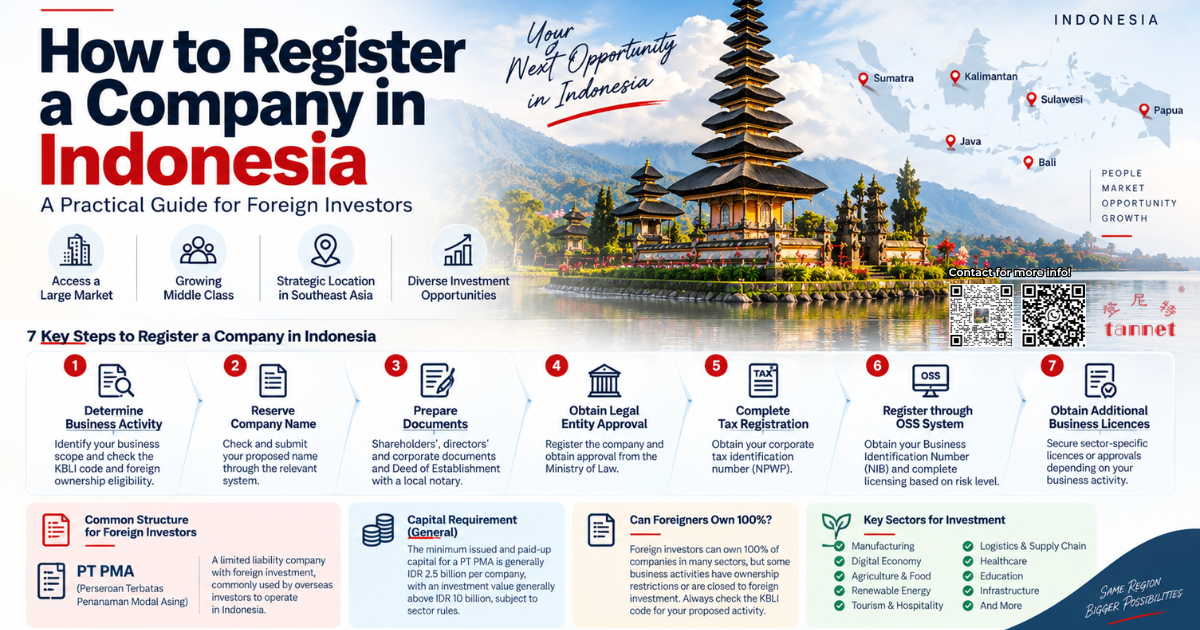
For most foreign investors planning to establish a local operating company, the standard structure is a PT PMA (Perseroan Terbatas Penanaman Modal Asing), which is an Indonesian limited liability company with foreign investment.
However, company registration in Indonesia involves more than establishing a legal entity. Investors must also select the correct business classification, confirm foreign ownership restrictions and obtain the appropriate licences through Indonesia’s risk-based licensing system.
1. What Is a PT PMA in Indonesia?
A PT PMA is a limited liability company established under Indonesian law that has foreign shareholding.
Foreign shareholders may be individuals or overseas corporate entities. Once foreign ownership is introduced into an Indonesian PT, the company is generally treated as a foreign investment company.
A PT PMA can conduct commercial activities in Indonesia, employ staff, enter into contracts, generate local revenue and apply for business licences according to its approved activities.
For foreign investors intending to operate directly in the Indonesian market, a PT PMA is therefore one of the most commonly used structures.
2. Can Foreigners Own 100% of an Indonesian Company?
Foreign investors can own 100% of companies in many Indonesian business sectors, but this does not apply universally.
Before incorporation, investors should check whether their proposed business activity is:
- Fully open to foreign investment
- Subject to foreign ownership limitations
- Reserved for Indonesian businesses
- Subject to additional sector-specific requirements
This makes the selection of the correct business activity particularly important.
Indonesia classifies business activities according to the KBLI (Klasifikasi Baku Lapangan Usaha Indonesia) system. The selected KBLI code affects foreign ownership eligibility, investment requirements, risk classification and the licences the company may need.
Investors should therefore confirm the correct KBLI classification before finalising the company structure.
3. What Are the Main Requirements to Register a PT PMA?
A foreign-invested company will generally need at least:
- Two shareholders
- At least one director
- At least one commissioner
- A registered company address in Indonesia
- Approved company name
- Defined business activities and KBLI codes
- Deed of Establishment and Articles of Association
- Beneficial ownership information
- Required investment and capital commitments
Shareholders may generally be foreign individuals, foreign legal entities or a combination of eligible investors, subject to the rules applying to the selected sector.
Foreign corporate shareholders will normally need to provide their corporate registration and supporting documents.
4. What Is the Capital Requirement for a PT PMA?
Foreign investors should distinguish between investment value and paid-up capital.
Under Indonesia’s current foreign investment framework, a PT PMA is generally considered a large-scale business. The investment value is generally required to exceed IDR 10 billion, excluding land and buildings, per business field and project location, although the calculation can differ for certain sectors.
Under the updated investment regulations, the general minimum issued and paid-up capital requirement for a PT PMA is IDR 2.5 billion per limited liability company, unless other laws or sector-specific regulations provide otherwise.
Because capital and investment requirements can vary according to the business activity, investors should confirm the requirements applicable to their selected KBLI before incorporation.
5. How to Register a Company in Indonesia
Step 1: Determine the Business Activity
The first step is to identify what the company will actually do in Indonesia.
The proposed activities should then be matched with the appropriate KBLI codes. This determines whether foreign investment is permitted and what licences may subsequently be required.
Step 2: Reserve the Company Name
The proposed company name must comply with Indonesian naming requirements and be submitted through the relevant company administration system.
It is advisable to prepare alternative names in case the preferred name is unavailable or rejected.
Step 3: Prepare the Deed of Establishment
A local notary prepares the company’s Deed of Establishment, including its Articles of Association.
The document normally records important information such as the shareholders, directors, commissioner, capital structure, registered address and business purposes.
Step 4: Obtain Legal Entity Approval
The incorporation application is submitted electronically through Indonesia’s Legal Entity Administration System.
Once approved by the Ministry of Law, the company obtains legal entity status and the relevant ministerial approval.
Step 5: Complete Tax Registration
The company must complete the relevant Indonesian tax registration requirements and obtain its corporate tax identification details.
Additional tax obligations may apply depending on the company’s activities, revenue and transactions.
Step 6: Register Through the OSS System
After establishing the legal entity, the company proceeds with business licensing through Indonesia’s Online Single Submission (OSS) system.
The company obtains a Business Identification Number (NIB – Nomor Induk Berusaha), which acts as an important business identity for operating in Indonesia.
Step 7: Obtain Additional Business Licences
Indonesia operates a risk-based business licensing system.
Business activities are classified according to their level of risk. Depending on the activity, obtaining an NIB alone may not be sufficient.
Medium- and high-risk activities may require additional certificates, standards, approvals or sector-specific business licences before commercial operations can begin.
6. What Documents Are Usually Required?
The exact documents depend on whether the shareholders are individuals or companies.
Foreign individual shareholders will generally need passport and personal information.
Foreign corporate shareholders may need documents such as:
- Certificate of incorporation
- Articles or constitutional documents
- Registered company information
- Details of authorised representatives
- Shareholder and beneficial owner information
Foreign documents may also require translation, notarisation, legalisation or other authentication depending on their origin and intended use.
7. Common Mistakes Foreign Investors Should Avoid
One of the biggest mistakes is registering the company before confirming the correct KBLI code.
Choosing an unsuitable business classification can create problems later when applying for licences or conducting the intended activities.
Foreign investors should also avoid assuming that incorporation automatically gives the company permission to conduct every commercial activity.
Company establishment and business licensing are related but separate processes.
The company must ensure that its registered activities, foreign ownership structure, OSS registration and operational licences are aligned before commencing regulated activities.
Conclusion
Registering a company in Indonesia can provide foreign investors with direct access to one of Southeast Asia’s largest economies, but successful market entry requires more than establishing a legal entity.
For most foreign investors, the PT PMA is the primary structure for conducting business locally. Before registration, investors should carefully confirm their KBLI classification, foreign ownership eligibility, investment requirements and licensing obligations.
A properly structured PT PMA, combined with the correct NIB and risk-based business licences, provides a stronger foundation for long-term operations and expansion in Indonesia.
Official and high-credibility sources
- Indonesia Ministry of Law – Directorate General of General Legal Administration (AHU)
AHU – Limited Liability Company Registration
- Indonesia OSS – Online Single Submission
OSS Indonesia
- Ministry of Investment and Downstream Industry / BKPM
Invest Indonesia / BKPM
- BKPM Regulation No. 5 of 2025
📞 Free 1-on-1 Consultation Now,
Official Service Hotline: +86-755-82148419
Cell: +86-13823131503;+60 19-309 2363
WeChat ID: 13823131503;
WhatsApp:+86-13823131503;+60 19-309 2363
Email: mytannet08@gmail.com; susiehu@citilinkia.com