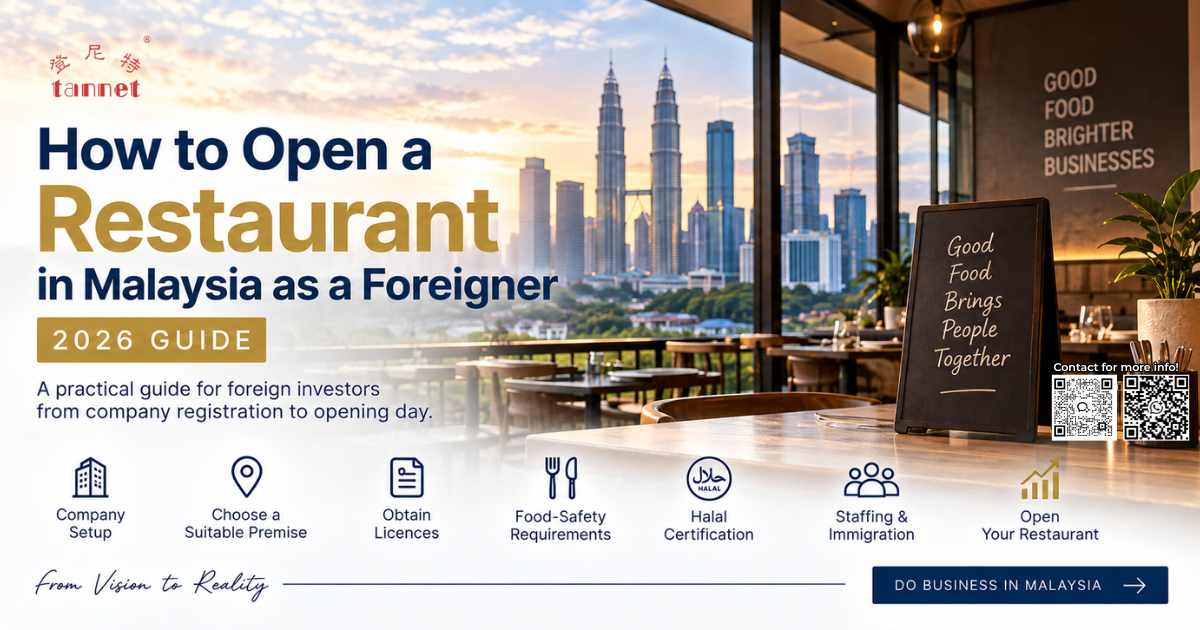
Malaysia’s diverse food culture, tourism market and large urban consumer base make the country an attractive destination for foreign F&B investors. However, opening a restaurant in Malaysia involves more than simply registering a company and renting a shop.
Foreign investors need to consider the company structure, premises, local authority licensing, food-safety requirements and immigration matters before commencing operations.
Here is a practical overview of how to open a restaurant in Malaysia as a foreigner.
- Register a Company in Malaysia
Foreign investors commonly establish a private limited company (Sdn. Bhd.) to operate a restaurant.
Under Malaysia’s Companies Act, a private company generally requires at least one director who ordinarily resides in Malaysia, a registered office and a qualified company secretary.
Foreigners can hold shares in Malaysian companies, but company ownership and permission to conduct a particular business activity are separate matters.
For foreign-owned businesses operating in sectors covered by Malaysia’s distributive trade framework, the applicable requirements should be reviewed based on the proposed restaurant concept, ownership structure and activities.
This should ideally be assessed before committing significant capital to the business.
- Find a Suitable Restaurant Premise
Choosing the right premises is one of the most important steps.
A commercial unit being available for rent does not automatically mean it is suitable for restaurant operations.
Before signing a long-term tenancy agreement, investors should check matters such as:
- Approved use of the premises
- Local zoning requirements
- Kitchen and food-preparation areas
- Ventilation and exhaust systems
- Grease traps and drainage
- Waste disposal
- Fire-safety requirements
- Signboard restrictions
Requirements vary between local authorities. A restaurant in Kuala Lumpur, for example, will be subject to the relevant requirements of Dewan Bandaraya Kuala Lumpur (DBKL).
Checking the premises first can prevent costly situations where renovation has started but the location cannot satisfy licensing requirements.
- Apply for Restaurant and Premise Licences
Registering a company with the Companies Commission of Malaysia (SSM) does not itself authorise the company to start operating a restaurant.
Restaurant businesses generally need approvals from the relevant local authority.
Depending on the location and business concept, these may include a business or premise licence, food-establishment approval and signboard or advertisement licence.
Additional approvals may be required for certain activities, such as selling alcoholic beverages, providing entertainment or carrying out substantial renovations.
Because licensing is handled locally, the exact requirements can differ between Kuala Lumpur, Petaling Jaya, Penang, Johor Bahru and other municipalities.
- Meet Food Handler Requirements
Restaurants must also comply with Malaysia’s food-safety requirements.
Food handlers are generally required to attend recognised Food Handler Training and meet applicable health requirements, including anti-typhoid vaccination requirements.
Local authorities may also inspect the restaurant’s kitchen, food-storage areas, cleanliness, drainage, waste management and other facilities.
These requirements should be included in the restaurant’s pre-opening schedule rather than addressed only when an inspection takes place.
- Consider Halal Certification
Not every restaurant licence is the same as Halal certification.
Malaysia has a formal Halal certification framework administered by JAKIM and the relevant state religious authorities. Restaurants seeking official Malaysian Halal certification must comply with the applicable standards concerning ingredients, suppliers, preparation, storage and operating procedures.
If Halal certification is important to the restaurant’s target market, it should be considered early because it may affect supplier selection, kitchen design and internal procedures.
- Plan Immigration and Staffing
Foreign ownership of a Malaysian company does not automatically give a shareholder or director permission to work in Malaysia.
If a foreign owner intends to actively work in or manage the restaurant, the appropriate immigration permission should be considered separately.
The same applies when the restaurant plans to employ foreign managers, chefs or workers. Employment of foreign personnel is subject to Malaysia’s prevailing immigration and manpower requirements.
What Is the Recommended Setup Process?
A practical sequence for a foreign restaurant investor is:
Business concept & ownership assessment → Company incorporation → Premise selection → Licensing → Renovation & compliance → Food handler requirements → Staffing & immigration → Opening
One of the most common mistakes is treating company registration as the final approval to operate.
For restaurant businesses, incorporation, premises approval, licensing and immigration are separate compliance areas.
Planning to Open a Restaurant in Malaysia?
Foreign investors should review the complete setup route before signing a tenancy agreement or investing heavily in renovations.
TANNET Malaysia assists foreign investors with Malaysia company incorporation, company secretarial services, registered address, licensing coordination, accounting and tax compliance, and other business setup requirements.
Planning your corporate structure and operational requirements together can help create a smoother route from company registration to restaurant opening.
Official and Credible Sources
- Companies Commission of Malaysia (SSM)
SSM Malaysia
- Ministry of Domestic Trade and Cost of Living (KPDN)
KPDN Malaysia
- Ministry of Health Malaysia (MOH)
MOH Food Safety and Quality Programme
- Dewan Bandaraya Kuala Lumpur (DBKL)
DBKL Licensing and Business Development Department
- Department of Islamic Development Malaysia (JAKIM)
JAKIM Halal Management Division
📞 Free 1-on-1 Consultation Now,
Official Service Hotline: +86-755-82148419
Cell: +86-13823131503;+60 19-309 2363
WeChat ID: 13823131503;
WhatsApp:+86-13823131503;+60 19-309 2363
Email: mytannet08@gmail.com; susiehu@citilinkia.com