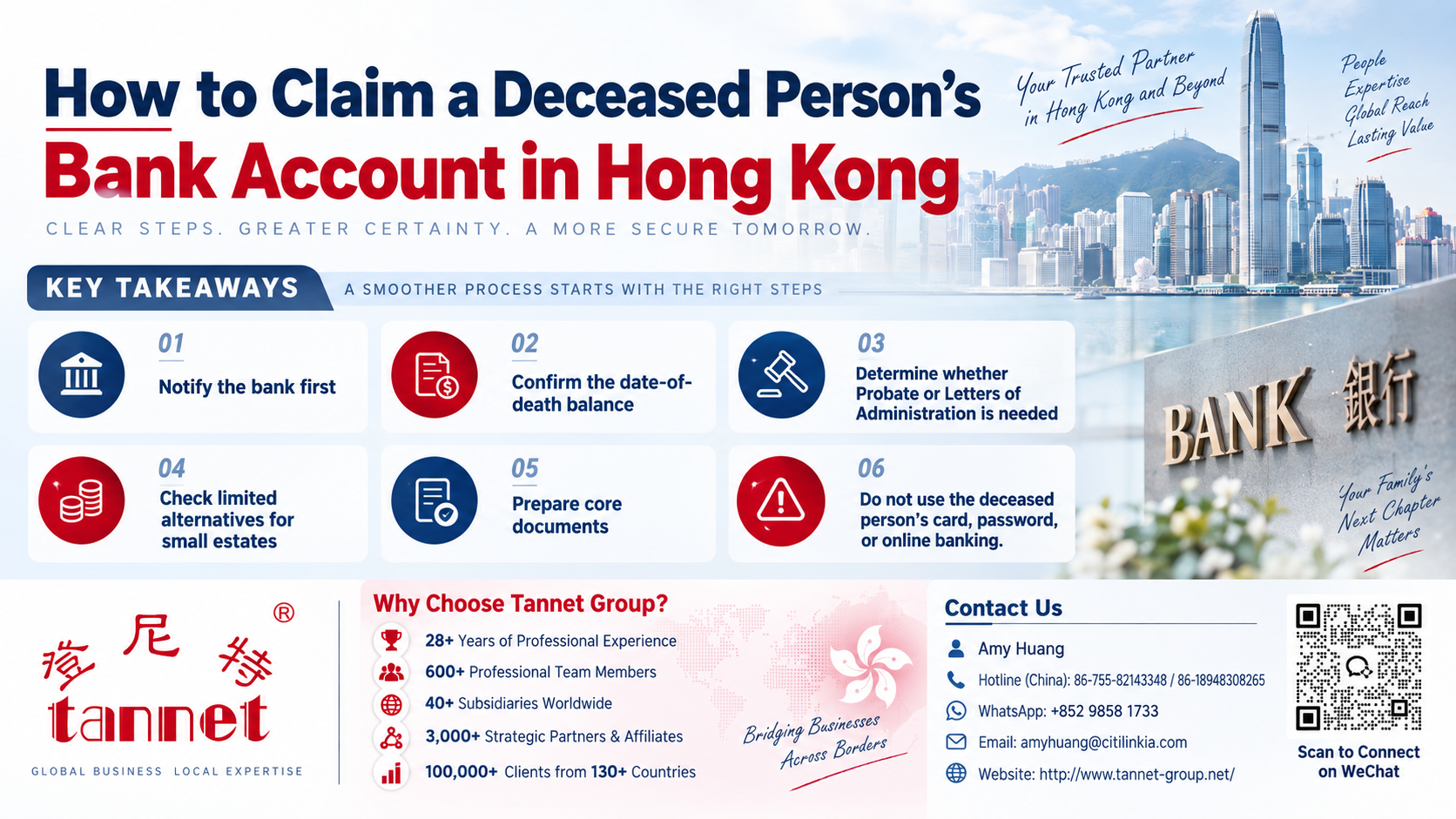
Key Takeaway
To claim money from a deceased person’s Hong Kong bank account, the person dealing with the estate normally needs legal authority, usually a Grant of Probate or Letters of Administration.
The process suits executors, administrators, beneficiaries, and overseas families handling Hong Kong assets.
First notify the bank, identify every account and date-of-death balance, confirm whether a valid will exists, and select the correct grant route.
Limited alternatives may apply to money-only estates not exceeding HK$50,000, qualifying estates for summary administration, or urgent funeral expenses. The main caution is simple: relationship to the deceased does not by itself authorize withdrawal, transfer, or account closure.
Why the bank normally freezes the account
A bank that learns of a customer’s death will normally restrict transactions on an account held solely by that customer. Existing cards, online credentials, standing instructions, and powers of attorney should not be used as if the customer were alive.
The restriction protects the estate and the bank. Money must be released to a person with lawful authority, not merely to the closest relative or the person holding the passbook.
A power of attorney generally ends when the donor dies. A beneficiary under a will also does not become an executor simply because the beneficiary expects to receive the money.
Step 1 Notify the bank and request estate instructions
Contact each bank through its official bereavement or branch channel. Provide the deceased person’s name, identity details, date of death, and account information that is already available.
Ask the bank for its current deceased-account checklist. Requirements differ between banks and may differ between deposits, securities, safe deposit boxes, loans, and jointly held products.
Do not send passwords or use the deceased person’s mobile banking. Preserve statements, letters, cheque books, passbooks, and evidence of liabilities for the estate records.
Step 2 Confirm the date-of-death balance
The estate schedule must identify Hong Kong assets and liabilities. Cash at bank should be recorded with the relevant account and balance as at the date of death.
The Hong Kong Monetary Authority and Hong Kong Association of Banks issued guidance in April 2025 on handling cash at bank of deceased account holders. The change was intended to reduce repeated grant amendments caused by post-death balance movements.
Ask the bank which balance confirmation and transaction information it will provide for the grant application. Keep written responses because interest, fees, refunds, or later credits can change the live balance.
Step 3 Decide whether a grant is required
A Grant of Probate usually applies where the deceased left a valid will naming an executor who can act. The executor applies to the Probate Registry and later presents the grant to the bank.
Letters of Administration usually apply where there is no valid will. The court appoints an administrator according to the legal priority rules.
Letters of Administration with Will Annexed may apply where a valid will exists but no executor was appointed, or no executor is able or willing to act.
The Hong Kong Judiciary states that a grant covers the Hong Kong estate only. A Hong Kong grant does not automatically authorize dealings with bank accounts in Mainland China, Macau, or another jurisdiction.
Step 4 Check whether a limited alternative applies
For deaths on or after 11 February 2006, the Home Affairs Department may issue a Confirmation Notice for a narrowly defined small estate. The estate must consist wholly of money in Hong Kong not exceeding HK$50,000 in aggregate, with no non-money property or debts.
A Confirmation Notice is not a grant of representation. The bank retains discretion over whether to release the money stated in the notice.
The Judiciary also explains that the Official Administrator may summarily administer a qualifying estate not exceeding HK$150,000 that consists of cash, money in sole-name bank accounts, and/or Mandatory Provident Fund benefits. Commission applies.
For urgent funeral costs, the Home Affairs Department has a separate application for a certificate supporting release of money to the funeral service supplier. The application must be made before payment to the supplier.
These routes have different conditions. Do not assume a low account balance automatically removes the need for a grant.
Step 5 Prepare the core documents
The bank and Probate Registry may request different evidence. A practical file commonly includes the death certificate, the original will and codicils where applicable, the applicant’s identity and address evidence, and the eventual grant.
An intestacy application may require marriage, birth, death, or renunciation evidence to establish the applicant’s priority. The estate schedule should include all Hong Kong assets and liabilities, not only the account being claimed.
The bank may also require its own indemnity, instruction, account-closure, tax-residency, or payment forms. Ask whether certified copies or originals are required and whether an appointment is necessary.
Foreign public documents may need authentication. Documents not in Chinese or English require translation. The Judiciary advises completing authentication on the original foreign public document before translation when both are needed.
Step 6 Apply for the correct authority
Personal applicants may apply for a grant, but the Probate Registry provides procedural assistance rather than legal advice. The applicant remains responsible for choosing and completing the correct specified forms.
The Judiciary says a simple and straightforward application usually takes about five to seven weeks after all legal requirements and requisitions have been satisfied. Complicated estates take longer.
Overseas residence does not always prevent an application. A person residing outside Hong Kong who is entitled to the grant may apply through a lawfully constituted attorney, subject to the applicable requirements.
Step 7 Present the authority and give payment instructions
After the grant is issued, contact the bank again. Provide the sealed grant or other document required by the bank, personal representative identification, and signed payment or closure instructions.
The bank may conduct verification, settle account charges or liabilities, sell or transfer investments under separate instructions, and pay the authorized recipient. Timing therefore varies by institution and product.
Estate money should be kept separate from personal money. The personal representative must collect assets, pay valid debts and liabilities, distribute the net estate under the will or intestacy law, and keep a true inventory and account.
Special cases that need separate review
Joint accounts require review of the mandate, beneficial ownership, survivorship position, and bank requirements. Do not assume that the entire balance belongs either to the survivor or to the estate.
Accounts containing securities, foreign currency deposits, structured products, or pledged assets may require additional documents and valuation. A safe deposit box follows inspection and inventory procedures before its contents can be dealt with.
If the deceased died before 11 February 2006, estate duty clearance papers may still be required. The modern small-estate procedures should not be applied without checking the date of death.
Common mistakes
- Withdrawing money using the deceased person’s card, password, or online banking.
- Assuming a spouse, child, or beneficiary automatically has authority.
- Asking the bank to close the account before identifying debts and other estate assets.
- Applying for Probate without checking the executor clause in the latest will.
- Treating the HK$50,000 Confirmation Notice as a general probate exemption.
- Omitting post-death credits, bank fees, loans, or investment products from the estate review.
- Filing overseas certificates without required authentication or translation.
Frequently asked questions
Q1 Can the spouse withdraw money immediately
Not merely because of marriage. The spouse needs appropriate authority unless a valid limited procedure or the terms of a joint account apply.
Q2 Does every bank require the original grant
Banks set their operational requirements. Ask whether the sealed original, a court-certified copy, or another accepted form is required.
Q3 Can funeral expenses be paid before probate
A separate Home Affairs Department procedure may support payment to a funeral service supplier. Check the conditions before the bill is paid.
Q4 What if the account balance is below HK$50,000
The Confirmation Notice route may apply only if the whole qualifying Hong Kong estate is money within the limit and the other conditions are met.
Q5 Can an overseas executor claim the account
Potentially. The Judiciary permits an entitled overseas resident to apply through a lawfully constituted attorney, subject to current requirements.
Q6 Does a Hong Kong grant cover a Shenzhen account
No. The Hong Kong Probate Registry’s jurisdiction covers Hong Kong estate. Mainland assets follow Mainland procedures.
Q7 What if money arrives after the grant
Tell the bank and check whether the grant schedule or estate record needs amendment. The answer depends on the asset description and current procedure.
When professional coordination is useful
Before contacting an institution, record who spoke to whom, the date, the documents requested, and the next deadline. Banks may operate different teams for deposits, investments, mortgages, and safe deposit boxes. A written contact log helps the personal representative reconcile instructions, respond to later questions, and demonstrate why each estate payment or transfer was made.
Tannet can assist with preliminary estate and bank-account mapping, document checklists, Hong Kong company-record review, overseas document coordination, and liaison planning with banks and qualified legal or tax advisers.
Independent Hong Kong legal advice is appropriate where authority is disputed, the estate is insolvent, joint ownership is unclear, beneficiaries are minors, domicile is complex, or assets span several jurisdictions.
Sources: Hong Kong Judiciary Probate Registry; Home Affairs Department Estate Beneficiaries Support Services;
Hong Kong Monetary Authority Banking Regulatory Document Repository
Written by: Tannet Business Services Team
Reviewed by: Consultant Amy Huang
First published: 17 Sep. 2026
Last reviewed: 17 Sep. 2026
————————————————Simplifying Business, Empowering Entrepreneurs————————————————