Key Takeaway
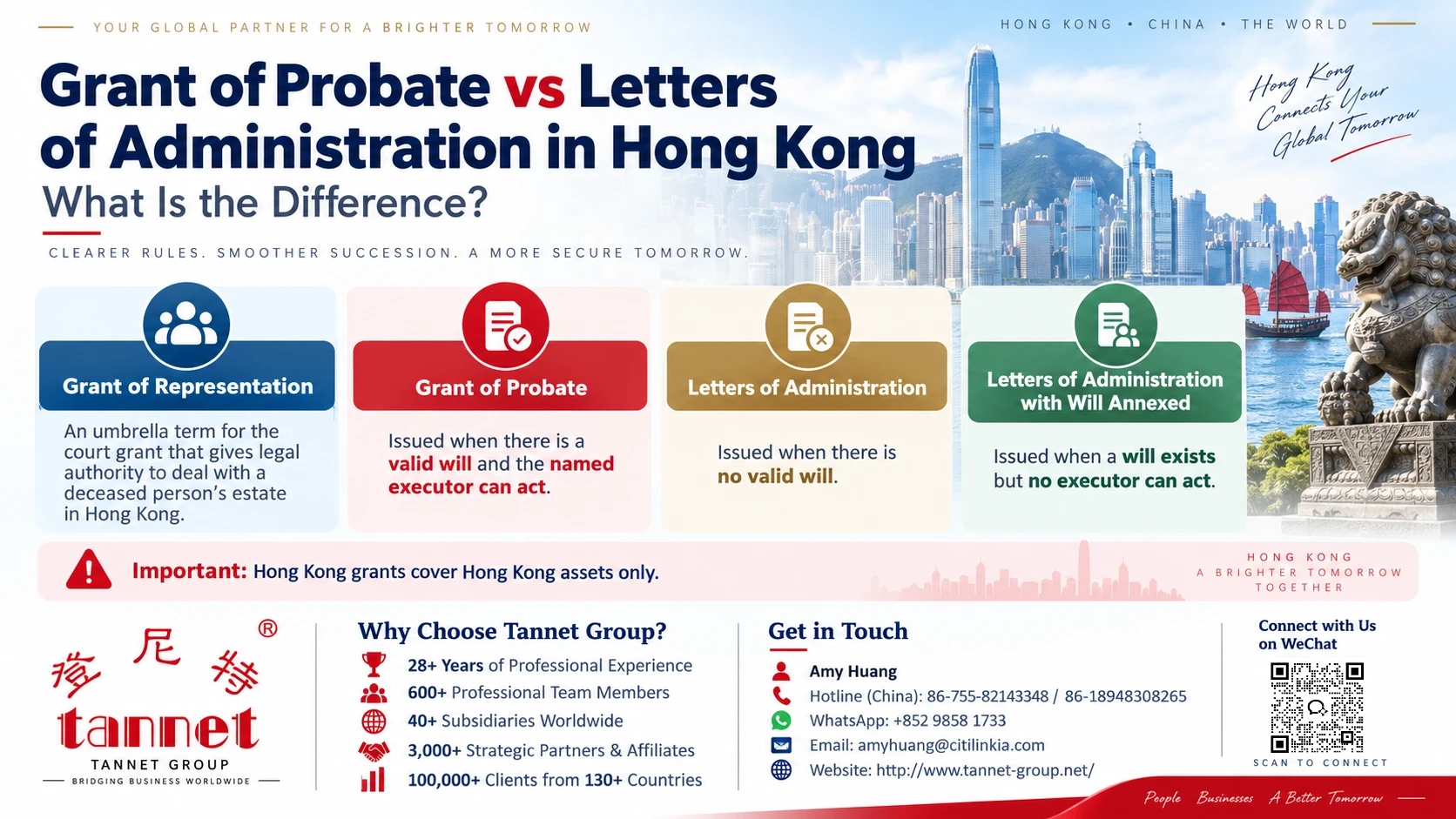
In Hong Kong, a Grant of Probate and Letters of Administration are both court orders that allow someone to deal with a deceased person’s Hong Kong estate.
The correct route depends mainly on whether there is a valid will and whether an executor can act. Probate normally applies where a will names an executor who is willing and able to apply.
Letters of Administration normally apply where there is no valid will.
A third route, Letters of Administration with Will Annexed, applies when a will exists but no executor can act.
The most important point is to identify the will and the applicant’s legal entitlement before collecting or distributing assets.
The umbrella term: grant of representation
Hong Kong’s Probate Registry uses the word “Grant” as an umbrella term. It includes Grant of Probate, Letters of Administration, and Letters of Administration with Will Annexed.
Each grant gives authority to administer the deceased’s Hong Kong estate. It does not itself decide every ownership dispute, validate informal family arrangements, or transfer overseas assets.
The Probate Registry states that Hong Kong probate jurisdiction covers Hong Kong assets only. Assets in the Mainland, Macau, or another country must be handled under the law and procedures of the place where those assets are located.
What is a Grant of Probate?
A Grant of Probate is a court order authorising one or more executors to administer the estate according to the directions in a will. An executor is the person named in the will to carry out that role.
This is usually the route where all three facts are present: a valid will exists, it appoints an executor, and that executor is able and willing to act.
The executor’s job does not end with receiving the grant. The executor must collect estate assets, pay debts and liabilities, distribute the net estate under the will, and prepare a proper inventory and account.
What are Letters of Administration?
Letters of Administration are a court order authorising one or more administrators to administer the estate in accordance with the law. This is the usual route where the deceased left no valid will.
The estate is then intestate. Distribution follows the applicable intestacy rules rather than personal family preferences or a verbal understanding.
The person who applies is called an administrator, not an executor. The title matters because the source of authority differs: an executor is named by a will; an administrator is appointed through the legal process.
Who can apply when there is no will?
The Probate Registry summarises the priority in straightforward intestacy cases as: spouse first, then child or children, then father and/or mother, then brother and/or sister.
This is a priority to apply, not a guarantee that one family member may exclude others. A lower-priority applicant may need evidence that higher-priority persons have died or renounced their right to the grant.
The detailed order and entitlement are governed by the Non-Contentious Probate Rules and the facts of the estate. Complex family structures, minors, foreign domicile, or disputes require careful review.
The frequently missed third route: Letters of Administration with Will Annexed
A will does not automatically mean the application is for Grant of Probate. This is one of the most common sources of confusion.
Letters of Administration with Will Annexed may be needed when a will exists but no executor is appointed, or no executor is able or willing to act. For example, the sole executor may have died, lacks capacity, declines the role, or has formally renounced it.
The court then appoints an administrator. The administrator’s authority comes from the grant, but the estate is still administered according to the will.
The core differences in plain English
The first difference is the presence of a will. Probate normally starts with a will. Ordinary Letters of Administration normally start with no valid will. Will-annexed administration starts with a will but without an acting executor.
The second difference is who applies. A named executor normally applies for Probate. A person entitled under the statutory priority normally applies for Letters of Administration. In a will-annexed case, the applicant is an administrator selected under the relevant priority rules.
The third difference is how the estate is distributed. Probate and will-annexed administration follow the will. Ordinary Letters of Administration follow the intestacy law.
The fourth difference is the evidence needed. Every application needs reliable evidence of death, assets, liabilities, identity, relationship and entitlement. The exact forms and supporting documents vary with the route.
How to identify the correct route before filing
Use this sequence before selecting a form or approaching institutions.
- Locate every will and codicil. Do not rely on a photocopy, an unsigned draft, or a family description of what the deceased “wanted.”
- Identify every executor named in the latest valid will. Check whether each person is alive, has capacity, is willing to act, and can be contacted.
- List Hong Kong assets and liabilities. Include bank accounts, securities, property, company interests, MPF, insurance, loans, tax liabilities and safe deposit boxes.
- Confirm whether the deceased was domiciled in Hong Kong. Domicile can affect the law governing entitlement to the grant and distribution.
- Check whether the estate is contested. An effective caveat stops the Registry from issuing a grant without notice to the caveator.
- Check for limited small-estate options. They are separate from a grant and are not a general substitute for probate.
The application and evidence burden
Applicants must use the appropriate specified forms and provide documents proving entitlement. The Probate Registry stresses that the primary obligation to choose and complete the correct forms rests with the applicant.
Foreign public documents may need authentication. Documents not in Chinese or English need translation. The Registry explains that authentication should be completed on the original document before translation where translation is required.
What happens after the grant is issued?
The grant permits administration. It is not the final distribution itself.
The personal representative should collect assets, settle valid debts and liabilities, distribute the net estate according to the will or applicable law, and maintain a true inventory and account.
Do not distribute too early simply because beneficiaries agree. Unknown liabilities, tax issues, missing assets, or competing claims can change the position.
Small estate procedures are not the same as a grant
All beneficially owned Hong Kong property must be money not exceeding HK$50,000 in aggregate. The estate must not include non-money assets or debts. The applicant must be the executor or the person entitled in priority to administer.
The Confirmation Notice is not a replacement for a grant of representation. A bank may still decide whether to release money. Do not assume this option applies merely because a bank balance appears modest.
Common mistakes
- Assuming every will leads to Grant of Probate and overlooking Letters of Administration with Will Annexed.
- Filing an intestacy application before checking for a later will or codicil.
- Using family consensus to bypass the statutory priority for a grant.
- Listing only bank accounts and omitting liabilities, securities, company interests, MPF, property, or safe deposit boxes.
- Including Mainland, Macau, or other overseas assets in a Hong Kong probate inventory without checking the separate local process.
- Filing foreign certificates without required authentication or translation.
- Distributing funds before debts, taxes, and proper estate records are addressed.
Frequently asked questions
Q1. Is a Grant of Probate always needed if there is a will?
No. A qualifying small-estate route may apply in limited circumstances, and institutions may have their own requirements. Where a court grant is needed, a will may lead to Probate or to Letters of Administration with Will Annexed, depending on the executor position.
Q2. My parent left a will but named no executor. What grant is needed?
This commonly points to Letters of Administration with Will Annexed. The court must still determine who is entitled to apply under the relevant rules and the will.
Q3. Can all siblings sign a letter so one sibling can use the deceased’s bank account?
Family consent does not by itself give legal authority to administer an estate. The bank and the Probate Registry may require the appropriate grant or another authorised route.
Q4. Who applies if someone dies without a will in Hong Kong?
In straightforward cases, the Registry lists priority beginning with spouse, then children, then parents, then siblings. The detailed result can differ on the facts.
Q5. Can an executor living overseas apply?
The Probate Registry states that a person residing outside Hong Kong who is entitled to the grant may apply through a lawfully constituted attorney. Check current formalities before proceeding.
Q6. Does a Hong Kong grant cover assets in Mainland China?
No. The Probate Registry says its jurisdiction covers Hong Kong estate only. Mainland assets need to be handled under Mainland law and local procedures.
Q7. Can an administrator change the gifts in a will?
No. In a will-annexed case, the administrator administers according to the will. In an intestacy case, the administrator distributes according to applicable law.
When professional coordination is useful
Tannet can assist families and business owners with early estate information gathering, Hong Kong asset and document checklists, cross-border document coordination, company-record review, and liaison planning with appropriate legal and tax professionals.
Where a will is disputed, the estate is insolvent, the deceased had complex domicile issues, minor beneficiaries, foreign documents, or assets across multiple jurisdictions, independent Hong Kong legal advice should be obtained before filing or distributing assets.
Sources: Hong Kong Judiciary, Probate Registry; Hong Kong Home Affairs Department, Administration of Small Estates;
Probate and Administration Ordinance (Cap. 10); Intestates’ Estates Ordinance (Cap. 73)
Written by: Tannet Business Services Team
Reviewed by: Consultant Amy Huang
First published: 17 Sep. 2026
Last reviewed: 17 Sep. 2026
————————————————Simplifying Business, Empowering Entrepreneurs————————————————