Key Takeaway
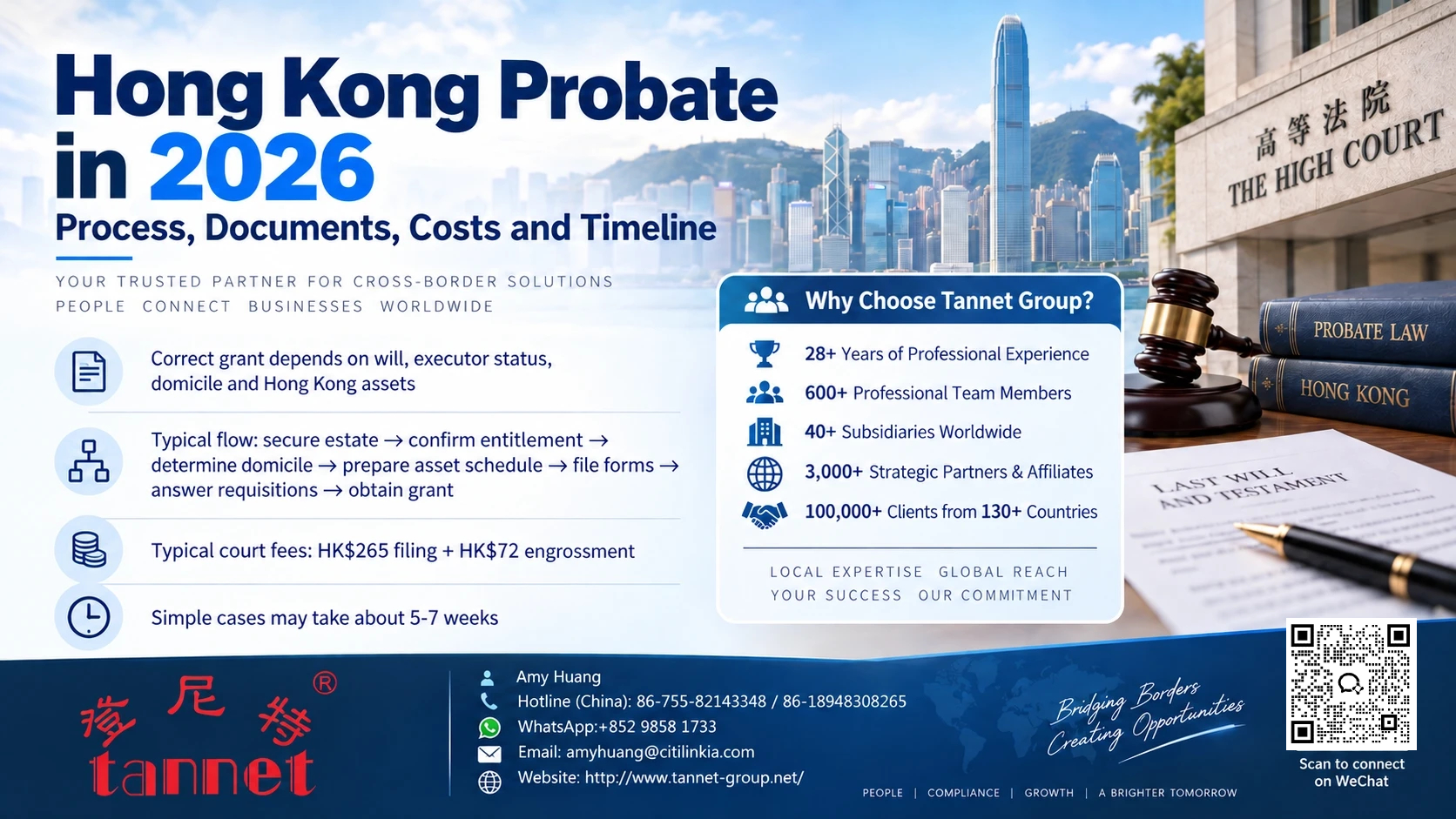
Applying for probate in Hong Kong means asking the High Court’s Probate Registry for authority to administer assets located in Hong Kong. The correct grant depends on whether there is a valid will and who is entitled to apply.
This guide is for executors, administrators, beneficiaries, and overseas families dealing with Hong Kong bank accounts, property, securities, company shares, or MPF benefits.
The main caution is to establish domicile, applicant priority, and complete asset evidence before filing. Incomplete forms, unauthenticated foreign records, or an incorrect grant route commonly lead to court requisitions and longer processing.
What a Hong Kong Grant Does
A grant of representation is the court document that gives a personal representative authority to administer the Hong Kong estate. It is often required before a bank, company, broker, or land-related institution will accept instructions concerning a deceased owner’s assets.
The Hong Kong Judiciary defines three main outcomes. Probate is issued to an executor named in a will. Letters of Administration apply when there is no valid will. Letters of Administration with Will Annexed apply when a will exists but no executor can or will act.
Hong Kong probate jurisdiction concerns assets in Hong Kong. Assets elsewhere follow the law and procedure of the place where they are situated. A Hong Kong grant does not automatically control a worldwide estate.
Choose the Correct Application Route
Start with four facts: date of death, domicile, original-will status, and the location and nature of each asset. They determine the grant, forms, and evidence.
If a valid will names an executor who is willing and able to act, that executor normally applies for Probate. For a death on or after 11 February 2006, the Judiciary’s forms guide identifies Form W1.1a for the usual executor application.
If there is no will, Rule 21 of the Non-Contentious Probate Rules governs priority. The Judiciary summarizes the usual order as spouse, children, parents, then siblings. A lower-priority applicant generally needs evidence that higher-priority persons have died or renounced.
If a foreign grant exists, check whether it qualifies for resealing under sections 48 to 52 of the Probate and Administration Ordinance. Otherwise, another Hong Kong application may be required.
Hong Kong Probate Application Process
Step 1 Secure the estate and locate the will
Protect records and assets. Do not distribute estate property prematurely. Find the original will and every codicil. Use the Home Affairs Department procedure if a will may be in a safe deposit box.
Step 2 Build the family and entitlement record
Identify close relatives and anyone with a prior right to apply. Obtain the relevant marriage, birth, death, adoption, divorce, and renunciation evidence. Match names and dates.
Step 3 Determine domicile
Domicile is not the same as nationality or residence. It may affect the grantee and distribution of movable assets. Cross-border facts can require an affidavit and foreign-law advice.
Step 4 Prepare the Hong Kong asset schedule
List Hong Kong assets and liabilities at death. Obtain institution evidence for balances, property, shares, MPF, insurance, and debts. Do not include overseas assets in Form N4.1.
Step 5 Select and complete the specified forms
Use the current Probate Registry forms. The combination changes with the will, applicant, date of death, domicile, renunciations, minority interests, and foreign grants.
Step 6 File the application and evidence
A personal applicant must attend the Registry and cannot apply by post or through an unqualified agent. An entitled overseas person may be able to act through a lawfully constituted attorney.
Step 7 Answer court requisitions
The Registrar may request corrections, affidavits, originals, domicile evidence, valuations, or priority evidence. Answer each point consistently and amend affected forms when facts change.
Step 8 Obtain the grant and administer the estate
After the grant, the grantee collects assets, pays proper expenses and liabilities, distributes the net estate, and keeps a complete inventory and account.
Documents to Prepare
Core records include an original or certified death certificate, relevant marriage and birth certificates, the original will plus a copy, identity evidence, and proof of entitlement.
Asset evidence should show ownership and the value at death. Institutions may impose separate post-grant requirements.
Foreign public documents may need authentication. Records outside Chinese or English require translation after authentication.
Costs to Budget
For a person who died on or after 11 February 2006, the Judiciary currently states usual court fees of HK$265 to file the application and HK$72 to engross the grant. Confirm the current High Court Fees Rules before filing.
Also budget for certified copies, authentication, translation, valuation, foreign-law evidence, surety, institution charges, and professional work.
Hong Kong estate duty was abolished for deaths on or after 11 February 2006. The Inland Revenue Department confirms that no estate-duty affidavit, account, or clearance paper is needed for a grant concerning those deaths. Older and transitional estates follow different rules.
How Long the Process May Take
The Judiciary says a simple case usually takes about five to seven weeks on average. This is not guaranteed. All requirements, fees, and requisitions must first be satisfied.
Foreign domicile, missing originals, priority issues, minors, valuations, name differences, caveats, or disputes can extend the process.
Small Estate Alternatives
For a qualifying estate made entirely of Hong Kong money not exceeding HK$50,000, the Home Affairs Department may issue a confirmation notice. It is not a grant, and banks retain discretion.
The Official Administrator may summarily administer certain estates not exceeding HK$150,000, usually limited to specified cash, bank money, and or MPF assets.
Common Mistakes
Before filing, maintain a single evidence register. Record the fact proved, document date, issuing authority, original or copy status, authentication, translation, and open issue. This simple control helps prevent one corrected fact from remaining inconsistent in another form or affidavit.
- Filing before confirming the original will and every codicil.
- Treating nationality as conclusive proof of domicile.
- Selecting an applicant without checking statutory priority or renunciations.
- Using current bank balances instead of balances at the date of death.
- Listing overseas assets in the Hong Kong schedule.
- Translating a foreign record before completing required authentication.
- Assuming the court grant automatically completes bank or company transmission.
Frequently Asked Questions
Q1 Can I apply for Hong Kong probate without a solicitor
Yes. Rule 4 permits a personal application. Registry staff may assist with procedure in simple cases but cannot give legal advice.
Q2 Can an executor living overseas apply
Potentially. An entitled overseas person may act through a lawfully constituted attorney. Review domicile, foreign records, and the power first.
Q3 Is probate required for every Hong Kong asset
No. Joint, nominated, trust, or low-value money assets may follow another route. Check ownership, contract terms, and institution requirements.
Q4 What happens if the original will is missing
Do not assume intestacy. Loss may require evidence about execution, custody, and revocation. Obtain Hong Kong legal advice.
Q5 Does Hong Kong charge inheritance tax
Estate duty does not apply to deaths on or after 11 February 2006. Later income, disposals, stamp duty, or foreign tax may still matter.
Q6 Why did the Probate Registry issue requisitions
A requisition seeks missing, inconsistent, or additional evidence so the Registrar can confirm entitlement. It is not necessarily a rejection.
Q7 Can beneficiaries distribute assets immediately after the grant
The grantee should first collect assets, settle liabilities, check claims, and prepare accounts. Early distribution can create personal risk.
When Tannet Can Assist
Tannet can assist with the initial Hong Kong asset and document inventory, application-readiness tracking, certification and translation coordination, and liaison with banks, valuers, company service providers, accountants, and an instructed Hong Kong solicitor. Company-share transmission and corporate record updates can also be coordinated after the grant. Disputed wills, caveats, competing applicants, foreign-law opinions, and court advocacy should be handled by a qualified Hong Kong solicitor.
This article provides general information. It is not legal, tax, or succession advice for a particular estate.
Written by: Tannet Business Services Team
Reviewed by: Consultant Amy Huang
First published: 14 Sep. 2026
Last reviewed: 14 Sep. 2026
Sources: Hong Kong Judiciary Probate Registry; Guide to the use of the Specified Forms for Probate Registry; Probate and Administration Ordinance Cap. 10; Non-Contentious Probate Rules Cap. 10A; IRD Estate Duty; Home Affairs Department Small Estates.
————————————————Simplifying Business, Empowering Entrepreneurs————————————————