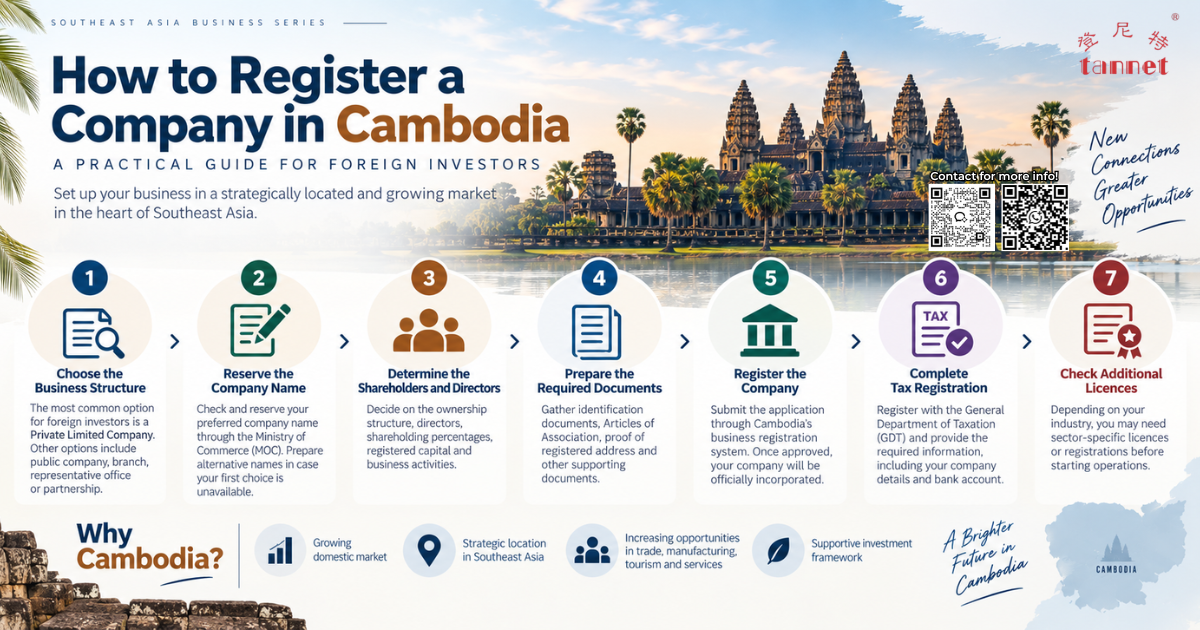
Cambodia has become an increasingly practical destination for foreign investors looking to establish operations in Southeast Asia. Its location between Thailand, Vietnam and Laos, relatively open foreign investment framework, growing consumer market and developing manufacturing base make it relevant for businesses involved in trading, manufacturing, services, logistics, tourism and other sectors.
Foreign investors planning to register a company in Cambodia should understand that company incorporation is only the first stage. Depending on the proposed activities, the business may also need tax registration, labour registration and industry-specific licences before commencing operations.
1. Choose the Appropriate Business Structure
One of the most common structures used by foreign investors is a Private Limited Company.
Other structures available in Cambodia include:
- Public Limited Company
- Branch of a foreign company
- Representative Office
- Partnership
For many foreign-owned commercial operations, a Private Limited Company provides a practical structure because it creates a separate legal entity and can conduct business directly in Cambodia.
Foreign ownership is generally permitted in many sectors. However, Cambodia maintains restrictions in certain areas, most notably land ownership, and some regulated industries may require additional approvals or licences.
The proposed business activities should therefore be reviewed before incorporation rather than assuming that company registration alone authorises every activity.
2. Reserve the Company Name
The next step is to select and reserve a company name.
Business registration is handled through Cambodia’s business registration system, involving the Ministry of Commerce (MOC) and other relevant government authorities.
The proposed name should be sufficiently distinctive and comply with Cambodian naming requirements. Preparing alternative names can help avoid delays if the first choice is unavailable or rejected.
3. Determine the Shareholders and Directors
Before submitting the registration, investors should determine the company’s ownership and management structure.
This normally includes:
- Shareholder information
- Director information
- Shareholding percentages
- Registered capital
- Registered office
- Principal business activities
- Ultimate ownership information where required
Where a shareholder is another company rather than an individual, additional corporate documents will be necessary.
Cambodia’s official registration requirements specifically provide for corporate shareholders and require supporting documents such as the parent company’s certificate, articles of association and authorisation documentation.
4. Prepare the Required Documents
The exact documentation depends on the proposed company structure and whether shareholders are individuals or legal entities.
Typical documents include:
- Identification documents of directors and individual shareholders
- Recent photographs of relevant individuals
- Registered office lease agreement or land documentation
- Articles of Association
- Information on the company’s proposed activities
- Corporate documents for corporate shareholders
- Authorisation letter where an application is submitted through a representative
Cambodia’s official registration guidance states that documents submitted through the online registration process should be clear scans of the original documents. Insufficient or illegible documentation can result in an application being rejected.
Foreign corporate shareholders should prepare their corporate documentation carefully, as additional authentication or supporting documentation may be required depending on the circumstances.
5. Register the Company
Once the information and documents are ready, the incorporation application can be submitted through Cambodia’s business registration system.
The authorities review the proposed company details, shareholders, directors, registered address and supporting documentation.
After successful registration, the company receives its relevant incorporation documentation and becomes a legally registered Cambodian entity.
However, investors should not treat incorporation as the end of the setup process.
6. Complete Tax Registration
A newly established company must also comply with Cambodia’s tax registration requirements administered by the General Department of Taxation (GDT).
The GDT maintains specific tax-registration documentation for private and public limited companies as well as separate forms for foreign-company branches and representative offices.
Depending on the company, tax registration may involve information relating to the company’s premises, shareholders, directors, business activities and bank account.
Official registration guidance also states that company bank-account information must be provided to the GDT within the applicable period following tax registration.
After establishment, companies must continue meeting applicable Cambodian tax filing and compliance obligations. The GDT provides electronic services including e-Filing and e-Payment for registered taxpayers.
7. Check Additional Licences Before Starting Operations
Not every Cambodian company can begin operating immediately after incorporation.
Additional registrations or licences may apply depending on the sector. Businesses involved in areas such as manufacturing, construction, tourism, food and beverage, education, finance, telecommunications, import and export, or other regulated activities should confirm their licensing requirements separately.
Companies employing staff should also review applicable labour and employment registration obligations.
For larger investment projects, investors may additionally consider whether the project qualifies for investment incentives under Cambodia’s investment framework.
Why Consider Cambodia for Business Expansion?
Cambodia can provide foreign investors with access to a developing domestic market and a strategic location within mainland Southeast Asia. Opportunities continue to develop beyond traditional garment manufacturing, including logistics, agriculture and food processing, tourism, consumer products, digital services and other industries.
However, the appropriate incorporation and licensing route depends heavily on the actual business activity. Foreign investors should therefore determine the company structure, ownership arrangement, registered address, tax requirements and sector-specific approvals before commencing registration.
For overseas companies entering Cambodia, proper planning at the beginning can reduce delays and avoid discovering additional licensing requirements after the company has already been incorporated.
Official and High-Credibility Sources
- Cambodia General Department of Taxation (GDT)
General Department of Taxation Cambodia
- GDT – Official Registration Document Requirements
Cambodia Business Registration Required Documents
- GDT – Tax Registration Forms
GDT Official Forms and Documents
📞 Free 1-on-1 Consultation Now,
Official Service Hotline: +86-755-82148419
Cell: +86-13823131503;+60 19-309 2363
WeChat ID: 13823131503;
WhatsApp:+86-13823131503;+60 19-309 2363
Email: mytannet08@gmail.com; susiehu@citilinkia.com