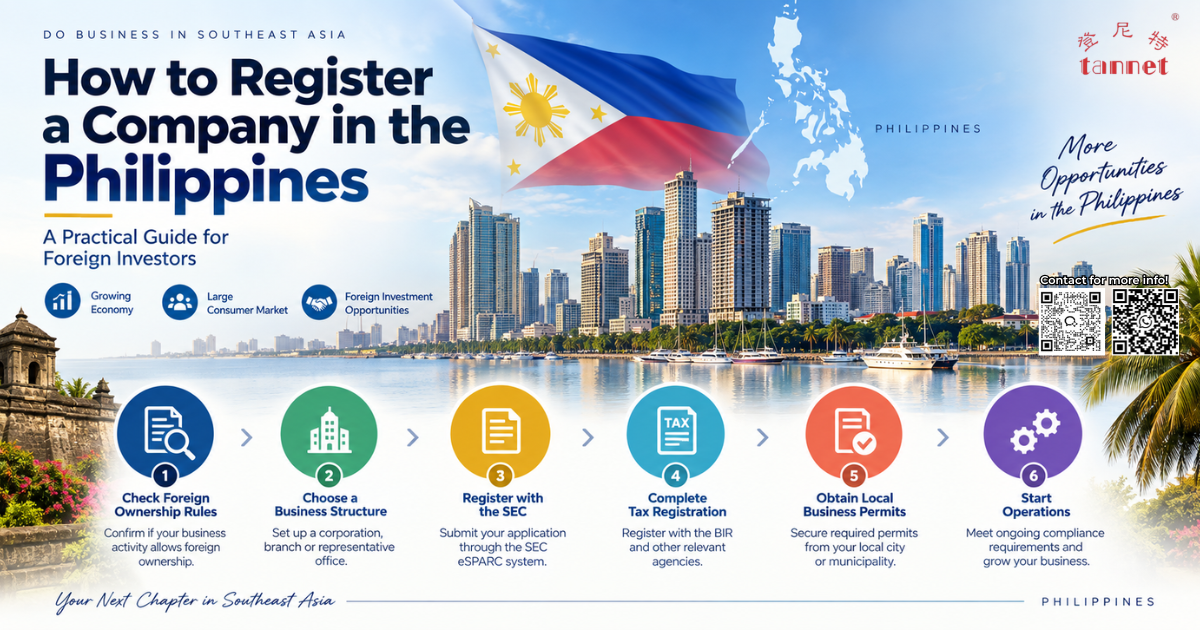
The Philippines is one of Southeast Asia’s major consumer markets and continues to attract foreign investors in sectors such as business process outsourcing, technology, manufacturing, e-commerce, logistics, construction and professional services.
For foreign investors planning to establish a business in the Philippines, company registration involves more than obtaining a corporate certificate. Investors must determine whether foreign ownership is permitted for the intended activity, select the appropriate business structure, register with the Securities and Exchange Commission (SEC), complete tax registration and obtain the licences required to operate.
This guide explains the main steps foreign investors should consider when registering a company in the Philippines.
1. Can Foreigners Register a Company in the Philippines?
Yes. Foreign individuals and companies can establish businesses in the Philippines.
The Philippine SEC’s OneSEC system specifically supports domestic stock corporations with foreign equity participation ranging from 1% to 100%.
However, 100% foreign ownership is not automatically permitted for every business activity. Certain sectors remain subject to foreign ownership restrictions under Philippine law.
Before incorporation, investors should therefore confirm:
- the proposed business activities;
- the permitted level of foreign ownership;
- whether a Filipino shareholder is required;
- whether minimum capitalization requirements apply; and
- whether the business requires a secondary licence or industry-specific approval.
This review should be completed before determining the final shareholding structure.
2. Choose the Appropriate Business Structure
Foreign investors generally consider several structures.
Domestic Corporation
A domestic stock corporation is incorporated in the Philippines and can have Filipino and/or foreign shareholders.
It is generally the most practical structure for investors planning to establish substantial local operations, employ staff, enter into commercial contracts and conduct business directly in the Philippine market.
One Person Corporation
A One Person Corporation (OPC) allows a corporation to have a single stockholder, subject to applicable Philippine regulations.
The SEC’s current registration system accommodates OPC applications, including qualifying corporations with foreign equity.
Branch Office
An overseas company can establish a Philippine branch rather than incorporating a separate domestic corporation.
The branch remains an extension of the foreign parent company and must obtain a License to Do Business from the SEC.
Representative Office
A foreign company may also establish a representative office for activities such as market research, information dissemination, promotion and liaison.
A representative office is generally not permitted to derive income from the Philippines, making it unsuitable for businesses intending to conduct direct commercial sales.
3. Check the Proposed Company Name
The proposed company name must comply with SEC naming requirements and be distinguishable from existing registered entities.
The name application forms part of the SEC electronic registration process.
Investors should prepare alternative names in case their preferred company name is unavailable or rejected.
It is also advisable to consider trademark availability separately. Registering a company name with the SEC does not automatically provide trademark protection.
4. Prepare the Incorporation Information and Documents
The exact requirements depend on the company structure, shareholders and business activity.
For a typical corporation, investors should prepare information including:
- proposed company name;
- principal office address in the Philippines;
- primary and secondary business purposes;
- shareholder/incorporator information;
- directors and corporate officers;
- authorized capital structure and share subscriptions;
- beneficial ownership information; and
- identification documents of the relevant parties.
Foreign investors may use their passport numbers instead of Philippine Tax Identification Numbers for purposes of the SEC corporation or partnership registration process.
Documents executed outside the Philippines may also require appropriate authentication or notarization depending on the application and document involved.
5. Register the Company with the Philippine SEC
Corporations are registered with the Philippine Securities and Exchange Commission’s eSPARC system.
The SEC currently provides electronic registration channels including OneSEC, Regular Processing and ZERO processing.
OneSEC supports eligible domestic stock corporations, including companies with up to 100% foreign equity participation. The SEC has also introduced ZERO processing, which uses electronic authentication and digitally signed Certificates of Incorporation for eligible applications.
The general process involves:
Step 1: Create and credential the required SEC electronic account.
Step 2: Submit the proposed company name and company information.
Step 3: Prepare and authenticate the incorporation documents.
Step 4: Complete the applicable SEC registration procedures.
Step 5: Obtain the Certificate of Incorporation.
Once the Certificate of Incorporation is issued, the company legally exists, but additional registrations are generally required before operations begin.
6. Complete Tax and Employer Registration
After SEC incorporation, the company must complete the relevant tax registration requirements with the Bureau of Internal Revenue (BIR).
The SEC’s eSPARC platform is integrated with the Philippine Business Hub, allowing newly registered companies to proceed with applications for their company TIN and employer registrations.
Companies employing personnel may also need registrations with:
- Social Security System (SSS);
- PhilHealth; and
- Pag-IBIG Fund.
The company should also establish appropriate accounting, invoicing, bookkeeping and tax compliance procedures from the beginning of operations.
7. Obtain Local Business Permits
SEC registration alone does not authorize every company to commence operations immediately.
Depending on the company’s location and activities, additional registrations may include:
- Barangay Clearance;
- Mayor’s/Business Permit;
- local government registrations;
- fire safety requirements; and
- occupancy or premises-related approvals.
The exact requirements depend on the city or municipality where the company operates.
8. Check Industry-Specific Licences
Certain activities require approvals beyond standard company registration.
This is particularly important for regulated industries such as:
- food and consumer products;
- construction;
- financial services;
- import and export;
- recruitment;
- education;
- telecommunications; and
- certain professional services.
Foreign investors importing regulated products should also check whether product registration, certification or import clearance is required before goods are shipped to the Philippines.
9. Maintain Corporate Compliance After Registration
Registration is only the beginning of the company’s compliance obligations.
Philippine corporations may have continuing requirements relating to:
- annual financial statements;
- corporate information filings;
- beneficial ownership declarations;
- tax returns;
- accounting records;
- business permit renewals; and
- industry-specific licences.
The SEC’s 2026 reporting framework also includes beneficial ownership reporting requirements through its HARBOR system.
Failure to maintain these obligations may result in penalties or affect the company’s good standing.
Conclusion
Registering a company in the Philippines can provide foreign investors with direct access to one of Southeast Asia’s largest markets. However, the appropriate setup depends heavily on the proposed business activity, foreign ownership restrictions and licensing requirements.
Before incorporation, investors should first determine what the company will actually do in the Philippines, then confirm the permitted ownership structure and regulatory requirements.
TANNET can assist foreign investors with Philippine company incorporation, corporate structuring, registration coordination, tax registration and related business support services, helping investors establish their Philippine operations under an appropriate and compliant structure.
Official and high-credibility sources
- Philippine Securities and Exchange Commission (SEC) – eSPARC
SEC eSPARC Company Registration
- SEC – Primary Registration
SEC Primary Registration Requirements
- SEC – Forms and Fees / Foreign-Owned Corporations
SEC Primary Registration Forms
- Bureau of Internal Revenue (BIR) – NewBizReg
BIR New Business Registration Portal
- SEC – Corporate Reportorial Requirements
SEC Corporate Reportorial Requirements
📞 Free 1-on-1 Consultation Now,
Official Service Hotline: +86-755-82148419
Cell: +86-13823131503;+60 19-309 2363
WeChat ID: 13823131503;
WhatsApp:+86-13823131503;+60 19-309 2363
Email: mytannet08@gmail.com; susiehu@citilinkia.com