Key Takeaway
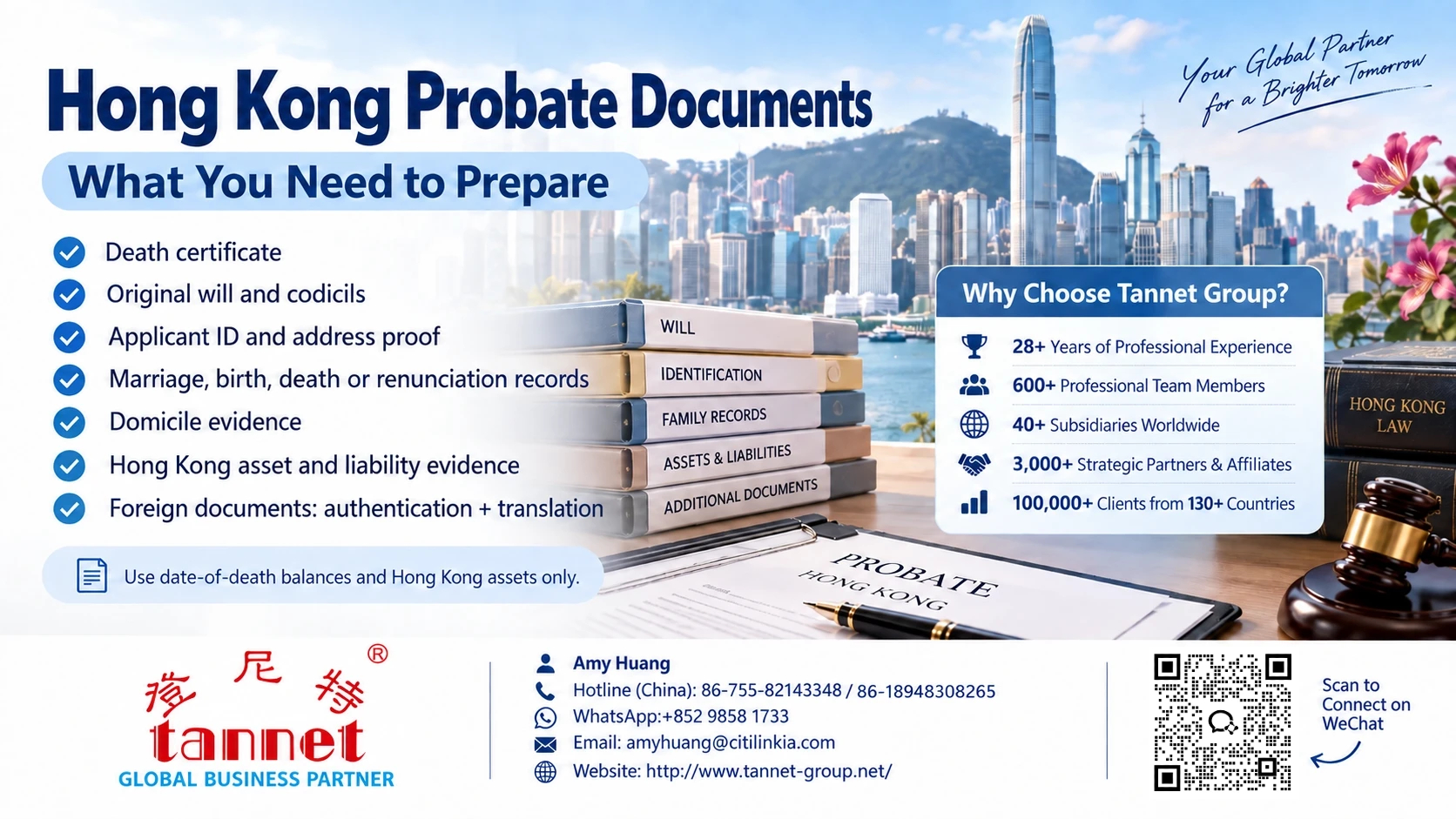
A Hong Kong probate application needs more than a death certificate and a will. The applicant must prove the death, will or intestacy position, entitlement to apply, domicile, and Hong Kong assets and liabilities.
This guide is for executors, administrators, beneficiaries, and overseas families preparing a grant application. The exact forms and evidence change with the grant type and facts.
The main caution concerns foreign records, missing originals, inconsistent names, incomplete family evidence, and unsupported date-of-death balances. These gaps commonly lead to Probate Registry requisitions.
Start With the Type of Grant
The document list depends on the application route. Probate is normally sought by an executor named in a valid will. Letters of Administration apply where there is no valid will. Letters of Administration with Will Annexed apply where a will exists but no executor can or will act.
The Judiciary publishes forms for each route. Its guide identifies Form W1.1a for a usual executor application after 11 February 2006. Intestacy uses L-series forms based on relationship.
Date of death, domicile, priority, minors, renunciations, a foreign grant, and unusual will facts can change the packet.
Core Identity and Death Documents
Use an original or certified death certificate. Match the deceased’s official name, date, and place of death across the file.
Add the deceased’s Hong Kong identity card copy where applicable. Use passport or other evidence to explain different names.
The applicant needs identity and address evidence. Asset institutions may impose separate post-grant due diligence.
Will and Executor Documents
File the original will and a copy, plus every codicil. Check names, execution, executor appointment, and alterations before drafting.
Execution, condition, alterations, or custody may require extra W-series evidence. A missing original, disputed signature, or possible revocation needs legal advice.
An executor who will not act may use Form W2.1 to renounce. If a named executor died, provide death evidence and use the appropriate form.
Family and Entitlement Documents
Prove entitlement with relevant marriage, birth, adoption, divorce, death, and renunciation records.
For intestacy, Rule 21 governs priority. The usual order is spouse, children, parents, then siblings. Account for everyone ahead of the applicant.
Use a family tree to control names and relationships, but support each material link with civil records or an affidavit where primary proof is unavailable.
Domicile Evidence
Domicile can affect who receives the grant and how movable estate is distributed. It is not decided only by passport, nationality, or place of death.
An overseas death or unclear Hong Kong status may require a domicile affidavit covering home, residence intention, business, investments, family ties, and personal papers.
Foreign domicile can require foreign-law evidence. A foreign grant may qualify for resealing under sections 48 to 52, subject to eligibility.
Hong Kong Asset and Liability Documents
The application includes a Schedule of Assets and Liabilities for property in Hong Kong. The Hong Kong Judiciary states that overseas assets should not be included in Form N4.1.
For each item, record owner, institution, reference, type, and date-of-death value. Support liabilities at death. Do not substitute current balances.
Evidence by Asset Type
- Bank accounts: institution confirmation of ownership, currency, and balance at death.
- Securities: custodian holdings and values, with valuation support for private assets.
- Company shares: register of members, certificates if issued, articles, accounts, and valuation evidence.
- Property: land and mortgage records plus date-of-death valuation where required.
- MPF and insurance: trustee or insurer records, nominations, and governing terms.
- Debts: statements for loans, cards, tax, and other amounts owed at death.
Safe deposit boxes may require the Home Affairs Department inspection process. Later transmission, sale, or claim steps remain separate from the grant application.
Specified Forms and Supporting Affidavits
Use the live Judiciary forms. Post-11 February 2006 applications generally use the relevant suffix “a” forms and N-series schedule material.
Extra affidavits may address identity, death, domicile, will condition, delay, relationship, or missing proof. Some administration cases require surety.
Foreign Documents Authentication and Translation
Foreign public documents may need authentication. The route depends on the issuing place and current arrangements. Confirm it before ordering services.
Documents not in Chinese or English must be translated. The Judiciary instructs applicants to authenticate the original foreign public document first and translate the authenticated document afterward.
Keep the original, authentication, translation, and any translator certification as one evidence set.
Filing Copies and Record Control
Filed documents usually remain in the court record. Limited return procedures may apply to certain civil-status originals after six months, subject to the Registrar.
Scan and index the file before submission. Mark each item as original, certified copy, ordinary copy, authenticated record, or translation.
Build a Document Status Register
Use one control list outside the court forms. For each application fact, record the supporting document, issuing authority, date, name used, original or copy status, authentication, translation, exhibit label, and open issue.
Add an owner and due date for every gap. When one fact changes, identify every form and affidavit affected. This prevents a corrected family record from remaining inconsistent with the asset schedule or applicant affidavit.
Request institution evidence in writing. Ask for the exact date-of-death position, ownership form, currency, and accrued amount where relevant. Save the request and response together so later valuation or transmission questions can be traced.
Verify the Final Application Set
Before signing, compare every name, date, relationship, asset reference, and exhibit label across the full set. Confirm that schedules contain Hong Kong items only and that values use the correct date. Check whether a new certificate changes applicant priority or another affidavit. Preserve a scan of every filed original and a log of Registry requisitions.
Common Mistakes
- Filing a copy of the will without addressing the missing original.
- Omitting a codicil or renunciation.
- Using family descriptions without civil-status evidence.
- Ignoring different spellings, aliases, or transliterations.
- Providing current asset balances instead of date-of-death evidence.
- Including overseas assets in the Hong Kong schedule.
- Translating foreign records before required authentication.
- Assuming one checklist covers every grant type.
Frequently Asked Questions
Q1 Do I need the original will
Yes. A will-based application needs the original and a copy. If the original is missing, obtain advice because loss can raise revocation issues.
Q2 Are photocopies of certificates accepted
Use originals or certified copies of relevant civil-status certificates. Confirm certification requirements for the issuing place.
Q3 What if names are different across documents
Explain material name variations consistently with identity records or an affidavit. Asset-holding names may need to appear in the grant.
Q4 Must I list assets outside Hong Kong
No. The Hong Kong schedule covers Hong Kong assets and liabilities. Overseas estate is administered under the relevant foreign procedure.
Q5 Do foreign documents need an apostille
The route depends on the issuing place and current arrangements. Check before ordering an apostille or legalization.
Q6 Can I submit the application by post
A personal applicant cannot apply by post. An entitled person living overseas may be able to act through a lawfully constituted attorney.
Q7 Do I need estate-duty clearance
Not for a death on or after 11 February 2006. The Inland Revenue Department confirms that no estate-duty affidavit, account, or clearance paper is required for those deaths. Earlier estates follow historical rules.
Q8 Will the grant release every asset automatically
No. Each bank, company, broker, trustee, insurer, or property authority may require its own post-grant documents and checks.
When Tannet Can Assist
Tannet can assist with a document gap assessment, Hong Kong asset schedule support, certification and translation coordination, and administrative liaison with banks, companies, valuers, accountants, and an instructed Hong Kong solicitor. Tannet can also coordinate corporate records for Hong Kong company-share transmission after the grant. Formal legal opinions, disputed wills, caveats, applicant conflicts, and court advocacy require a qualified Hong Kong solicitor.
This article provides general information. It is not legal, tax, or succession advice for a particular estate.
Written by: Tannet Business Services Team
Reviewed by: Consultant Amy Huang
First published: 14 Sep. 2026
Last reviewed: 14 Sep. 2026
Sources: Hong Kong Judiciary Probate Registry; Guide to the use of the Specified Forms for Probate Registry; Probate and Administration Ordinance Cap. 10; Non-Contentious Probate Rules Cap. 10A; IRD Estate Duty; Home Affairs Department Estate Services.
————————————————Simplifying Business, Empowering Entrepreneurs————————————————