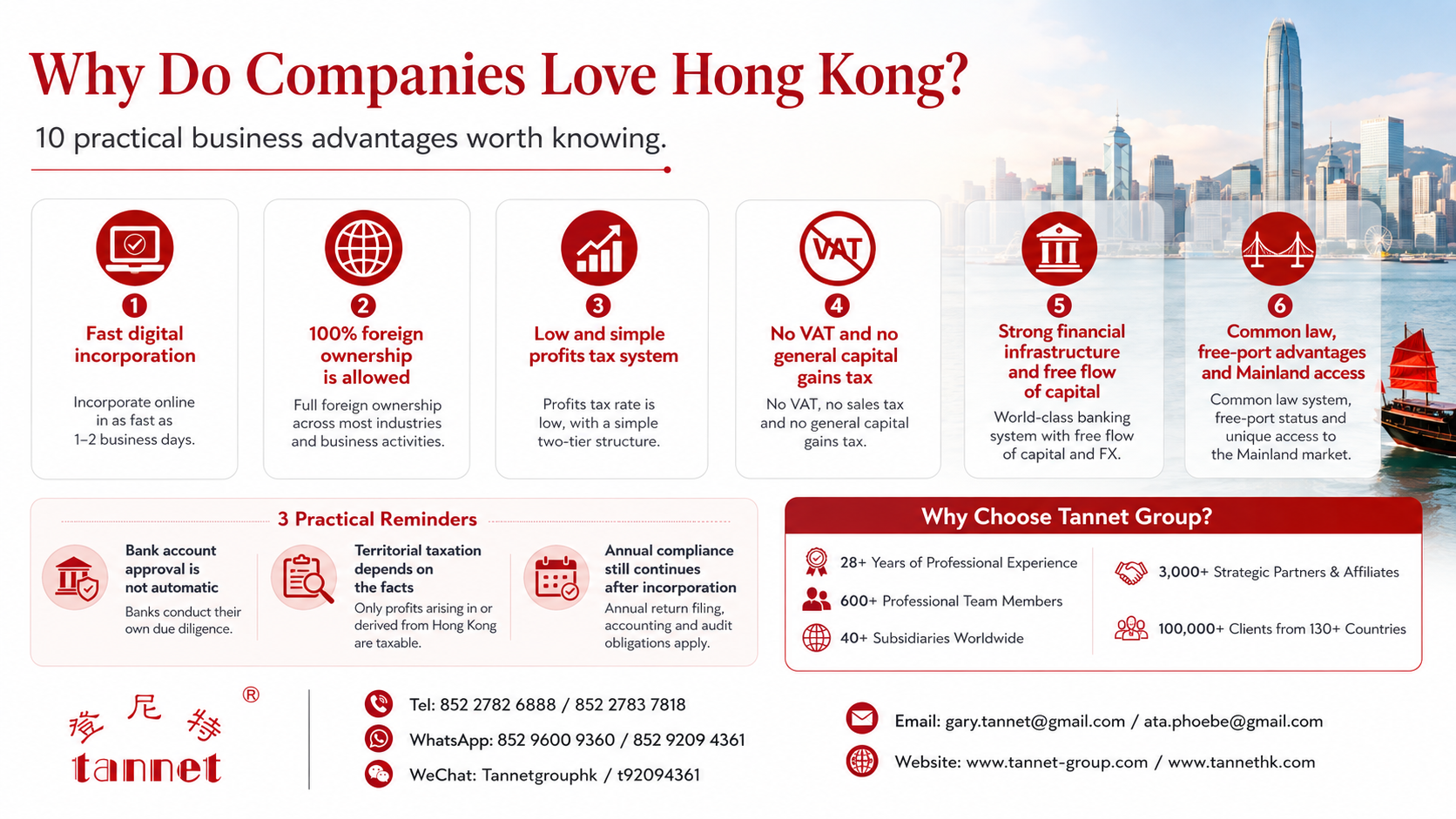
Key Takeaway
A Hong Kong private company limited by shares is a separate legal entity used for international trade, services, technology, investment holding and regional operations. It suits overseas founders and established groups that need a recognised contracting platform, flexible foreign ownership, a territorial tax system and access to Hong Kong’s financial and professional-services ecosystem.
The most important caution is substance.
Incorporation does not guarantee a bank account, tax exemption, Mainland market access or immigration status. The company needs a real business model, documented transactions, appropriate licences and continuing corporate, accounting, audit and tax compliance.
Hong Kong Remains a Widely Used Corporate Base
The Companies Registry reported 1,609,720 local and re-domiciled companies at 30 June 2026.
Hong Kong remains an established corporate jurisdiction with searchable records, standardised filings and a large professional-services market.
The right question is not whether Hong Kong is popular. It is whether the entity will perform a clear commercial function in the proposed group.
Benefit 1 — Separate Legal Identity and Limited Liability
A company limited by shares has a legal identity separate from its shareholders. It can sign contracts, own assets, hire people, incur liabilities and continue despite changes in ownership.
Shareholder liability is generally limited to unpaid amounts on their shares. This separation can support risk management, investment and succession planning.
Limited liability is not absolute. Personal guarantees, director misconduct, fraud or other legal exceptions may create personal exposure. Contracts and governance still need careful review.
Benefit 2 — International Ownership and Simple Governance
Non-Hong Kong residents may incorporate a local limited company. The Companies Registry states that a director need not be a Hong Kong resident.
A private company needs at least one natural-person director. Its sole director cannot also act as company secretary. An individual secretary must ordinarily reside in Hong Kong; a corporate secretary needs a Hong Kong registered or principal office.
The company also needs a Hong Kong registered office. These requirements allow international ownership while preserving a local statutory contact and administration structure.
Benefit 3 — A Low and Structured Profits Tax Regime
Under the two-tier regime, a corporation generally pays 8.25% on the first HK$2 million of assessable profits and 16.5% on the remainder, subject to the applicable rules.
Hong Kong does not impose a sales tax or VAT. InvestHK also notes that Hong Kong has no withholding tax on dividends and interest and no general capital-gains tax.
Labels are not enough. A gain described as “capital” may still be examined by reference to its facts. Sector-specific concessions, connected entities and global minimum tax rules can also change the result.
Benefit 4 — Territorial Taxation, with Important Conditions
Hong Kong generally taxes profits arising in or derived from Hong Kong. Residence, incorporation and the place where money is received do not alone determine source.
Businesses should document where profit-producing activities occur. Contracts, negotiation records, staff functions, supplier management, customer delivery and decision-making evidence may all matter.
The foreign-sourced income exemption regime is also relevant to MNE entities receiving specified foreign-sourced interest, dividends, intellectual-property income or disposal gains in Hong Kong. Economic-substance, participation or nexus conditions may apply.
Hong Kong had signed comprehensive double-taxation agreements with 57 jurisdictions by mid-April 2026, with a 58th announced in June. Treaty access depends on residence, beneficial ownership and the relevant agreement.
Benefit 5 — Financial Infrastructure and Capital Mobility
Hong Kong supports a freely convertible currency and movement of capital. The Hong Kong Monetary Authority describes the city as a leading international financial centre with extensive financial institutions and infrastructure.
This can support multi-currency collections, supplier payments, financing and treasury activity. The practical value depends on the company’s customers, currencies, transaction corridors and internal controls.
Banking is not automatic. Banks apply customer due diligence and ongoing monitoring using a risk-based approach. Applicants should explain ownership, source of funds, business activity, expected transaction patterns and counterparties.
Benefit 6 — A Free-Port Trading Environment
Hong Kong Customs states that the city does not levy customs tariffs on imports or exports. Excise duties apply to four types of dutiable commodities: liquor, tobacco, hydrocarbon oil and methyl alcohol.
Free-port status can reduce tariff friction for many trading models. It does not remove import and export declarations, controlled-goods rules, origin requirements or overseas tariffs.
Trading companies should map the physical cargo route separately from the invoicing route. A Hong Kong invoice does not by itself change origin, customs value or destination-country duty.
Benefit 7 — Common Law and Contract Flexibility
Hong Kong operates a common law system. The Department of Justice notes that freedom of contract is well established and businesses can create agreements suited to their commercial needs.
This can assist shareholder arrangements, distribution, licensing, financing, intellectual-property ownership and dispute-resolution clauses. English and Chinese are both used in Hong Kong’s legal system.
The governing law should match the transaction. A Hong Kong company can still become subject to foreign consumer, employment, data, sanctions or tax rules when it operates elsewhere.
Benefit 8 — Access to Mainland and CEPA Opportunities
Hong Kong can coordinate trade, investment and professional services connected with the Chinese Mainland and Greater Bay Area. Geographic proximity and cross-border service networks are practical advantages.
CEPA provides preferential treatment in many Mainland service sectors for qualifying Hong Kong service suppliers. The Trade and Industry Department states that a juridical person normally needs substantive business operations in Hong Kong to qualify.
Incorporation alone does not create CEPA status. Mainland licences, foreign-investment rules and sector restrictions remain separate questions.
Benefit 9 — A Larger Business and Start-up Ecosystem
InvestHK reported 11,070 companies with Mainland or overseas parent companies in Hong Kong in 2025. Its 2025 Startup Survey counted 5,221 start-ups employing nearly 20,000 people.
This ecosystem can help founders access professional advisers, technology partners, investors, logistics providers and multilingual talent. Availability does not mean every service is inexpensive or suitable.
Before hiring, assess employment, visa, payroll, MPF and office requirements. Registering a company does not grant the founder permission to work or reside in Hong Kong.
Benefit 10 — Digital Incorporation and Searchable Records
The Companies Registry’s e-Services Portal accepts electronic incorporation applications 24 hours a day. Incorporation and business-registration processes are coordinated.
Digital access can shorten administration when the proposed name, documents and identification information are complete. The company should still choose its ownership, articles, business scope and signing authority before filing.
A quick certificate should not drive a rushed structure. Reorganising shares, control or contracts later may require additional filings, tax analysis and bank updates.
The Continuing Obligations
A Hong Kong company generally maintains statutory registers, a Significant Controllers Register, accounting records and governance evidence. It files annual returns, renews business registration, prepares financial statements and completes audit and Profits Tax work where required.
Regulated activities may need licences before operations begin. Examples can include financial services, money services, employment agencies, travel services, education, food businesses or certain import and export activities.
Budget for administration even before revenue starts. A company with no sales is not automatically exempt from annual, accounting, audit or tax obligations.
Common Mistakes
- Registering before defining customers, contracts and payment routes.
- Assuming incorporation guarantees bank-account approval.
- Treating foreign revenue as automatically offshore and tax-free.
- Expecting CEPA benefits without substantive operations or qualification.
- Using a Hong Kong company to operate in another country without checking local rules.
- Choosing shareholders and directors without a governance agreement.
- Ignoring audit, annual-return, business-registration and record-keeping costs.
- Assuming company registration grants a work visa or residence right.
Frequently Asked Questions
Q1. Can a foreigner own 100% of a Hong Kong company?
Yes. Non-Hong Kong residents may incorporate and own a local private company. A non-resident can also be a director, but the company needs a qualifying Hong Kong company secretary and registered office.
Q2. Is HK$1 enough as share capital?
A company can be formed with a small amount of issued capital. The appropriate amount should reflect contracts, credibility, financing and operational needs rather than only the legal minimum.
Q3. Will the company automatically pay only 8.25% tax?
No. The rate applies to the first HK$2 million of assessable profits under the two-tier rules. Connected-entity restrictions and the nature and source of income require review.
Q4. Is overseas income always tax-free?
No. Source is determined from facts and operations. The FSIE regime may affect specified foreign-sourced income received in Hong Kong by an MNE entity.
Q5. Does incorporation guarantee a business bank account?
No. Each bank or payment provider conducts risk-based due diligence and makes its own onboarding decision.
Q6. Can I use the company to work in Hong Kong?
Company ownership does not itself grant immigration permission. A separate visa or entry-permit assessment is required.
Q7. Does a Hong Kong company allow direct business in Mainland China?
Not automatically. Mainland registration, licensing and tax rules still apply. CEPA benefits require the relevant eligibility and procedures.
Q8. Who should reconsider this structure?
A founder with no clear Hong Kong function, no compliance budget or operations entirely governed elsewhere should compare local incorporation, a branch, an employer-of-record model or direct contracting first.
When Tannet Can Assist
Tannet is suited to founders and groups that need help comparing structures, checking a company name, organising shareholders and officers, arranging a registered office and company secretary, preparing incorporation documents, coordinating bank-account preparation, or setting up accounting and compliance workflows before the first filing begins. Tax, legal, licensing and immigration conclusions should be confirmed against the actual business model.
Sources
Consult:
📍 HK Office:Unit B, 26/F, EGL Tower, 83 Hung To Road, Kwun Tong, Kln., Hong Kong
📞 Tel:852 2782 6888(PHOEBE)/ 852 2783 7818 (GARY)
📞 WhatsApp:852 9600 9360 | WeChat:Tannetgrouphk/ t92094361 |
Email:gary.tannet@gmail.com / ata.phoebe@gmail.com 🌐 Website:www.tannet-group.com / www.tannethk.com
You are also welcome to visit our service outlets in Beijing, Shanghai, Guangzhou, Shenzhen, and other cities at any time.
Written by: Tannet Business Services Team
Reviewed by: Consultant Amy Huang
First published: 31 August 2026
Last reviewed: 31 August 2026