Key Takeaway
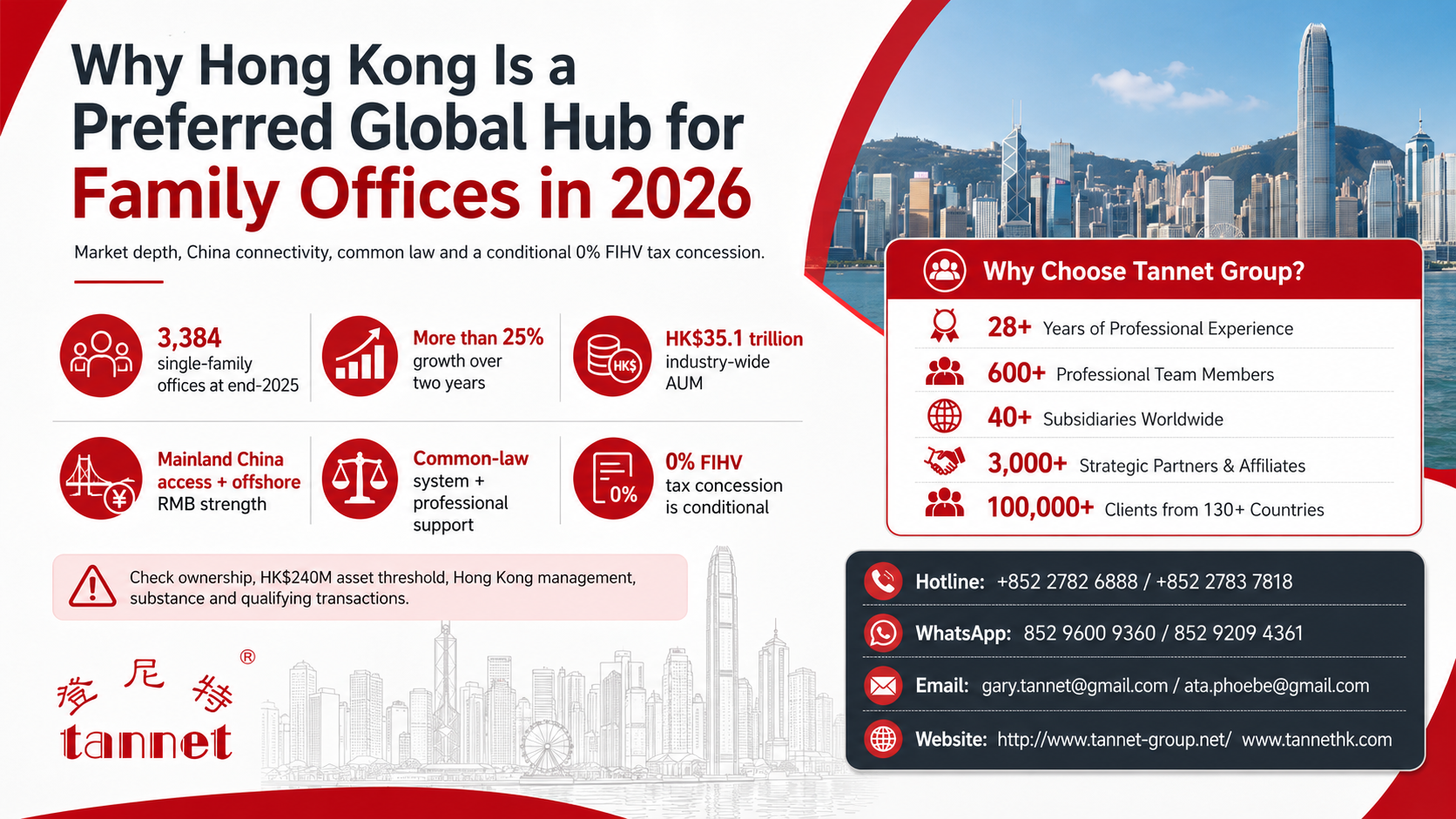
Hong Kong is a strong family-office location for wealthy families that need an Asia-based platform for investment, succession, governance and cross-border coordination. Its main advantages are market depth, access to Mainland China, common law, professional services and a targeted 0% profits tax concession.
The most important caution is that the concession is not automatic. Families must satisfy ownership, asset, management, substance and transaction conditions. They should also distinguish current law from the wider tax measures proposed in the 2026 amendment bill.
What the Latest Numbers Show
Invest Hong Kong reported that 3,384 single-family offices were operating in Hong Kong at the end of 2025. This was 681 more than at the end of 2023, an increase of more than 25% over two years. The estimate came from a market study commissioned by InvestHK and conducted by Deloitte.
The same study estimated that single-family offices contribute about HK$12.6 billion each year through operating expenditure. It also estimated direct employment of more than 10,000 full-time professionals. These figures describe an operating ecosystem, not only capital booked through Hong Kong entities.
Hong Kong’s wider asset and wealth-management market provides additional scale. The Securities and Futures Commission reported HK$35.1 trillion, or US$4.53 trillion, in assets under management at the end of 2024. This is industry-wide AUM. It should not be described as assets managed only by family offices.
Why Tax Efficiency Matters, but Does Not Decide Everything
Hong Kong applies a territorial tax system. FamilyOfficeHK states that capital gains are not taxed, offshore profits are not taxed when the applicable sourcing rules are met, and dividend income is generally not taxable. Each income stream still requires classification and source analysis.
For an eligible family-owned investment holding vehicle, or FIHV, the concessionary profits tax rate is 0% on assessable profits from qualifying and permitted incidental transactions. The regime applies to years of assessment beginning on or after 1 April 2022.
The FIHV must be managed by an eligible single-family office in Hong Kong. The aggregate net asset value of specified assets managed for the family’s relevant FIHV or FIHVs must generally be at least HK$240 million.
Substance is required. The Inland Revenue Department states that the FIHV must conduct its core income-generating activities in Hong Kong. The minimum is two qualified full-time employees and HK$2 million of Hong Kong operating expenditure, although actual staffing and expenditure must be adequate for the scale and complexity of the activities.
Ownership also matters. As a general rule, family members must hold at least 95% of the beneficial interest in the FIHV and the eligible single-family office, subject to specific rules for charitable entities and unrelated persons. The structure should be tested before assets are transferred.
A 2026 Legislative Change That Must Be Described Carefully
The Government gazetted an amendment bill on 12 June 2026. It proposes to expand qualifying investments, remove the 5% threshold for incidental transactions, relax parts of the special-purpose-entity treatment and enhance the carried-interest regime.
The proposal is relevant to portfolios containing private credit, loans, digital assets, precious metals and other non-traditional investments. However, it was not yet enacted as of 27 August 2026. The Bills Committee had completed clause-by-clause examination, and the Government aimed to resume the second reading debate in the second half of 2026.
Families should model both the law currently in force and the proposed rules. Implementation should follow the final enacted text and any Inland Revenue Department guidance, not headlines or consultation summaries.
Direct Access to Mainland China and the Greater Bay Area
Hong Kong connects international portfolios with Mainland markets through established channels. Stock Connect links the Hong Kong and Mainland securities markets. The Cross-boundary Wealth Management Connect scheme allows eligible residents in Hong Kong, Macao and Mainland Greater Bay Area cities to invest in approved wealth-management products across the boundary.
These programmes do not give every family office unrestricted access to every Mainland asset. Eligibility, product scope, quotas, account arrangements and regulatory requirements still apply. Their strategic value is the presence of regulated channels within a broader cross-border financial ecosystem.
Hong Kong also has the deepest offshore renminbi liquidity pool outside Mainland China, according to the Hong Kong Monetary Authority. This can support families with renminbi assets, Mainland business interests, trade flows or future investment needs.
A Common-Law Platform for Ownership and Succession
Hong Kong’s legal system is based on common law and judicial independence. The Department of Justice notes that it is distinct from the legal system of Mainland China under the “one country, two systems” framework.
For family offices, legal-system familiarity can help with shareholder agreements, trusts, investment mandates, employment arrangements, financing documents and dispute resolution. It does not remove the need to coordinate the laws of every country connected to the family, settlor, beneficiaries, assets or controlled businesses.
Succession planning should connect ownership, control and family governance. A trust, foundation, company or partnership solves only part of the problem. Families also need decision rights, conflict procedures, distribution policies, next-generation roles and a plan for incapacity or death.
Professional Depth and Operational Capability
A family office usually relies on more than an investment manager. It may need tax advisers, lawyers, accountants, trustees, private banks, insurance specialists, company secretaries, valuation experts, technology providers and philanthropy advisers.
Hong Kong’s established financial sector gives families access to this mix. Families should still document who provides each service, under which licence or professional responsibility, from which legal entity, for what fee and with what deliverables.
Innovation, Alternatives and “Wealth for Good”
The 2026 InvestHK study found interest in private equity, technology, healthcare, hedge funds and digital assets. Hong Kong also promotes philanthropy through the Hong Kong Academy for Wealth Legacy and the Wealth for Good initiative.
Philanthropy still requires legal and tax design. Families should choose an appropriate giving structure and document governance, due diligence and impact measurement.
Who Is Hong Kong Most Suitable For?
Hong Kong may be suitable when a family wants a genuine Asian management base, not a passive nameplate. It is particularly relevant for families with Mainland China or Greater Bay Area exposure, international investment portfolios, renminbi needs, operating businesses in Asia, or a planned intergenerational transfer.
It may be less suitable when decision-making will remain elsewhere or another jurisdiction better matches the family’s residence and assets. Compare tax, licensing, substance cost, banking, reporting, investment access and governance together.
Common Mistakes
- Treating the 0% FIHV rate as an automatic exemption for every family office.
- Using the HK$35.1 trillion industry AUM figure as if it were family-office AUM.
- Calling the 2026 amendment bill effective law before it has been enacted.
- Combining active trading or operating businesses with a passive investment vehicle without tax analysis.
- Assuming that the label “single-family office” removes all SFC licensing questions.
- Building legal entities before mapping family ownership, control, residence and beneficiary tax exposure.
- Outsourcing functions without documenting who performs Hong Kong core income-generating activities.
Frequently Asked Questions
Q1. Does a Hong Kong single-family office need an SFC licence?
Not always. Hong Kong has no separate family-office licence. Licensing is activity-based. An SFO may fall outside licensing where it does not conduct a regulated activity for third parties or where an exemption applies. A multi-family office is more likely to require licensing. Obtain a fact-specific assessment before operations begin.
Q2. Is the 0% tax rate available to any wealthy family?
No. It applies to qualifying assessable profits of an eligible FIHV or related family-owned special-purpose entity. The structure, family ownership, Hong Kong management, HK$240 million asset threshold, substance, transaction scope and election requirements must be satisfied.
Q3. Can digital assets and private credit already receive the expanded concession?
Do not assume so. Wider coverage was proposed in the 2026 amendment bill. As of 27 August 2026, the bill remained under legislative scrutiny. Check the final law, effective provisions and IRD guidance before filing or restructuring.
Q4. Must the family move to Hong Kong?
The tax regime does not simply require every family member to relocate. However, the FIHV and eligible SFO must meet Hong Kong management, control and substance conditions. Immigration, personal tax residence and day-to-day management should be planned separately.
Q5. Can one SFO manage several investment vehicles?
Yes, subject to the detailed regime. The IRD states that no more than 50 FIHVs managed by the same eligible SFO may benefit from the concession. The aggregate asset threshold and ownership links must also be tested.
Q6. Does Hong Kong tax all investment gains at 0%?
No. Capital and revenue classification, source, asset type, transaction conditions, anti-avoidance provisions and private-company tests can change the result. The concession applies only within its statutory scope.
Q7. What should a family prepare before incorporation?
Prepare a family and ownership map, asset inventory, tax-residence analysis, investment mandate, governance chart, staffing plan, operating budget, licensing review, banking profile, service-provider responsibilities and an implementation timeline.
Conclusion
Hong Kong’s family-office proposition combines market scale, China connectivity, legal infrastructure, professional depth and a targeted tax regime. Its value is strongest when these elements support a real operating model.
Tannet may assist families that need preliminary structure coordination, Hong Kong company establishment, company-secretarial and registered-address support, bank-account preparation, accounting and tax coordination, and links with relevant professional advisers. Legal, tax, investment and licensing conclusions should be confirmed by the appropriately qualified specialists for the family’s facts.
Contact Information
Consult:
📍 HK Office:Unit B, 26/F, EGL Tower, 83 Hung To Road, Kwun Tong, Kln., Hong Kong
📞 Tel:852 2782 6888 / 852 2783 7818
📞 WhatsApp:852 9600 9360 / 852 9209 4361
💬 WeChat:Tannetgrouphk / t92094361
📧 Email:gary.tannet@gmail.com / ata.phoebe@gmail.com
🌐 Website:www.tannet-group.com / www.tannethk.com
You are also welcome to visit our service outlets in Beijing, Shanghai, Guangzhou, Shenzhen, and other cities at any time.
Sources
————————————————Simplifying Business, Empowering Entrepreneurs————————————————