Key Takeaway
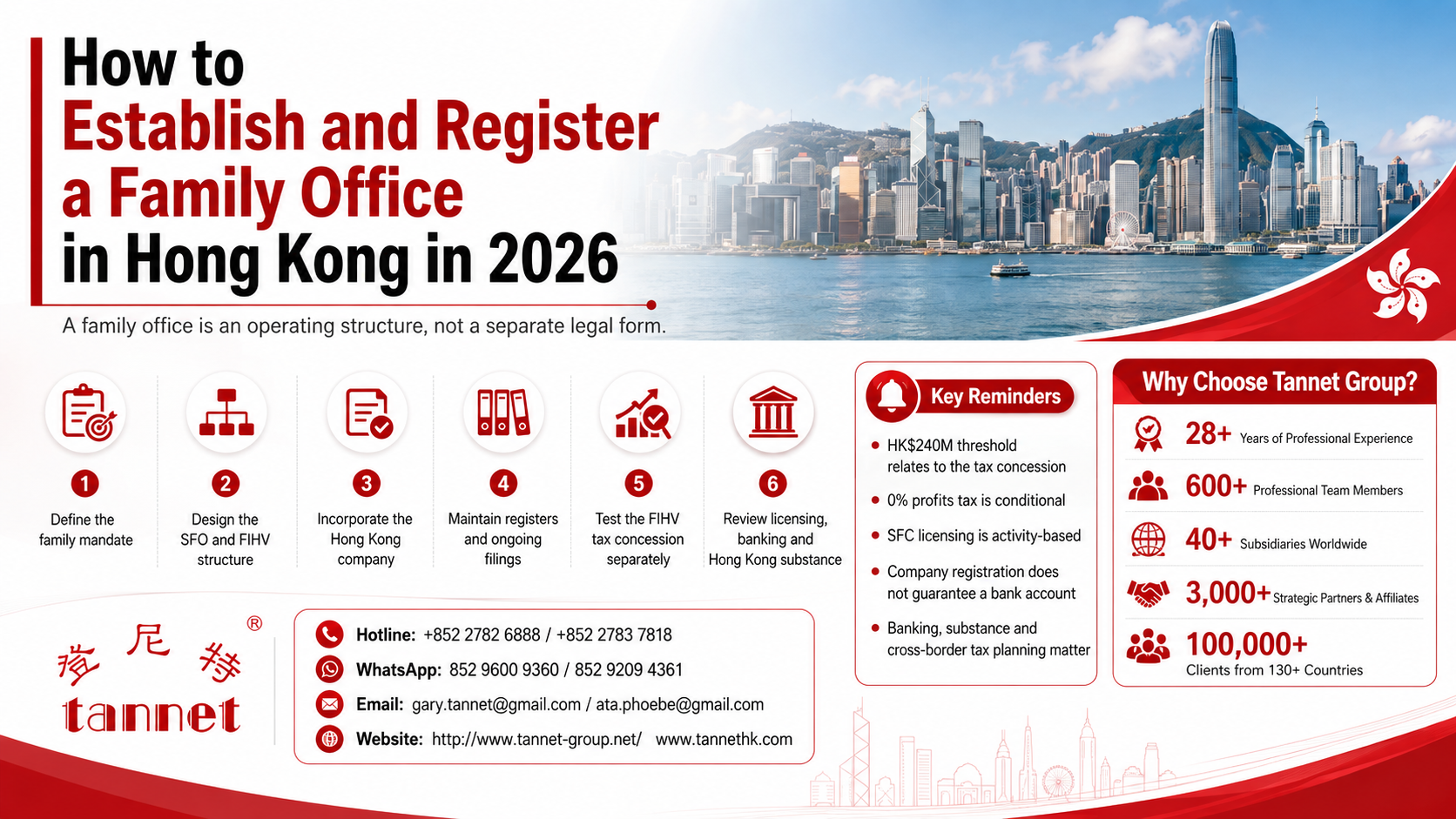
A Hong Kong family office is an operating structure used to manage one family’s investments, governance and long-term affairs. It is not a separate legal form or a special registration category. It suits families that need a genuine Asian decision-making base, coordinated ownership vehicles and professional administration.
The main caution is to separate company incorporation from tax and licensing eligibility. The HK$240 million threshold relates to the FIHV tax concession, not ordinary company registration. The 0% rate is conditional. SFC licensing is activity-based. Banking, substance and cross-border tax issues should be planned before assets move.
What “Registering a Family Office” Actually Means
Hong Kong has no single application that creates an approved family office. The Securities and Futures Ordinance does not define “family office,” according to the Securities and Futures Commission.
A family usually incorporates a private company to operate the single-family office, or SFO. It may also create FIHVs, trusts, partnerships or special-purpose entities. Registration therefore covers corporate, tax, regulatory and banking workstreams.
Step 1: Define the Mandate Before Choosing Entities
Start with the family’s objectives. Decide whether the office will manage investments only or also cover accounting, succession, philanthropy, property, education and family-business coordination.
Record the clients. Serving other families or third parties may change an SFO into a multi-family office and increase licensing risk.
Prepare an asset inventory. Note the owner, jurisdiction, tax basis, restrictions and transfer method for each material asset.
Document the investment committee, reserved decisions, delegation limits, conflicts and succession. An entity chart without decision rules is incomplete.
Step 2: Design the Ownership and Operating Structure
A common model separates the SFO service company from the FIHV that holds investments. The SFO employs or engages the team. It provides management services under a written agreement. The FIHV owns the portfolio.
This separation clarifies fees, responsibilities and records. The FIHV concession applies to qualifying investment-vehicle profits, not every receipt earned by the SFO.
Map family ownership through every entity. For the current concession, family members generally need at least 95% of the beneficial interest in the eligible SFO and FIHV, subject to defined exceptions.
Before transferring assets, review foreign taxes, duties, lender consent, shareholder restrictions and trust powers.
Step 3: Incorporate the Hong Kong Company
Most operating family offices use a private company limited by shares. The Companies Registry requires an incorporation form, articles of association and a notice to the Business Registration Office.
Choose a registrable name and appoint at least one natural-person director. The director need not be a Hong Kong resident. The company secretary must satisfy the local residence or office rule. A sole director cannot hold both roles.
Provide a Hong Kong registered office and accurate ownership information. Approved electronic applications normally receive certificates within one hour, according to the Companies Registry. The full project takes longer.
The incorporation process also produces a Business Registration Certificate through the simultaneous registration arrangement. The certificate does not authorise regulated investment services.
Step 4: Complete Corporate Transparency and Ongoing Filings
A Hong Kong company must maintain statutory registers and accounting records.
An unlisted local company must also keep an up-to-date Significant Controllers Register. It must take reasonable steps to identify people or entities with significant control and appoint an eligible designated representative in Hong Kong.
The company must file annual returns, report specified changes and keep business registration valid. Schedule accounts, audit and tax duties from the first period.
These duties continue even when the family office has few transactions. A private structure is not a compliance-free structure.
Step 5: Test the FIHV Tax Concession Separately
The current regime can apply a 0% profits tax rate to qualifying assessable profits of an eligible FIHV and qualifying family-owned special-purpose entities. No advance approval from the Inland Revenue Department is required, but eligibility must be supportable.
The aggregate net asset value of specified assets held by the relevant FIHV or FIHVs must generally be at least HK$240 million. This is a tax-concession threshold. A family with less may still establish a family office under ordinary corporate and tax rules.
The eligible SFO must be a private company normally managed or controlled in Hong Kong. It must provide services to specified family persons. At least 75% of its assessable profits must come from those services under the safe-harbour rule.
Substance is required. The FIHV must have at least two qualified full-time employees in Hong Kong and incur at least HK$2 million of Hong Kong operating expenditure for the relevant activities. The actual level must also be adequate for the portfolio.
The FIHV must make a written, irrevocable election. Qualifying assets and transactions must be tracked. Private-company investments face additional tests. Anti-avoidance rules can deny relief where arrangements are designed mainly to obtain a tax benefit.
Step 6: Determine Whether SFC Licensing Is Required
There is no blanket family-office licence and no blanket exemption. The SFC applies three questions: does the service constitute a regulated activity, is it carried on as a business, and is that business carried on in Hong Kong?
An SFO that manages only group assets may rely on the Type 9 intra-group carve-out where the precise wholly owned relationships are satisfied. A genuine internal office that is not run for profit may also fall outside the “business” element.
The analysis changes when the office manages third-party assets, serves more than one family, charges commercial fees or shares investment staff across unrelated families. Type 1, Type 4 or Type 9 issues may arise, depending on the activities.
Complete this review before hiring investment staff, signing mandates or describing services publicly. A company name does not determine regulatory status.
Step 7: Prepare Banking and AML Evidence
Company incorporation does not guarantee a bank account. The Hong Kong Monetary Authority states that banks must conduct customer due diligence and ongoing monitoring.
Prepare the ownership chart, family biography, wealth and funds evidence, asset statements, tax-residence data and expected transactions. Trusts require supporting deeds and role explanations.
Keep figures consistent across the incorporation file, tax analysis and bank application. Unexplained changes in ownership, funding routes or activity can delay review.
Step 8: Build Real Hong Kong Operations
Keep committee minutes, research, approvals, instructions, valuations and service-provider reports.
Document which roles are employed or outsourced. Outsourcing should not be used to avoid the substantial-activities requirement.
Immigration is separate. A non-resident can own shares or act as a director, but working in Hong Kong may require the appropriate visa or permission.
The 2026 Bill: Proposed Rules, Not Yet Enacted Rules
The Government gazetted a bill in June 2026 to expand qualifying investments, remove the 5% threshold for incidental transactions and relax parts of the special-purpose-entity rules. The policy direction covers areas such as private credit, digital assets and precious metals.
As of 27 August 2026, the Bills Committee had completed clause-by-clause examination. The Government aimed to resume the second reading debate in the second half of 2026. Implementation should follow the final enacted text and IRD guidance.
Common Mistakes
- Treating “family office” as a special company type or government approval.
- Assuming HK$240 million is required to incorporate any family-office company.
- Advertising asset-management services before completing the SFC perimeter review.
- Moving assets before checking overseas tax, duty, consent and trust consequences.
- Meeting headcount figures on paper without real Hong Kong decision-making.
- Failing to maintain the Significant Controllers Register and annual filing calendar.
- Describing the 2026 bill as current law.
Frequently Asked Questions
Q1. Do I need HK$240 million to register a family office?
No. It is the specified-asset threshold for the FIHV tax concession. It is not a general incorporation minimum. A smaller office may operate under the ordinary tax regime.
Q2. Must family members live in Hong Kong?
Not automatically. However, the eligible SFO and FIHV must satisfy Hong Kong management, control and substance conditions. Personal residence and immigration require separate analysis.
Q3. Can the director and shareholder be non-Hong Kong residents?
Yes. The Companies Registry says a director need not be a Hong Kong resident. The company must still have a qualifying company secretary and Hong Kong registered office.
Q4. Does an SFO always need an SFC licence?
No. Licensing is activity-based. Internal management, the intra-group carve-out and the “carrying on a business” test may be relevant. The ownership chain and actual services must be reviewed.
Q5. How long does registration take?
Electronic incorporation may be completed quickly after approval. Structuring, tax review, banking, licensing, staffing and asset transfers usually take longer. There is no single official timeline for the full project.
Q6. Can the family office outsource staff and functions?
It may outsource selected work, subject to tax and regulatory rules. The arrangement must preserve adequate Hong Kong substance, supervision and records.
Q7. Is the 0% rate automatic after incorporation?
No. The FIHV must meet ownership, management, asset, substance, transaction and election requirements. The SFO’s service income is analysed separately.
Conclusion
Establishing a Hong Kong family office is a coordinated governance, corporate, tax, regulatory and banking project. Incorporation is only one milestone.
Tannet may assist where a family needs entity-establishment coordination, company-secretarial and registered-office support, business registration, bank-account document preparation, accounting and tax coordination, or referrals to legal and regulated specialists. Final legal, tax, immigration and licensing conclusions should come from appropriately qualified advisers for the family’s facts.
Contact Information
Consult:
📍 HK Office:Unit B, 26/F, EGL Tower, 83 Hung To Road, Kwun Tong, Kln., Hong Kong
📞 Tel:852 2782 6888 / 852 2783 7818
📞 WhatsApp:852 9600 9360 / 852 9209 4361
💬 WeChat:Tannetgrouphk / t92094361
📧 Email:gary.tannet@gmail.com / ata.phoebe@gmail.com
🌐 Website:www.tannet-group.com / www.tannethk.com
You are also welcome to visit our service outlets in Beijing, Shanghai, Guangzhou, Shenzhen, and other cities at any time.
Sources
————————————————Simplifying Business, Empowering Entrepreneurs————————————————