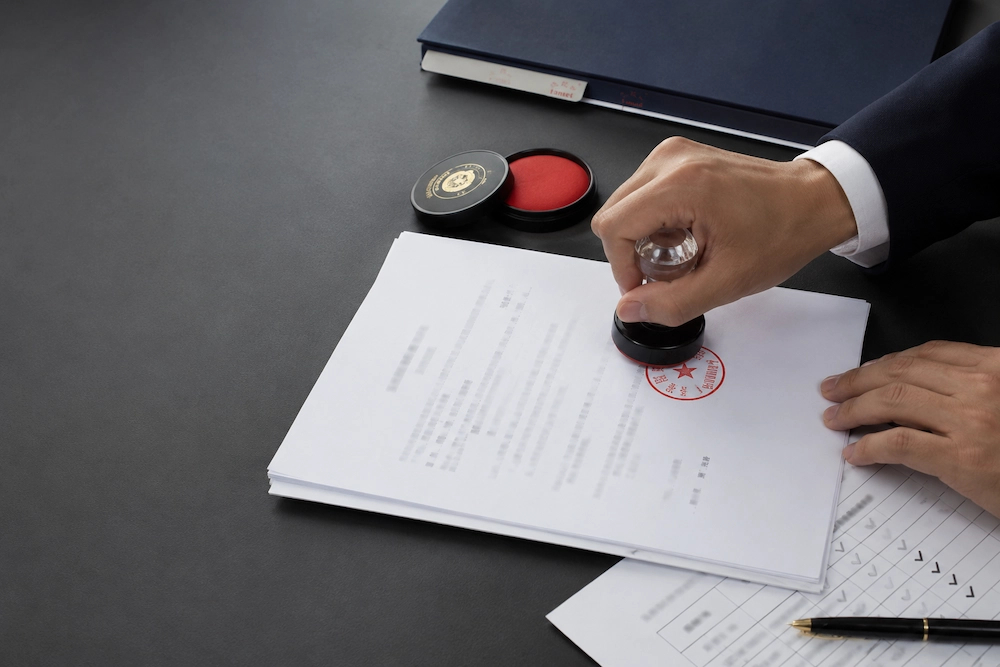
TLDR: Company chops in China are official corporate seals used in contracts, banking, and compliance, giving them significant operational importance. However, while they enable business execution, they do not automatically confer legal authority, and without proper controls, they can expose companies, especially foreign investors, to unauthorized contracts, financial risk, and internal disputes.
Key Takeaways
- Company chops in China are legally recognized instruments of corporate execution, but they do not replace proper authority, approval systems, or governance structures.
- Control of chops is often distributed across departments, making internal authorization procedures more important than physical possession alone.
- Weak chop governance can expose companies to unauthorized contracts, financial leakage, and serious shareholder or management disputes.
- Strong risk control depends on clear documentation, defined approval workflows, and alignment between China operations and overseas headquarters.
For foreign investors doing business in China, one small object often creates more confusion and risk than expected: the company chop. At first glance, it seems straightforward, a red stamp used on contracts and official documents, but in China’s business environment, that simple stamp can carry really legal and commercial weight.
This naturally raises a question many overseas founders only think about asking when it is already too late: who actually controls your company chops? If the answer is not clear, it can directly affect contracts, payments, internal authority, and even control of the company itself. Understanding how chops work is therefore not optional but an essential part of running a safe, well-governed business in China.
What a company chop really is
A company chop, also called a company seal, is an official stamp used by Chinese companies to confirm corporate actions and indicate formal approval of documents. Under China’s Civil Code, affixing a chop is a legally recognized way to express corporate intent and can form a contract alongside or instead of a signature.
This is why chops are so important in practice. They are not symbolic, but functional. However, there is a key nuance many foreign investors overlook: holding a chop does not automatically mean holding legal authority.
In reality, chops matter because they are:
- A legally recognized method of expressing corporate intent
- Widely required in contracts, banking, tax, and administrative procedures
- Powerful tools that must still be used within proper internal authorization
Ultimately, while a chop carries significant weight in business operations, its use must always be backed by valid corporate approval. Possession alone is not enough to establish authority.
Types of Company Chops
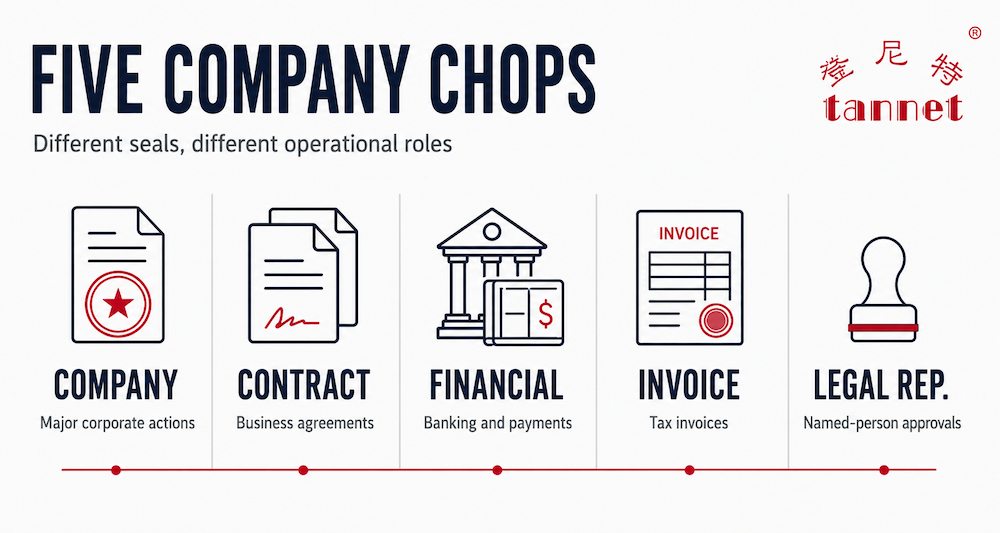
Most companies in China do not use just one chop. They use several, each with a different purpose.
Official company chop
This is the most important one. It carries the company’s registered name and is used for major corporate actions, including contracts, filings, and official approvals.
In practice, it is often considered the “highest authority” chop inside a company. Because of this, it also requires the strictest control.
Contract chop
This chop is used specifically for business agreements. Companies with high transaction volume often use it to streamline contract processing while keeping the official company chop for more sensitive matters.
Financial chop
This chop is linked to banking and financial operations. It is commonly used together with other approvals when dealing with payments, bank accounts, and financial documentation.
Invoice chop
This chop is used for issuing invoices under China’s tax system. It is tied to the company’s tax identity and is especially important for compliance in billing and reporting.
Legal representative chop
This is a personal-name chop used by the company’s legal representative. It is not the same as the company chop and is usually required for specific administrative or banking procedures.
Who Controls Company Chops?
This is where many foreign investors underestimate the risk. There is a common assumption that the legal representative automatically controls everything, but in reality, that is not always the case.
In many companies, chop custody is divided:
- The company chop may be held by administration or corporate affairs staff
- The contract chop may be managed by business or sales teams
- The financial chop is usually kept by finance staff
- The legal representative chop may be separately controlled
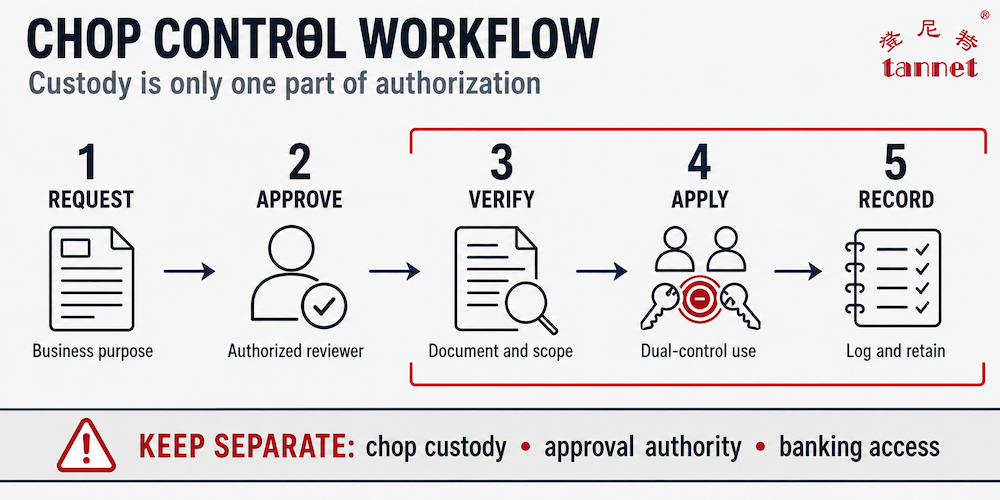
This structure can be healthy when properly managed, as it creates checks and balances. The real issue is not just who physically holds the chop, but:
- Who is authorized to use it
- Under what conditions it can be used
- What approval is required
- How usage is recorded and monitored
When these rules are unclear, control becomes informal and risks emerge. In some cases, one person may control multiple chops, banking access, and contract authority, creating significant exposure for foreign shareholders who are not physically present in China.
Why Chops Matter in Contracts
Imagine this situation: a supplier presents a contract stamped with your company chop. On the surface, everything looks correct, your company name, an official stamp, and someone who appears to represent your business. Yet internally, no one has approved the agreement.
At the same time, it is important not to oversimplify Chinese law. A company chop alone does not automatically determine a contract’s validity. Courts also consider authority, good faith, and internal procedures, meaning a contract may still be enforceable if the counterparty reasonably believed the person had the proper authority.
Risks of Weak Chop Control
When chop management is not properly structured, problems usually do not appear immediately. They appear when there is pressure, change, or conflict.
Unauthorized agreements
An employee with access to a chop may sign contracts without proper approval. Even if the company later disputes the contract, resolving it can be costly and time-consuming.
Internal disputes
Chops often become a central issue when shareholders or senior management disagree. If someone leaves the company but still controls a chop, it can create operational disruption or even legal conflict.
Financial exposure
If financial chops and banking access are not properly separated, the company may face payment risks or unauthorized transactions.
Lack of oversight from headquarters
For foreign investors, one of the biggest challenges is distance. Without clear systems, headquarters may not know how chops are being used until a problem appears.
Key Checks for Chinese Companies
Chop awareness is important internally. It also matters when working with partners, suppliers, or clients in China.
Before signing important contracts, consider:
- Is the company properly registered and active?
- Does the person signing have clear authority?
- Is the contract consistent with the company’s business scope?
- Are approvals and documentation reasonable for the transaction size?
For example, conducting a professional due diligence service can help verify the legitimacy of a company, confirm authority structures, and reduce the risk of entering into unsafe or unauthorized agreements.
Why Choose Tannet
For foreign investors operating in China, the key challenge is not only understanding what company chops are but also ensuring they are properly controlled within a compliant and workable corporate structure. Tannet provides end-to-end corporate and business services to help international companies establish, manage, and safeguard their operations in China, including company formation, corporate secretarial support, compliance management, accounting, tax services, and practical governance systems that reduce operational risk.
When it comes to company chops and corporate authority, we help clients establish clear internal approval systems, define proper chop custody and usage controls, and build documentation frameworks that reduce risks linked to unauthorized contract execution. Instead of treating company setup as a one-time registration task, we focus on long-term control, compliance, and operational clarity in China, giving foreign investors stronger safeguards and a more reliable foundation for growth.
Before Problems Arise
Company chops may look simply, but they sit at the center of corporate authority in China. If you are unsure who controls your chops, how they are being used, or whether your internal approvals are properly structured, it is better to address it early.
Contact us today!