Key Takeaway
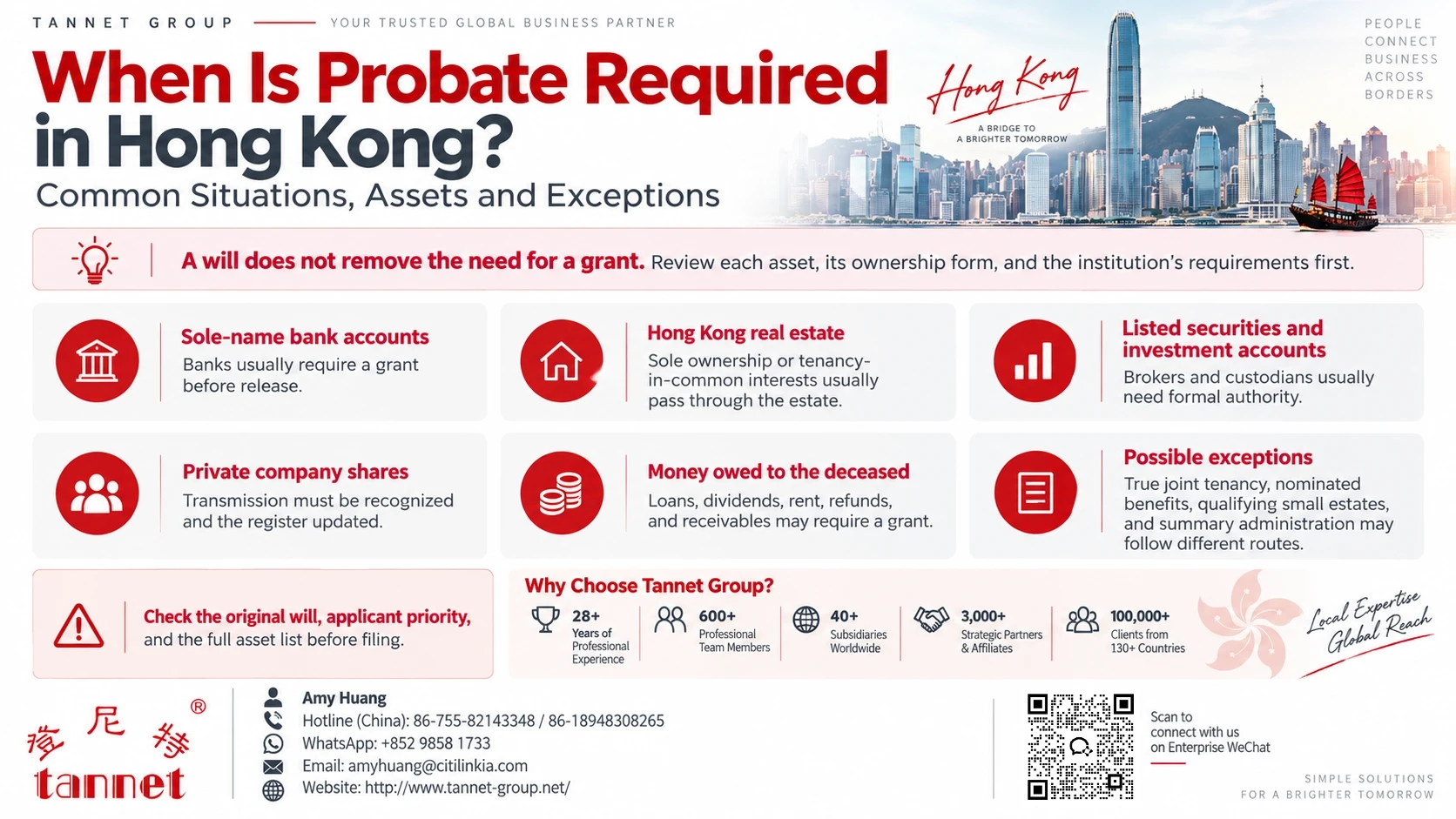
Hong Kong probate is usually required when a deceased person left assets in Hong Kong that an institution cannot release, transfer, or sell without court authority. It is relevant to executors, family members, overseas beneficiaries, and professional advisers dealing with Hong Kong bank accounts, real estate, investments, company shares, or debts owed to the deceased.
The main point is to review each asset, its ownership form, and the asset holder’s requirements before applying.
A will does not remove the need for a grant. Limited alternatives may apply to certain jointly owned assets, nominated benefits, or qualifying small estates, but the facts and documents must be checked first.
What probate means in Hong Kong
The broad court document is a grant of representation. It confirms who has authority to collect and administer the deceased person’s Hong Kong estate.
A grant of probate is normally issued when there is a valid will and an executor named in that will can act. Letters of administration are normally required when there is no valid will. Letters of administration with the will annexed may apply when a will exists but no executor can obtain probate.
The Hong Kong Probate Registry processes non-contentious applications under the Probate and Administration Ordinance and the Non-Contentious Probate Rules. Disputed wills, competing claims, missing beneficiaries, and other contentious matters may require separate legal proceedings.
The practical test for whether a grant is required
The useful question is not only whether the deceased owned something in Hong Kong. Ask whether another person or institution needs formal evidence of authority before dealing with that asset.
A grant is commonly required where the asset was in the deceased’s sole name. Banks, the Land Registry, brokers, and private companies need protection before transferring estate property to an executor, administrator, or beneficiary.
The asset holder’s written requirements also matter. Two institutions may request different supporting documents even when the assets appear similar. Obtain the balance, ownership record, nomination terms, and release requirements before deciding on the procedure.
Situations that commonly require Hong Kong probate
A bank account held in the deceased’s sole name
A sole-name current account, savings account, time deposit, or foreign-currency account normally forms part of the estate. The bank may freeze withdrawals after receiving notice of death.
The personal representative usually needs a grant before the bank will release a material balance.
Hong Kong real estate owned solely or as a tenant in common
Solely owned land or a fractional interest held as a tenant in common remains part of the deceased’s estate. A personal representative normally needs court authority before completing the transmission, sale, or other dealing.
The title documents must be checked. A property described informally as jointly owned may legally be held as a tenancy in common. That difference can decide whether the deceased’s share passes through the estate.
Listed securities and investment accounts
Shares, bonds, funds, and brokerage accounts registered in the deceased’s sole name normally require an authorized personal representative. The broker, registrar, or custodian may request the grant, death certificate, identity documents, and its own transmission forms.
Shares in a Hong Kong private company
Company shares do not transfer automatically because the family controls the business. The deceased remains the registered member until a lawful transmission is recognized and the register of members is updated.
The grant, the company’s articles, any shareholders’ agreement, and board procedures should be reviewed together.
Money owed to the deceased
Loans, unpaid salary, dividends, rent, refunds, and contractual receivables can be estate assets. A debtor may require a grant before paying anyone who claims to represent the estate.
Multiple Hong Kong assets held by an overseas deceased
Hong Kong court authority may still be needed when an overseas deceased left local property, deposits, securities, or company shares.
Some foreign grants can be resealed. Otherwise, a fresh Hong Kong application may be required.
A will does not eliminate the probate process
A will identifies the intended executor and beneficiaries. It does not itself give a bank or registry the same protection as a court grant.
The Probate Registry must still consider whether it is the deceased’s last valid will and whether the applicant is entitled to act.
Where there is no valid will, the estate is not automatically ownerless. The Intestates’ Estates Ordinance determines entitlement, and the correct person must apply for letters of administration according to the statutory priority.
Situations where a full grant may not be required
No Hong Kong estate needs administration
No application is normally needed if the deceased left no Hong Kong asset requiring collection or transfer.
Property held under a true joint tenancy
An asset held under a joint tenancy may pass to the surviving joint owner by survivorship rather than through the deceased’s estate. This commonly arises with some jointly owned property.
The ownership instrument controls. Joint bank accounts require a separate review of the mandate and beneficial ownership.
Benefits payable outside the estate
Some insurance proceeds, trust assets, or contractual death benefits may be payable directly to a validly nominated beneficiary. Whether a grant is needed depends on the governing document, nomination, legislation, and provider’s procedure.
Ask the trustee or insurer for its written claim requirements.
A qualifying small estate consisting only of money
The Home Affairs Department’s Estate Beneficiaries Support Unit may issue a Confirmation Notice for a qualifying Hong Kong estate consisting wholly of money not exceeding HK$50,000. The service applies under statutory conditions and does not cover land, business interests, safe-deposit-box contents, or other non-money assets.
A Confirmation Notice is not a grant of representation. It is a limited route for specified small estates. If another asset is discovered or the value exceeds the threshold, a court application may still be required.
Summary administration by the Official Administrator
Section 15 of the Probate and Administration Ordinance provides a separate summary administration mechanism for certain estates not exceeding the statutory limit, currently HK$150,000. It is not interchangeable with the HK$50,000 Confirmation Notice procedure.
Eligibility and the Official Administrator’s acceptance must be checked.
How to decide before filing
- Obtain the death certificate and search for the original will and codicils.
- Prepare an asset and liability inventory with ownership and date-of-death values.
- Ask each institution what authority it requires. Keep written replies and current forms.
- Identify whether the deceased was domiciled in Hong Kong or elsewhere.
- Confirm who has priority to apply. Do not distribute assets merely because all family members appear to agree.
- Check for disputes, minor beneficiaries, insolvency, missing originals, and foreign documents.
- Select the correct route: probate, letters of administration, letters with the will annexed, resealing, Confirmation Notice, or another lawful process.
Common mistakes
- Assuming a will lets the executor withdraw money immediately. The executor usually still needs a grant for estate assets.
- Counting only cash. Property, company shares, receivables, tax refunds, digital accounts, and business interests can also matter.
- Treating every joint account as outside the estate. Legal and beneficial ownership may require closer review.
- Confusing the HK$50,000 Confirmation Notice with the HK$150,000 summary administration mechanism.
- Applying before confirming the original will, applicant priority, and the full asset list. Corrections can lead to Registry requisitions.
- Distributing money before identifying debts and expenses. Personal representatives can face liability for an improper distribution.
- Assuming an overseas grant automatically works in Hong Kong. Resealing is available only in qualifying cases and still requires a Hong Kong court process.
Frequently asked questions
Q1 Is probate required if the deceased left only one Hong Kong bank account
Often yes, if the account was in the deceased’s sole name and the bank requires a grant. A qualifying money-only estate not exceeding HK$50,000 may be eligible for a Confirmation Notice. Confirm the date-of-death balance and bank requirements first.
Q2 Is probate required when there is a valid Hong Kong will
Usually yes for assets that require court authority. The executor normally applies for a grant of probate. The will guides the distribution, while the grant proves the executor’s authority to deal with institutions.
Q3 What happens if the deceased did not leave a will
An eligible person normally applies for letters of administration. The priority to apply and the beneficiaries’ shares follow Hong Kong intestacy law. Family agreement alone does not replace the statutory rules.
Q4 Does jointly owned property require probate
Property held under a true joint tenancy may pass by survivorship. A tenancy-in-common share remains part of the estate. Review the registered title and obtain advice if ownership or contribution is disputed.
Q5 Can an overseas executor use a foreign probate grant in Hong Kong
Possibly. A qualifying foreign grant may be resealed in Hong Kong. If resealing is unavailable, a new Hong Kong grant may be needed. The jurisdiction, grant type, domicile, and document evidence must be checked.
Q6 Are Hong Kong company shares covered by probate
Usually, if the shares were registered in the deceased’s name. The personal representative must also follow the company’s articles, register-of-members procedure, and any shareholders’ agreement.
Q7 Can the family sell estate assets before the grant is issued
Usually not where valid title or institutional authority depends on the grant. Urgent preservation steps may be possible, but sale proceeds and distribution should be handled only with proper authority.
When Tannet may assist
Tannet may assist families, executors, overseas beneficiaries, and business owners with preliminary asset mapping, document checklists, institution liaison, application coordination, certified-document logistics, and post-grant administrative steps. Matters involving disputed wills, competing claims, court advocacy, foreign-law opinions, or complex legal interpretation should be handled with a qualified solicitor or other appropriate professional.
This article provides general information and is not legal advice. Procedures and institution requirements should be checked for the specific estate.
Sources: Hong Kong Judiciary Probate Registry; Probate and Administration Ordinance Cap. 10; Non-Contentious Probate Rules Cap. 10A; Intestates’ Estates Ordinance Cap. 73; Home Affairs Department Estate Beneficiaries Support Services; Inland Revenue Department Estate Duty.
Written by: Tannet Business Services Team
Reviewed by: Consultant Amy Huang
First published: 16 Sep. 2026
Last reviewed: 16 Sep. 2026
————————————————Simplifying Business, Empowering Entrepreneurs————————————————