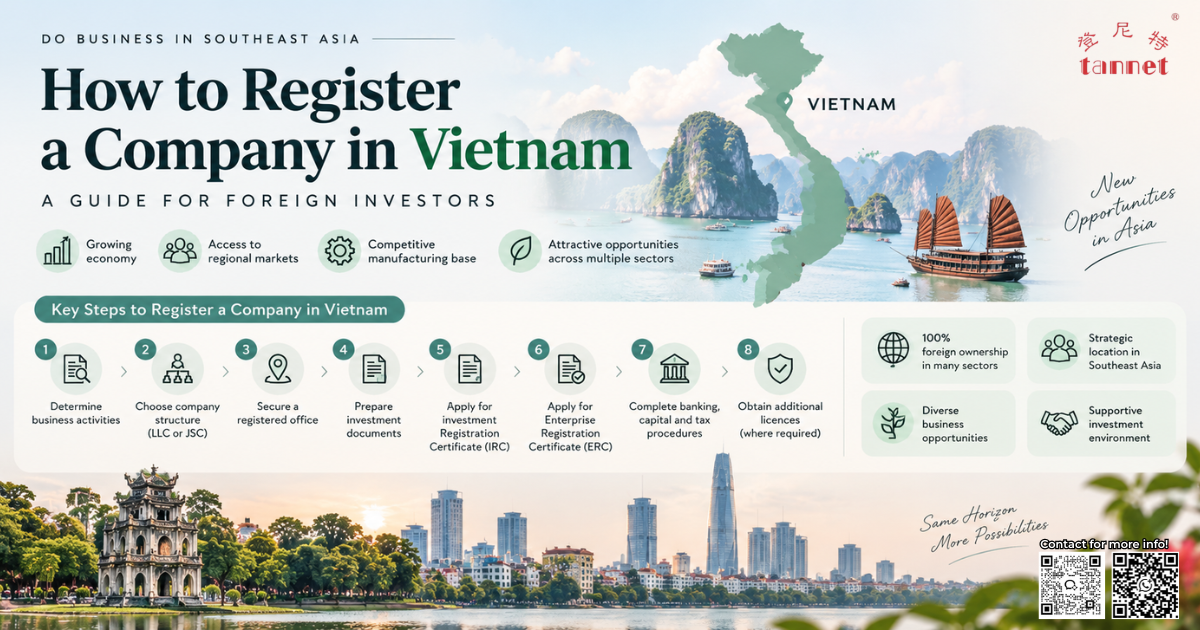
Vietnam has become an important destination for foreign investment in Southeast Asia, particularly in manufacturing, trading, technology, logistics and professional services. Its growing domestic market, expanding industrial base and integration into international supply chains continue to attract overseas businesses.
Foreign investors can register a company in Vietnam, with 100% foreign ownership permitted in many sectors. However, certain industries are subject to foreign ownership restrictions or additional market-access conditions.
For most foreign investors establishing a new company, the process involves two key registrations: the Investment Registration Certificate (IRC) and the Enterprise Registration Certificate (ERC).
1. Can Foreigners Register a Company in Vietnam?
Yes. Foreign individuals and overseas companies can establish businesses in Vietnam.
Foreign investors generally have access to business sectors unless the proposed activity is restricted or subject to specific market-access conditions. Depending on the industry, these conditions may include:
- Foreign ownership limitations
- Joint venture or investment structure requirements
- Investor qualification requirements
- Additional licences or regulatory approvals
Investors should therefore confirm whether their proposed business activities are open to foreign investment before beginning the Vietnam company registration process.
2. What Type of Company Can Foreign Investors Establish?
One of the most common structures is a Limited Liability Company (LLC).
A Single-Member LLC is suitable for one individual or corporate owner, while a Multiple-Member LLC can have between two and 50 members.
Foreign investors may also establish a Joint Stock Company (JSC), which is generally more appropriate for businesses involving multiple shareholders or more complex capital and ownership arrangements.
The appropriate structure depends on the number of investors, proposed activities and long-term business plans.
3. What Are the Requirements for Vietnam Company Registration?
Before setting up a company in Vietnam, foreign investors generally need to determine:
- Company name
- Business activities
- Company structure
- Shareholders or members
- Legal representative
- Registered office
- Investment and charter capital
- Investment project details
The registered office must be a legitimate location suitable for the proposed activities. Businesses involving manufacturing, warehousing or regulated activities may face additional location requirements.
4. Is 100% Foreign Ownership Allowed in Vietnam?
Yes, 100% foreign ownership is permitted in many Vietnamese business sectors, but not all.
Certain industries remain subject to foreign investment conditions. Depending on the proposed activity, there may be foreign ownership limits, joint-venture requirements or additional approvals.
Investors entering areas such as telecommunications, advertising, logistics, education and certain regulated services should carefully check the applicable market-access rules before incorporation.
5. Is There a Minimum Capital Requirement?
Vietnam does not impose one universal minimum capital requirement for every foreign-owned company.
For many ordinary business activities, the proposed investment should instead be reasonable for the company’s intended operations. Authorities may consider factors such as the business model, premises, staffing, equipment and scale of the project.
Certain regulated industries may have specific statutory capital requirements.
Foreign investors may also need to provide evidence of sufficient financial capacity to implement the investment project.
6. How to Register a Company in Vietnam
For a typical foreign-invested company, the registration process generally follows these steps:
Step 1: Determine the Business Activities
Identify the activities the company intends to conduct and confirm whether they are open to foreign investment.
Step 2: Choose the Company Structure and Registered Office
Select the appropriate legal structure and secure a legitimate business address in Vietnam that is suitable for the intended activities.
Step 3: Prepare the Investment Documents
Prepare the investor identification, project, financial capacity and registered-address documents.
Foreign-issued documents may need to undergo consular legalization, Vietnamese translation and certification, depending on the applicable requirements.
Step 4: Apply for the Investment Registration Certificate (IRC)
A typical foreign investor establishing a new foreign-invested company must obtain an Investment Registration Certificate where required.
The IRC records key information about the investment project, including the investor, investment objectives, capital, location and implementation arrangements.
For projects that do not require investment policy approval, the statutory processing period is generally 15 days after a complete and valid application is received.
Step 5: Apply for the Enterprise Registration Certificate (ERC)
After obtaining the IRC, the investor applies for the Enterprise Registration Certificate to formally establish the Vietnamese company.
For a valid enterprise registration application, the statutory processing period is generally three working days.
Step 6: Complete Post-Registration Procedures
After incorporation, the company may need to complete corporate banking, capital contribution, tax, accounting, electronic invoice, employment and other operational procedures.
Additional licences must also be obtained before conducting regulated business activities.
7. What Documents Are Required?
Documents commonly required for company registration in Vietnam may include:
- Passport or identification documents of individual investors
- Certificate of incorporation or equivalent documents for corporate investors
- Investment project proposal
- Evidence of financial capacity
- Registered office or lease documentation
- Company charter
- Details of members or shareholders
- Legal representative information
- IRC and ERC application documents
Corporate investors should allow additional preparation time because overseas corporate documents may require legalization and translation.
8. How Long Does Company Registration in Vietnam Take?
For a standard project that does not require investment policy approval, the IRC has a statutory processing period of generally 15 days after receipt of a complete and valid dossier.
The subsequent ERC application generally has a statutory processing period of three working days after receipt of a valid application.
The overall setup can take longer where document legalization, additional regulatory review or sector-specific licences are required.
9. Common Mistakes Foreign Investors Should Avoid
Foreign investors should avoid treating incorporation as simply obtaining an enterprise certificate.
Common problems include:
- Selecting an inaccurate business scope
- Failing to check foreign ownership restrictions
- Using an unsuitable registered address
- Setting unrealistic investment capital
- Assuming the IRC and ERC cover all operating licences
Planning these matters before incorporation can reduce complications when the company begins operations, opens bank accounts, contributes capital or applies for additional licences.
Conclusion
Vietnam offers significant opportunities for foreign investors, and 100% foreign-owned companies can be established in many sectors. However, investors must carefully consider their business activities, ownership structure, capital, registered location and licensing requirements.
For most foreign-invested businesses, the process can be summarized as:
Confirm business activities → Choose company structure → Secure registered address → Prepare documents → Obtain IRC → Obtain ERC → Complete banking, capital, tax and licensing procedures.
Understanding these requirements before starting the Vietnam company registration process can help investors establish a compliant structure and avoid unnecessary delays.
Official and credible sources
- Vietnam National Legal Database — Law on Investment No. 61/2020/QH14
Vietnam Law on Investment
- Invest Vietnam — Procedures for Establishment of Foreign-Invested Company
Foreign-Invested Company Establishment Procedures
- Invest Vietnam — Enterprise Registration Certificate
Enterprise Registration Certificate Guidance
📞 Free 1-on-1 Consultation Now,
Official Service Hotline: +86-755-82148419
Cell: +86-13823131503;+60 19-309 2363
WeChat ID: 13823131503;
WhatsApp:+86-13823131503;+60 19-309 2363
Email: mytannet08@gmail.com; susiehu@citilinkia.com