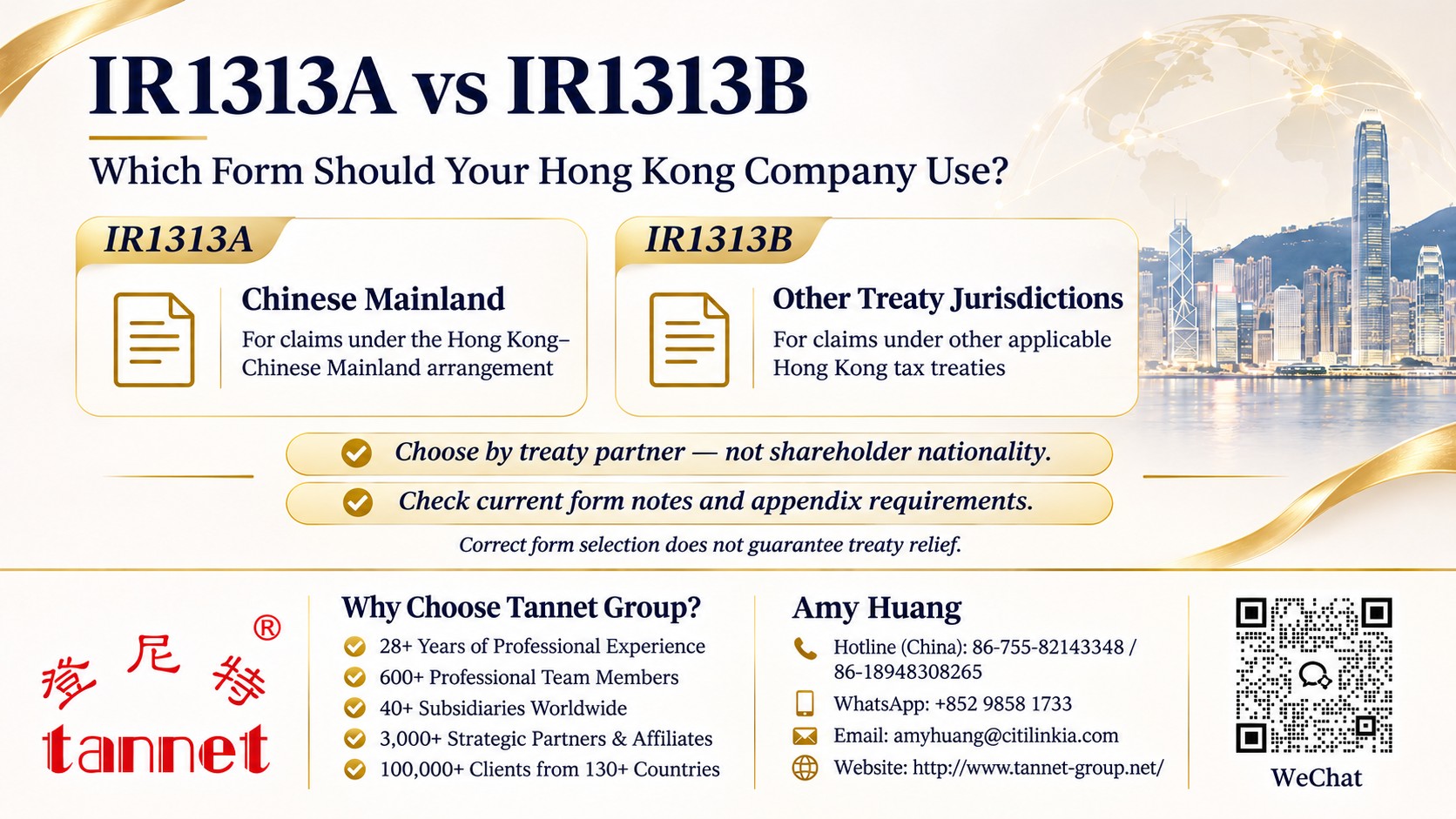
Key Takeaway
A company should use IR1313A for a Certificate of Resident Status application concerning the arrangement between Hong Kong and the Chinese Mainland. IR1313B applies to relevant treaties with other jurisdictions. The distinction follows the treaty claim, not the shareholders’ nationality or where the application is posted.
This guide suits company directors, finance teams and service providers preparing residence evidence. Identify the applicant, treaty partner and claim period before selecting a form. Then check the current notes and any appendix requirements.
Choosing the correct form does not establish entitlement to a reduced foreign tax rate. Residence certification and acceptance of the underlying treaty claim remain separate decisions.
Step one identify the actual applicant
Confirm which legal entity receives the income and claims treaty benefits. Use its registered name and identifiers consistently. A Hong Kong trading name, group abbreviation or bank account label may not identify the company that must apply.
Both IR1313 forms cover companies and certain other non-individual applicants. Individuals use the IR1314 series instead. A shareholder seeking personal certification should not use the company’s form merely because that shareholder owns the business.
Distinguish incorporation from management facts. A company established outside Hong Kong may have a relevant residence position, but must meet the applicable treaty definition. Do not select IR1313B solely because the company was incorporated overseas; the treaty partner still determines the A or B route.
Step two select the treaty partner
Use IR1313A when requesting Hong Kong residence evidence for benefits under the arrangement with the Chinese Mainland. The application is made to Hong Kong’s competent authority. It is not an application to become a resident of the Chinese Mainland.
Use IR1313B for another relevant jurisdiction. Identify that jurisdiction expressly in the application. Before proceeding, check the IRD treaty register for effectiveness during the claim period. A signed agreement that is not yet effective cannot simply be treated as an available benefit.
The location of an intermediary bank does not settle this question. Ask which jurisdiction’s tax is being relieved and which entity is responsible for the payment or claim. Escalate ambiguous payment structures before filling in the jurisdiction field.
Step three use current official documents
At the source check for this article, the IRD lists both corporate forms with the revision reference 07/2025. Download them from the official application page. A saved historical form or an adviser template may omit current instructions.
Read the notes together with the application. Keep the entire downloaded file rather than separating the first page from later instructions. The front page, notes and appendix serve different purposes and should not be treated as interchangeable attachments.
Create a short application brief identifying the claimant, treaty, relevant calendar years and income description. Obtain factual confirmation from the finance team before asking someone to sign. The person completing the form should not guess missing amounts or dates.
Step four understand the A form’s additional features
IR1313A includes information specific to the Chinese Mainland claim, including the applicant’s local tax identification number if any and the responsible tax authority if known. It also asks about earlier certification and material changes in operations.
Its appendix has separate triggers. Part 1 concerns applicants established outside Hong Kong, other than re-domiciled companies. Part 2 concerns specified dividend claims falling within Articles 3 or 4 of STA Circular 2018 No. 9. Not every dividend application automatically requires that part.
Where the specified dividend facilitation provisions are relevant, review the accompanying notes on coordinated applications and ownership information. Do not assume the immediate recipient alone supplies every required fact. Obtain advice on the relevant ownership chain before declaring a position.
Step five check the B form’s appendix separately
IR1313B is not simply IR1313A with another destination typed into the heading. Its appendix applies to applicants established outside Hong Kong, other than re-domiciled companies, and to applications under the Hong Kong–Japan treaty. A Hong Kong-incorporated company should therefore check the Japan requirement.
Where applicable, prepare evidence explaining actual operations and decision-making. Assign responsibility for obtaining historical records before the filing deadline. Do not invent meetings, staff or management activity because an appendix asks about them; accurate explanations are preferable to unsupported assertions.
Do not transplant answers from a different group company. Even businesses sharing an address or directors may have different income, management arrangements and claim periods. Reusable document formats should not become reusable factual declarations.
Step six assemble and reconcile supporting information
Review the relevant form notes for establishment documents, name changes and any special applicant category. They also identify eligible signatories for companies. Confirm that the person signing understands the completed declarations and that a contact can answer follow-up questions.
Reconcile the applicant name against contracts, invoices and withholding information. Record the calendar years relevant to the claim. A payment forecast, accounting year and foreign tax reporting period may differ; explain those differences rather than forcing them into one unsupported date.
Resolve conditional fields before declaring the submitted information complete.
Step seven submit through the appropriate channel
IRD guidance allows online applications through the relevant tax portals, as well as postal or in-person submission. Confirm portal access and service-agent authorization in advance. Keep copies of what was actually submitted, including the appendix where required.
If preparing several claims, separate them by applicant and treaty partner. Use clear file names and an internal register. A folder containing one B form should not be assumed to cover every jurisdiction from which a company expects income.
The IRD’s performance pledge targets a certificate or an assessing officer’s notification within 21 working days after receipt of a properly completed application. A notification can request information or advise that the application cannot be accepted. It is not a guaranteed issue deadline.
Step eight coordinate the foreign claim
Ask the payer or destination adviser which residence evidence and other documents its procedure requires. Supplying the correct Hong Kong application form to the payer is not the same as supplying an issued certificate. Label application status accurately.
The IRD cautions that certification does not guarantee foreign treaty benefits. Check the relevant article and remaining conditions independently. A company’s application may be properly prepared while a particular income stream still fails another requirement.
Common mistakes
Avoid interpreting A as “applicant incorporated in Hong Kong” and B as “applicant incorporated abroad.” Avoid using the individual form for company income. Do not submit both corporate forms for the same claim merely because the company has cross-border shareholders.
Do not reuse a certificate for a different treaty without checking its scope. Do not confuse the Chinese Mainland administrative arrangement on certificate coverage with worldwide validity. Avoid assuming a correct form removes the need to examine beneficial ownership or anti-abuse rules.
Frequently asked questions
Q1 Our shareholder lives in the Chinese Mainland, but the income arises elsewhere. Which form applies?
Identify the treaty under which the company claims relief. The shareholder’s residence does not alone decide the form. Confirm the income’s tax treatment with the destination adviser.
Q2 Can we file one IR1313B for several treaty partners?
Prepare partner-specific applications. The B form asks which treaty jurisdiction is concerned. Do not list unrelated jurisdictions as though a single general certificate necessarily covers them all.
Q3 Does a Japan claim use IR1313A?
No. It follows the B route, with its specific appendix requirement. Check the current instructions rather than treating Japan as part of the A category.
Q4 Do all Chinese Mainland dividend claims require appendix Part 2?
No. Check whether the claim falls within the specified Circular provisions. Seek advice if the ownership chain or facilitation conditions are unclear before completing that part.
Q5 Can we correct the wrong form after submission?
Contact the IRD with the application reference and explain the issue. Ask what replacement or supplementary information is required. Do not assume a silent second submission corrects the first.
Q6 Does a certificate prove every foreign tax condition?
No. Residence evidence is only part of the claim. The relevant foreign authority determines relief under the applicable treaty and procedures.
Q7 Which version should we use next year?
Check the official website again. This article records the versions available when reviewed, not a promise that forms and instructions will remain unchanged.
Where Tannet can assist
Tannet can help identify the application route, organize company records and coordinate preparation. Complex residence questions, dividend ownership chains and foreign filing requirements may need specialist advice. Confirm the scope before submission.
Written by: Tannet Business Services Team
Reviewed by: Consultant Amy Huang
First published: 4 Nov. 2026
Last reviewed: 4 Nov. 2026
30th Anniversary Offer: Tannet has been established for 28 years, we are offering exclusive limited-time promotional pricing to celebrate Tannet’s 30th anniversary. Slots are limited and available on a first-come, first-served basis. Contact Consultant Amy Huang for details.
————————————————Simplifying Business, Empowering Entrepreneurs————————————————