Businesses entering international retail markets, expanding into cross-border e-commerce or supplying products to overseas distributors often need internationally recognised product barcodes. A GS1 barcode provides a standardised way to identify individual products, helping businesses manage inventory, facilitate retail transactions and exchange product information across supply chains.
For companies considering Hong Kong as their business or trading base, applying for a GS1 barcode through GS1 Hong Kong is an important step towards establishing a reliable product identification system.
However, obtaining a barcode involves more than simply generating a series of numbers. Businesses must understand the GS1 membership requirements, company prefix allocation, product identification rules and supporting documentation before beginning the application.
This guide explains how to apply for a Hong Kong GS1 barcode, the documents required, the registration process and the key considerations for manufacturers, exporters, retailers and cross-border e-commerce businesses.
1. What Is a GS1 Barcode?
A GS1 barcode is a globally recognised product identification system that allows businesses to assign unique identification numbers to their trade items.
The most commonly used product identifier is the Global Trade Item Number (GTIN). This number is encoded into a barcode that can be scanned by retail checkout systems, warehouses, distributors and other supply chain participants.
Depending on the product and market requirements, businesses may use different barcode formats, including:
- EAN-13: Commonly used for consumer products in international retail markets.
- UPC-A: Widely used in the United States and Canada.
- ITF-14: Commonly used for identifying outer cartons and packaging levels in distribution.
- GS1-128: Used in logistics and supply chain applications to encode additional information.
The appropriate barcode format depends on how the product will be distributed, packaged and sold.
A GS1 barcode is particularly useful for businesses supplying supermarkets, distributors, international retailers and online marketplaces that require standardised product identification.
2. Why Apply for a GS1 Barcode in Hong Kong?
Hong Kong is an established international trading and business hub. Companies operating through Hong Kong entities may choose to obtain GS1 identification numbers to support their product distribution and international business activities.
There are several reasons why businesses consider Hong Kong product barcode registration.
International product identification
GS1 standards are used across international supply chains. A properly assigned GTIN helps retailers, distributors and trading partners identify products consistently across different markets.
E-commerce product listing
Many online marketplaces require sellers to provide valid product identifiers when creating product listings. Official GS1 numbers help businesses establish product identification and support marketplace verification requirements.
Retail distribution
Retailers and distributors commonly rely on standardised barcodes to manage product catalogues, stock movement, point-of-sale transactions and replenishment.
Inventory and supply chain management
Unique product identifiers help businesses distinguish between different products, packaging sizes and product variations. This improves inventory accuracy and reduces identification errors.
Business credibility
GS1 membership provides access to an established international product identification system. It can also help businesses demonstrate that their product numbers have been allocated through an authorised GS1 organisation.
Importantly, a Hong Kong GS1 barcode does not automatically certify a product’s origin, quality or authenticity. A barcode identifies a product within the GS1 system; it does not replace manufacturing certifications, regulatory approvals or product compliance documentation.
3. Who Can Apply for GS1 Hong Kong Membership?
Businesses planning to register products using Hong Kong GS1 identification numbers generally need to apply for the relevant membership through GS1 Hong Kong.
Typical applicants include:
- Manufacturers registering their own branded products.
- Importers and exporters managing international product distribution.
- Trading companies supplying overseas retailers.
- Retailers developing private-label product ranges.
- E-commerce businesses selling consumer goods internationally.
- Brand owners coordinating production through third-party manufacturers.
Businesses should first assess whether a Hong Kong company is the appropriate applicant and whether the proposed membership structure meets GS1 Hong Kong’s current eligibility requirements.
A Hong Kong company registration alone should not be assumed to guarantee membership approval. The applicant must satisfy the association’s documentation and membership requirements.
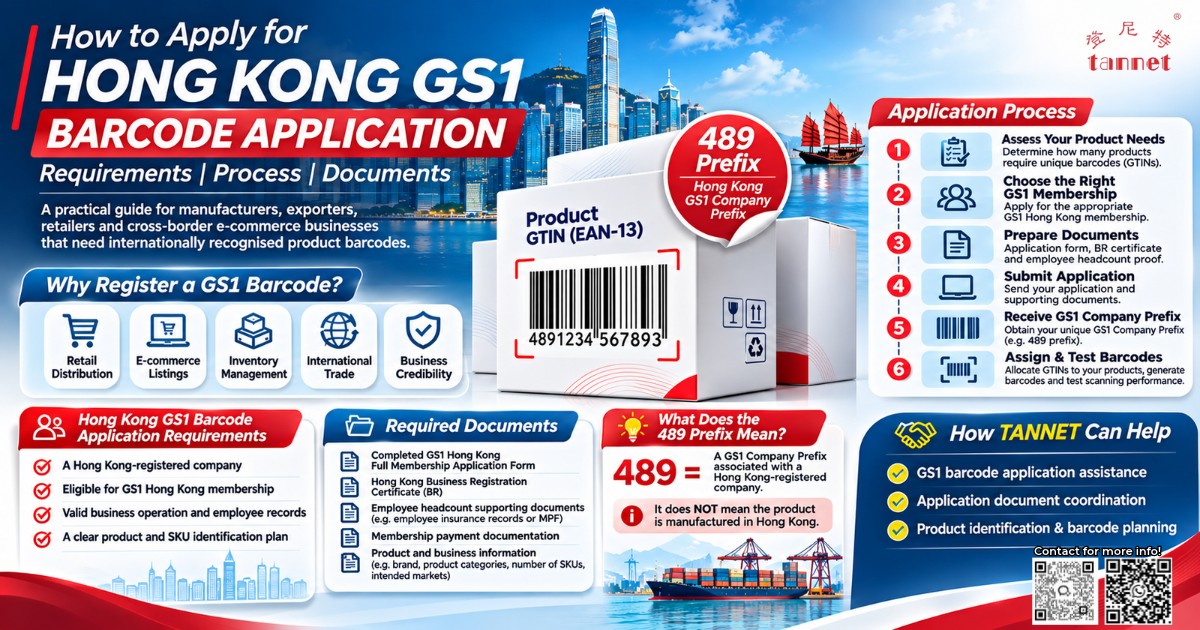
4. What Documents Are Required for a Hong Kong GS1 Barcode Application?
Preparing the correct documentation is essential for a smooth GS1 Hong Kong membership application.
The standard full membership application documentation identified by GS1 Hong Kong includes the following:
1. Completed GS1 Hong Kong Full Membership Application Form
The applicant must complete the relevant membership application form and provide accurate company and contact information.
This normally includes the company’s registered details, business nature, applicant’s information and other requested particulars.
2. Hong Kong Business Registration Certificate
A copy of the company’s valid Business Registration Certificate (BR) is required to establish its business registration details.
3. Employee Headcount Supporting Documents
Applicants may be required to provide evidence of their employee headcount. Supporting documentation may include employee insurance records or Mandatory Provident Fund (MPF) documentation.
The supporting evidence should reflect the company’s actual employment situation and meet the association’s requirements.
4. Membership Payment Documentation
The application requires payment of the applicable membership entrance and annual fees according to the relevant membership arrangement.
The applicant should confirm the current payment instructions and applicable membership category before submission.
5. Product and Business Information
Although the core membership documentation is centred on company eligibility, applicants should also prepare product information to support their barcode planning.
Useful information includes:
- Company and brand names.
- Product categories.
- Product descriptions.
- Number of existing SKUs.
- Estimated number of products requiring barcodes.
- Intended sales markets.
- Retail, wholesale or e-commerce distribution channels.
Preparing these details in advance makes it easier to determine the appropriate barcode allocation requirements.
5. Step-by-Step Process for Applying for GS1 Barcodes in Hong Kong
The Hong Kong GS1 barcode application process generally involves several stages.
Step 1: Assess Your Business and Product Requirements
Before submitting an application, identify the products that require unique identification numbers.
For example, a business selling skincare products in five different formulations and three packaging sizes may need to account for multiple distinct trade items.
The number of barcodes required should therefore be assessed based on the actual product range rather than simply the number of product categories.
Step 2: Determine the Appropriate GS1 Membership
GS1 Hong Kong offers membership arrangements that provide access to GS1 identification services.
The appropriate membership and company prefix allocation should be considered according to the company’s eligibility, expected product range and business requirements.
Businesses should avoid selecting an allocation without first estimating their future product identification needs.
Step 3: Prepare the Required Documents
Gather the completed application form, Business Registration Certificate and employee headcount supporting documents.
Check that the company information is consistent across all supporting records.
If additional information is requested during the review, provide the relevant clarification promptly.
Step 4: Submit the Membership Application
Submit the completed application and supporting documents through the designated GS1 Hong Kong application channel.
The association will review the submitted information and confirm whether further documentation or clarification is required.
Step 5: Obtain the GS1 Company Prefix
Upon successful application, GS1 Hong Kong allocates the relevant GS1 Company Prefix.
This prefix forms part of the identification structure used to create unique product GTINs.
The company can then manage its product identification numbers in accordance with GS1 allocation rules.
Step 6: Assign GTINs to Individual Products
After obtaining the necessary membership and allocation, the business can assign unique GTINs to its products.
Each product that requires a distinct trade item identity must be assigned an appropriate identifier.
For example, different product sizes, flavours or packaging configurations may require separate GTINs where they represent distinct trade items.
A GTIN should not be reused for an unrelated product.
Step 7: Generate and Test the Barcode
Once the GTIN has been assigned, the corresponding barcode image can be generated and incorporated into the product packaging or label design.
Before mass production, businesses should check barcode placement, print quality, dimensions and scanning performance.
GS1 Hong Kong also provides barcode testing services for members.
This step helps reduce the risk of scanning problems when products enter retail or distribution channels.
6. What Does the 489 Barcode Prefix Mean?
One important consideration when applying for Hong Kong GS1 barcodes is the 489 prefix.
GS1 Hong Kong is the authorised organisation in Hong Kong for allocating GS1 identification numbers with the 489 prefix.
A 489 prefix indicates that the GS1 Company Prefix is associated with a company registered in Hong Kong.
However, it does not mean that the product was manufactured in Hong Kong.
For example, a Hong Kong-registered brand owner may manufacture its products in Malaysia, Mainland China or another country while using its Hong Kong-allocated GS1 identification numbers.
Businesses should not use the barcode prefix as proof of product origin when dealing with customs authorities, importers or consumers.
7. Common Mistakes to Avoid When Applying for GS1 Barcodes
Businesses should pay attention to several common issues before proceeding with their applications.
Purchasing unauthorised barcodes
Some third-party sellers offer inexpensive barcode numbers without providing legitimate GS1 membership or allocation. Such numbers may have been assigned to another company or may not be recognised as valid identifiers.
Always verify the source and ownership of a barcode.
Underestimating the number of required barcodes
A product range may contain multiple sizes, flavours, colours or packaging configurations. Failing to plan for these differences can create problems when expanding product listings.
Using one barcode for different products
Each distinct trade item requiring separate identification must have its own appropriate GTIN. Reusing a barcode across unrelated products can lead to inventory and product identification errors.
Ignoring packaging and scanning requirements
A correctly assigned GTIN does not guarantee that the printed barcode will scan properly. Packaging design, printing quality and barcode placement must also meet the relevant specifications.
Confusing barcode registration with product certification
A GS1 barcode does not replace regulatory approvals, product safety certifications, import permits or labelling requirements. Businesses must separately confirm the compliance obligations applicable to their products and target markets.
8. How TANNET Can Assist with GS1 Barcode Applications
Obtaining GS1 barcodes requires proper preparation, an understanding of membership requirements and accurate product identification planning.
For businesses entering international retail markets or expanding their cross-border e-commerce operations, handling these requirements correctly from the beginning can help avoid unnecessary delays and administrative complications.
TANNET provides GS1 barcode application and product identification assistance for businesses looking to establish or expand their product distribution activities through Hong Kong.
Our support includes preliminary business and eligibility assessment, application document coordination, product range evaluation, barcode requirement planning and application follow-up.
Whether you are a manufacturer launching a new product line, an exporter preparing for international distribution or an e-commerce seller expanding into overseas marketplaces, having the right product identification arrangement is an important part of your market entry preparation.
Contact TANNET to discuss your Hong Kong GS1 barcode application requirements and receive assistance in preparing your application.
Frequently Asked Questions (FAQs)
1. How do I apply for a GS1 barcode in Hong Kong?
You generally need to apply for the relevant membership through GS1 Hong Kong, submit the required company documents and obtain a GS1 Company Prefix before assigning GTINs to individual products.
2. What documents are required for GS1 Hong Kong membership?
The standard full membership application documentation includes a completed application form, a copy of the company’s Business Registration Certificate and supporting evidence of employee headcount, such as employee insurance or MPF documentation.
3. Can a Hong Kong company use GS1 barcodes internationally?
GS1 identification numbers are based on international standards and are designed for use across global supply chains. However, individual retailers, marketplaces and destination markets may impose additional requirements.
4. Does a 489 barcode mean the product is made in Hong Kong?
No. The 489 prefix identifies a GS1 Company Prefix associated with a Hong Kong-registered company. It does not establish the product’s country of manufacture.
5. Does every product need a separate barcode?
Each distinct trade item requiring separate identification should have its own GTIN. Different sizes, flavours and packaging configurations may require different identifiers.
6. Can I buy a GS1 barcode from a third-party supplier?
Businesses should obtain GS1 identification numbers through an authorised GS1 Member Organisation. Purchasing numbers from unauthorised sellers may create ownership, validity and marketplace compliance problems.
7. Can TANNET help with the Hong Kong GS1 barcode application?
Yes. TANNET can assist with preliminary assessment, document preparation and coordination, product identification planning and application follow-up.
Final Thoughts
A properly registered GS1 barcode is more than a retail scanning requirement. It provides a standardised foundation for product identification, inventory management and international distribution.
For businesses planning to sell through overseas retailers, distributors or e-commerce platforms, understanding the Hong Kong GS1 membership and application process is an important step towards building a scalable product distribution system.
With the right preparation and professional application support, businesses can approach GS1 barcode registration with greater clarity and confidence.
📞 Free 1-on-1 Consultation Now,
Official Service Hotline: +86-755-82148419
Cell: +86-13823131503;+60 19-309 2363
WeChat ID: 13823131503;
WhatsApp:+86-13823131503;+60 19-309 2363
Email: mytannet08@gmail.com; susiehu@citilinkia.com