Key Takeaway
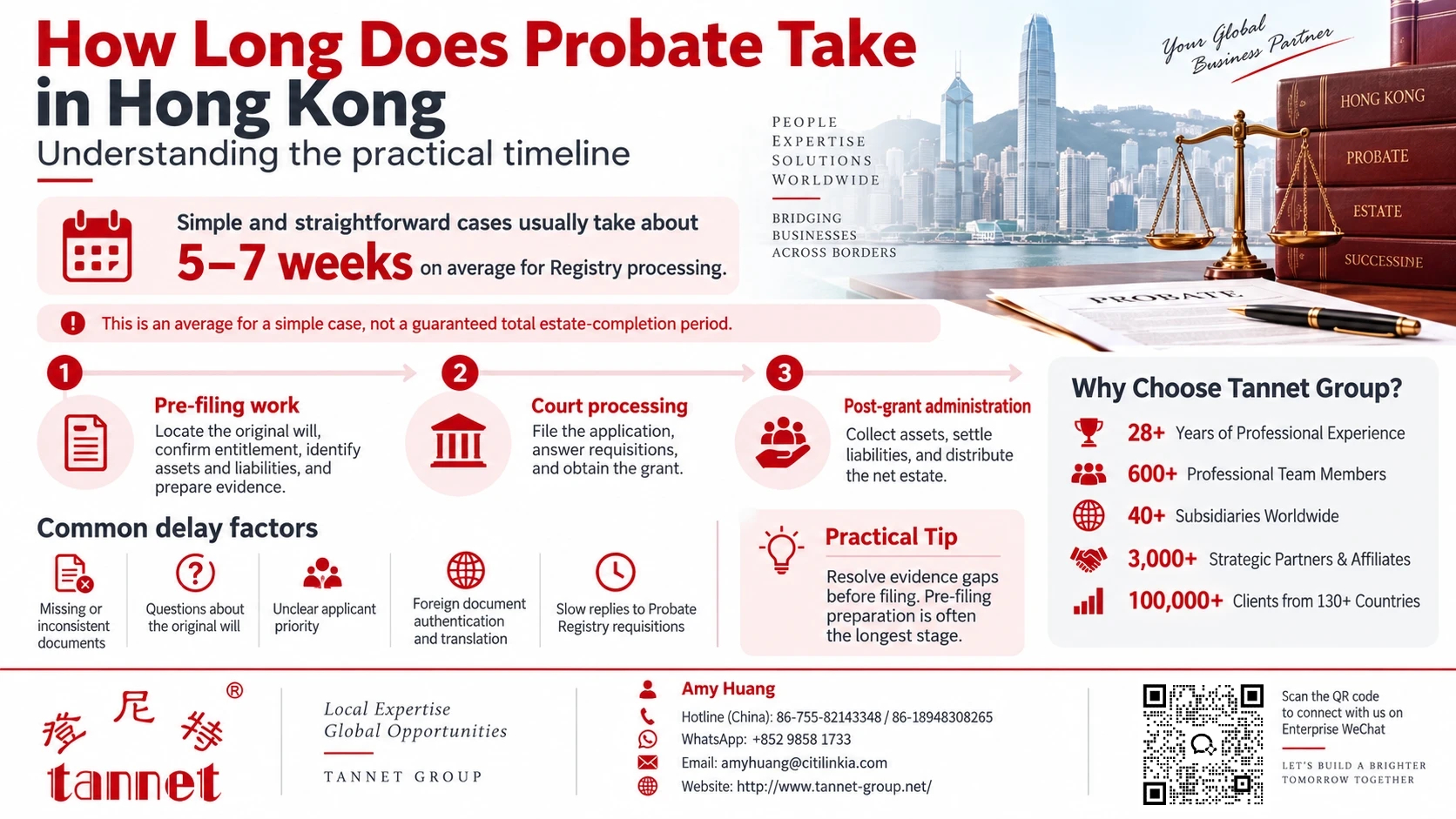
A simple and straightforward Hong Kong probate application usually takes about five to seven weeks on average, according to the Hong Kong Judiciary. That estimate is most relevant to executors and administrators who have complete documents, a clear right to apply, and an undisputed estate.
It is not a deadline and does not cover the entire estate process. Time spent locating assets, proving domicile, authenticating foreign records, answering court requisitions, collecting assets, paying debts, and distributing the estate comes in addition.
The most important step is to resolve evidence gaps before filing rather than treating five to seven weeks as a guaranteed completion date.
The Official Five to Seven Week Benchmark
The Probate Registry states that a grant is issued only after the applicant has met all legal requirements and answered every requisition to the Registrar’s satisfaction. For a simple and straightforward case, the average is about five to seven weeks.
The Judiciary’s performance pledges use the same conditions. For solicitor-filed cases, the Registry aims to issue the grant within 28 working days after all fees are paid and all requisitions are complied with.
These statements describe Registry processing. They do not promise that every estate will finish within that period. They also do not include all preparation before filing or administration after the grant.
What the Probate Timeline Actually Includes
Probate is one phase of estate administration. The practical timeline begins when the family identifies the deceased’s Hong Kong assets and ends only when the personal representative has completed administration.
The process normally has three broad periods:
- Pre-filing work. The applicant identifies the correct grant, establishes entitlement, locates the original will, determines domicile, obtains civil-status records, and prepares the asset and liability schedule.
- Court processing. The Probate Registry examines the application, raises requisitions where necessary, receives answers, and issues the grant after requirements and fees are satisfied.
- Post-grant administration. The grantee collects assets, settles expenses and liabilities, addresses claims, distributes the net estate, and prepares a complete inventory and account.
A five-to-seven-week court estimate therefore should not be used as the total time from death to payment of beneficiaries.
The Pre Filing Stage Can Be the Longest Part
The specified-forms guide requires evidence of death, family relationships, the will, identity, entitlement, and Hong Kong assets and liabilities. Asset holders may use different procedures for date-of-death balances and ownership records.
Foreign public documents may require authentication. Any document outside Chinese or English needs translation. The Judiciary advises completing authentication before translation.
Filing merely to start the clock can transfer unresolved work into formal court requisitions.
Factors That Commonly Extend Hong Kong Probate
Incomplete or inconsistent application papers
The Judiciary’s Guide to Non-Contentious Probate Practice identifies badly prepared papers, missing particulars, inconsistent checklists, and slow answers to requisitions as common causes of serious delay.
Names, dates, relationships, and asset descriptions must align across the certificates, affidavits, will, and asset schedule.
Questions about the will
Delay may arise if the original will is missing, damaged, undated, improperly witnessed, altered, or accompanied by unclear codicils. The court may require affidavits explaining execution, condition, custody, or possible revocation.
Unclear applicant priority
Where there is no valid will, Rule 21 of the Non-Contentious Probate Rules governs the usual order of priority. A lower-priority applicant may need death certificates, renunciations, or other evidence clearing persons with a prior right.
Minor beneficiaries or life interests can also affect the required number of administrators. The Probate Registry states that at least two grantees are generally required in those circumstances.
Foreign domicile and overseas documents
Domicile can affect who receives the grant and how movable property is distributed. Nationality or residence may not settle the issue.
For an overseas deceased, the court may require a domicile affidavit, authenticated civil records, translations, foreign-law evidence, or a review of whether a foreign grant can be resealed under sections 48 to 52 of the Probate and Administration Ordinance.
Caveats and disputes
The Registrar cannot issue a grant while an effective caveat blocks the estate. The Judiciary states that a caveat remains effective for six months and can be entered again.
A dispute over the will, applicant, or entitlement may require negotiation or court proceedings before ordinary processing resumes.
Difficult assets and missing information
Company shares, business interests, property, safe deposit boxes, and receivables often require more evidence than a single bank account.
Further assets discovered after the grant require an amendment. The Judiciary says a straightforward amendment usually takes about four to eight weeks, subject to additional time where requisitions are raised.
Small Estate Procedures Have Different Timelines
The Home Affairs Department may issue a Confirmation Notice for a qualifying Hong Kong estate wholly made up of money not exceeding HK$50,000. Its published pledge is 12 working days after receiving all required documents and information.
A Confirmation Notice is not a grant. A bank retains discretion over release.
Section 15 of the Probate and Administration Ordinance also allows the Official Administrator to summarily administer certain estates not exceeding HK$150,000. The Judiciary says this route is usually considered for cash, bank money, and MPF assets. It is a separate process, not a faster version of an ordinary grant.
How to Reduce Avoidable Delay
Build one evidence register
Record each fact, supporting document, name used, date, original status, authentication, translation, and inconsistency. Ask every institution for its date-of-death evidence requirements.
Confirm the grant route before drafting
Decide whether the application is for probate, letters of administration, letters of administration with will annexed, or resealing of a qualifying foreign grant. Confirm the correct applicant and any renunciations.
Answer requisitions as a connected set
Read each requisition against the whole application. Update every document affected by the answer.
Separate grant timing from distribution timing
Beneficiaries should receive a realistic two-stage explanation. The first stage obtains court authority. The second collects assets, settles liabilities, checks claims, and distributes the balance.
A Practical Timeline Planning Method
Start with the official benchmark, then list work that sits outside it. Do not assign a completion date until the original will, applicant priority, domicile, Hong Kong asset scope, and foreign-document status have been checked.
Create a dependency schedule rather than one single countdown. Record when each institution was asked for evidence, what remains outstanding, when the application was filed, which requisitions are open, and whether every fee has been paid. After issue, open a separate schedule for asset release, liabilities, claims, accounts, and distribution.
Update beneficiaries when a dependency changes. State the completed step, the outstanding item, who controls it, and the next review date. This avoids turning the Judiciary’s simple-case average into a promise that no party can control.
Where a caveat or substantive dispute appears, replace the administrative estimate with legal advice on the contested process. Ordinary non-contentious timing no longer describes the matter accurately.
Common Mistakes
- Promising beneficiaries that the estate will finish within five to seven weeks.
- Starting the estimate from the date of death instead of a complete filing.
- Filing before the original will and all codicils have been checked.
- Treating nationality as conclusive evidence of domicile.
- Ignoring people with a prior right to apply on intestacy.
- Sending inconsistent answers to separate court requisitions.
- Distributing assets immediately after the grant without completing administration checks.
Frequently Asked Questions
Q1 Does every Hong Kong probate application take five to seven weeks
No. That is the Judiciary’s average for a simple and straightforward case. Complex assets, foreign documents, entitlement questions, caveats, disputes, or incomplete evidence can extend the period.
Q2 When does the five to seven week period start
Treat it as a Registry processing benchmark after a proper application has been filed. Pre-filing asset searches, document collection, authentication, translation, and legal analysis are additional.
Q3 How long does probate take if the deceased lived overseas
There is no single official period. The court may need domicile evidence, authenticated foreign records, translations, or a foreign-grant analysis. Each requirement can affect timing.
Q4 Will using a solicitor guarantee a faster grant
No. Representation can improve preparation and response management, but the court controls the grant. The facts, documents, requisitions, and any dispute determine the actual timing.
Q5 Does a caveat delay probate
Yes. An effective caveat prevents the Registrar from issuing the grant. The underlying concern must be resolved through the appropriate procedure before ordinary processing can continue.
Q6 Can beneficiaries receive money as soon as the grant is issued
Not necessarily. The grantee must first collect assets, pay proper expenses and liabilities, address claims, and determine the distributable balance. Institutions also have their own release procedures.
Q7 Is the 12 working day small estate procedure the same as probate
No. It concerns a Home Affairs Department Confirmation Notice for a qualifying money-only estate of no more than HK$50,000. The notice is not a court grant, and a bank retains discretion.
When Tannet May Assist
Tannet can assist with the initial Hong Kong asset and document inventory, readiness tracking, certification and translation coordination, and communication with banks, valuers, company service providers, accountants, and an instructed Hong Kong solicitor. Tannet can also coordinate company-share transmission and corporate record updates after the grant.
Disputed wills, caveats, competing applicants, foreign-law opinions, and court advocacy should be handled by a qualified Hong Kong solicitor. This article provides general information and is not legal, tax, or succession advice for a particular estate.
Written by: Tannet Business Services Team
Reviewed by: Consultant Amy Huang
First published: 16 Sep. 2026
Last reviewed: 16 Sep. 2026
Sources: Hong Kong Judiciary Probate Registry; Guide to the use of the Specified Forms for Probate Registry;
Guide to Non-Contentious Probate Practice; Probate and Administration Ordinance Cap 10; Home Affairs Department Small Estates.
————————————————Simplifying Business, Empowering Entrepreneurs————————————————