Key Takeaway
Hong Kong tax residency can support treaty claims that reduce or remove foreign withholding tax on eligible income. Relief at source means the payer applies the permitted treatment when withholding, rather than deducting excess tax and leaving the recipient to seek a refund later.
This matters to companies receiving overseas dividends, interest, royalties or other payments covered by an effective agreement. The real benefit depends on the income, treaty conditions and local procedure, not merely having a Hong Kong company.
A Certificate of Resident Status supports residence evidence. It does not guarantee relief, establish beneficial ownership or eliminate Hong Kong tax. Assess the complete transaction before estimating savings.
Understand what residency provides
Treaty residence determines whether a company can access the relevant agreement as a resident. The Inland Revenue Department’s guidance directs applicants to the particular residence article and protocol. Incorporation, a bank account and immigration status should not be treated as interchangeable proof of every treaty condition.
The IRD issues a Certificate of Resident Status for claiming benefits under an effective comprehensive double taxation agreement or arrangement. Its guidance expressly warns that the treaty partner ultimately decides relief. Certification is therefore an important document, not an instruction that overrides the payer’s tax law.
Start with the jurisdiction imposing tax. A customer group headquartered in one country may pay through an entity in another. Identify the actual payer, recipient and income source before selecting an agreement. The currency or collection bank does not settle that analysis.
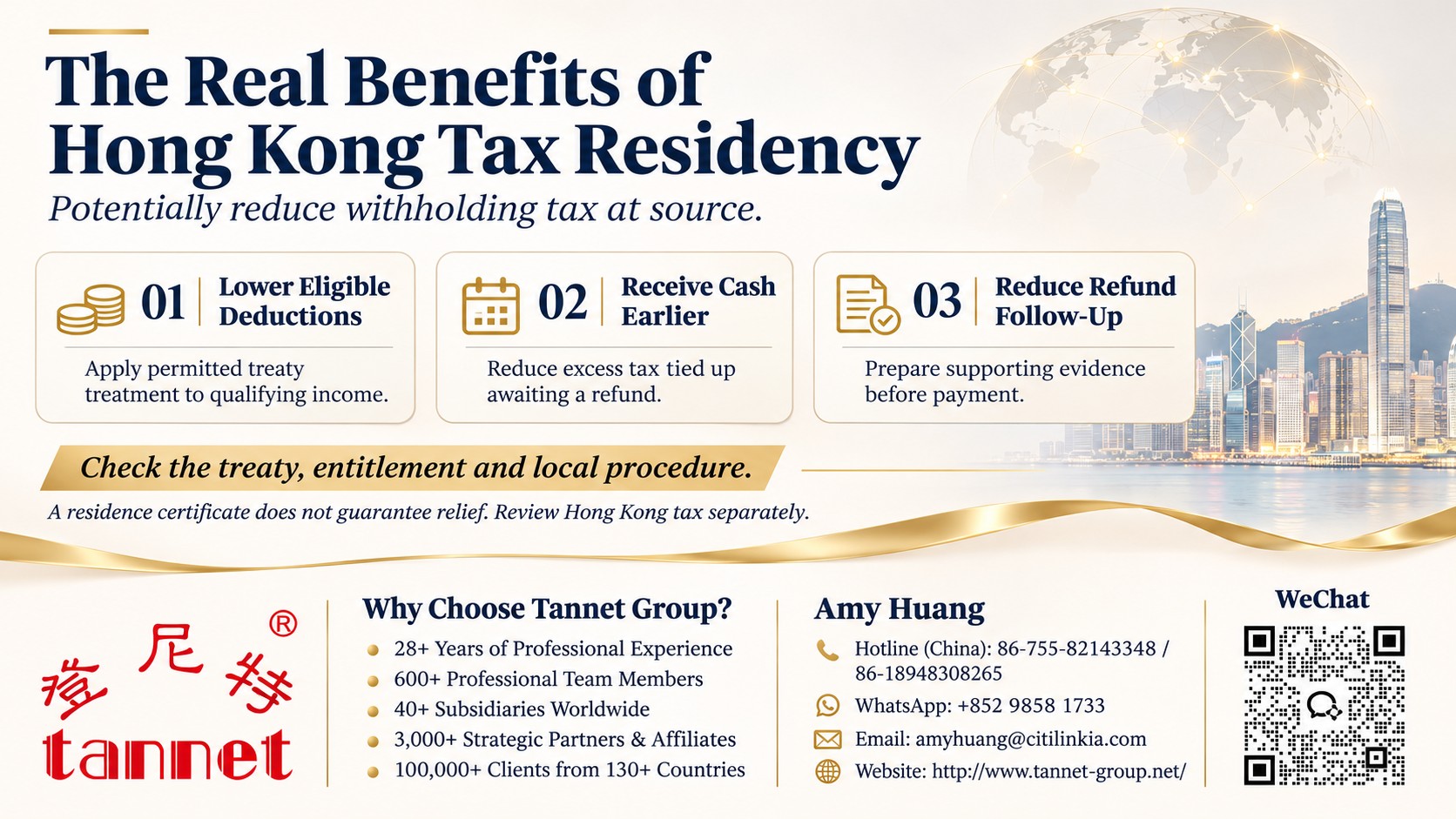
Benefit one reduce eligible deductions from payments
A treaty may limit source taxation of dividends, interest or royalties. Some agreements address technical fees separately. Other service income may fall under business profits provisions. The contract label alone cannot decide the article; analyse what the recipient supplies and what rights the payer receives.
The IRD’s rate summary illustrates these differences. For Chinese Mainland dividends, it lists 5% for qualifying companies and 10% for other dividends. These are conditional treaty categories. Check Article 10, beneficial ownership, the applicable shareholding and holding-period requirements, and anti-abuse provisions before using the lower category.
For illustration, assume a RMB 1,000,000 dividend genuinely qualifies for 5% instead of an otherwise applicable 10% deduction. Withholding would be RMB 50,000 rather than RMB 100,000. The RMB 50,000 difference concerns withholding only. It is not a promised result or the group’s complete tax saving.
Not every payment produces a reduction. Domestic law may already exempt the receipt or provide a lower rate. A treaty generally limits taxing rights; it should not be read as requiring a higher deduction than applicable domestic law. Compare the actual alternatives before recommending an application.
Benefit two receive eligible cash earlier
When local procedures allow relief at source and the claim is properly supported, less cash may be withheld on payment. The recipient can use the additional amount without waiting for an excess-tax refund. This is a practical working-capital benefit, not a separate exemption.
Distinguish permanent tax savings from timing. If the same excess deduction would certainly be refunded later, applying relief immediately mainly changes when cash becomes available. Where refund eligibility or recovery is uncertain, do not forecast the amount as assured cash or treat uncertainty as a guaranteed saving.
Benefit three avoid unnecessary refund work
An eligible source claim can reduce the need to recover excess deductions. Refund procedures may require tax vouchers, payment records and correspondence with a foreign authority. They have deadlines and administrative costs. Avoiding avoidable overwithholding can simplify follow-up, although source relief itself still requires documentation.
Relief at source is not always available on the preferred timetable. If required documents are missing, the payer may need to withhold under local rules. Discuss the lawful correction or refund route promptly. A pending Hong Kong application is not equivalent to an issued certificate.
Benefit four price contracts with clearer assumptions
Review whether the agreed price is gross or net of withholding. A gross-up clause may make the payer bear additional tax cost. Treaty relief can therefore benefit different parties depending on the contract. Calculate the effect before promising a particular increase in the recipient’s margin.
Document who supplies residence evidence, who files locally and who receives any refund. If a customer uses a standard deduction across all vendors, ask its tax team to assess the applicable agreement. Do not ask an accounts clerk to disregard a statutory withholding obligation.
Step one establish entitlement for the income
Confirm treaty effectiveness for the payment period and identify the correct article. Check the company’s residence position, any dual-residence issue and relevant entitlement conditions. Beneficial ownership may matter for dividends, interest or royalties. Artificial conduit arrangements can face anti-abuse scrutiny despite holding a certificate.
Where related parties are involved, review commercial terms and pricing separately. A treaty rate does not validate excessive interest, unsupported royalties or services that were never provided. The income amount eligible for the article may itself require analysis before any rate is selected.
Step two prepare residence evidence early
Use the IRD’s current corporate application route. IR1313A concerns the arrangement with the Chinese Mainland; IR1313B concerns other relevant treaty jurisdictions. Identify the applicant, period and claim accurately. Read the notes and conditional appendix requirements rather than copying another company’s declarations.
Ask the payer which evidence its procedure requires and when. The IRD’s published processing target allows a certificate or an officer’s notification within 21 working days after a properly completed application. A request for further information is possible. Do not promise issuance by an invoice date.
Step three complete the source procedure
The State Taxation Administration describes Chinese Mainland treaty claims through self-assessment, claiming treatment and retaining records for review. For withholding cases, the non-resident supplies a complete reporting form to the withholding agent. Without that form or with incomplete information, domestic withholding rules apply.
Other jurisdictions use different processes. Singapore’s IRAS guidance requires the payer to check eligibility, indicate the applicable treaty treatment in withholding filings and obtain residence evidence. Its certificate submission timetable must be checked separately. This example should not be copied into another jurisdiction’s procedure.
Step four calculate the whole tax position
Review Hong Kong taxation independently. The foreign-sourced income exemption regime can affect specified foreign income received in Hong Kong by an MNE entity carrying on business there. Relevant exceptions differ by income type. Treaty relief abroad does not automatically create an exemption in Hong Kong.
Compare eligible foreign tax credits, where available, without counting the same relief twice. Consider professional fees and ongoing recordkeeping when assessing value. A company with small receipts or an existing domestic exemption may gain little from a new treaty claim.
Keep an income file after the payment. Reconcile the gross amount, deduction and net receipt to the voucher and filing. If ownership, residence or payment terms change, review the next claim instead of repeating old instructions. A valid historical claim does not establish that an altered transaction qualifies in a later period. Document the reason for changes.
Common mistakes
Do not advertise a universal 5% rate. Do not confuse corporate treaty residence with personal immigration status. Avoid treating a certificate as proof of all entitlement conditions, applying yesterday’s rate without checking amendments, or assuming every foreign deduction will be refunded.
Frequently asked questions
Q1 Does registration alone give us a lower foreign rate?
No. Check residence, income eligibility and the local claim procedure. Registration does not complete those tasks.
Q2 Is the certificate the same as a tax exemption?
No. It supports residence evidence. The treaty partner decides the remaining conditions for relief.
Q3 Can every overseas customer pay without withholding?
No. Treatment depends on the jurisdiction, transaction and effective agreement. Some payments remain taxable at source.
Q4 What if the payer already deducted excess tax?
Check correction or refund procedures and deadlines locally. Keep the tax voucher and payment evidence.
Q5 Must a certificate be ready before payment?
Check the source jurisdiction’s rules. Do not assume that every jurisdiction permits later evidence on identical terms.
Q6 Does source relief remove Hong Kong reporting obligations?
No. Assess Hong Kong taxation and reporting separately, including FSIE where applicable.
Q7 When is the claim commercially worthwhile?
Compare expected eligible relief and cash timing with preparation costs, ongoing obligations and uncertainty.
Where Tannet can assist
Tannet can help identify relevant payments, coordinate residence applications and organize supporting records. Foreign rate selection, disputed entitlement and complex Hong Kong tax questions may require specialist advice before filing.
Written by: Tannet Business Services Team
Reviewed by: Consultant Amy Huang
First published: 5 Nov. 2026
Last reviewed: 5 Nov. 2026
30th Anniversary Offer: Tannet has been established for 28 years, we are offering exclusive limited-time promotional pricing to celebrate Tannet’s 30th anniversary. Slots are limited and available on a first-come, first-served basis. Contact Consultant Amy Huang for details.
————————————————Simplifying Business, Empowering Entrepreneurs————————————————