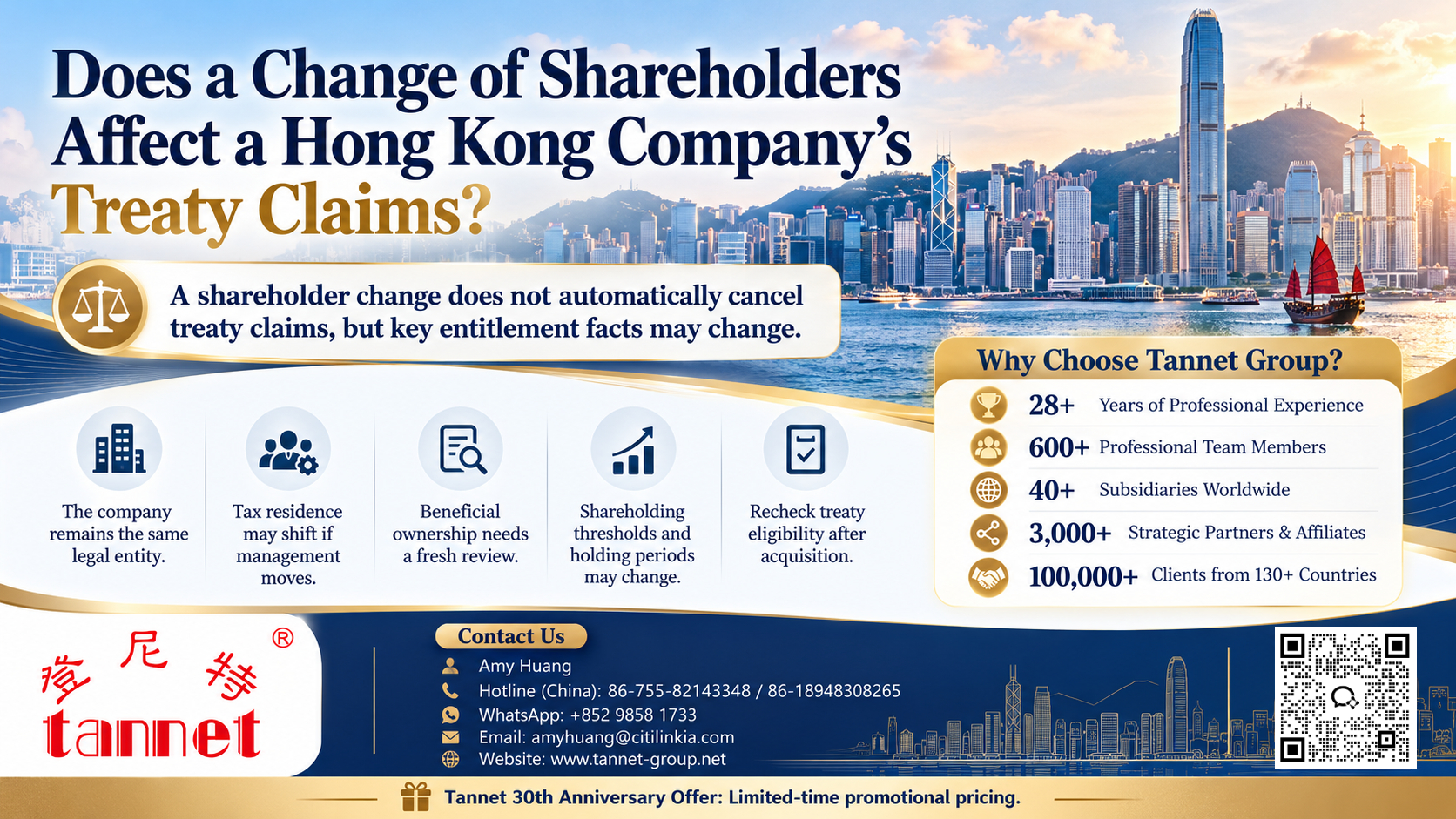
Key Takeaway
A change of shareholders does not automatically cancel a Hong Kong company’s tax treaty claims.
The company remains the same legal entity. However, the transaction can change facts that determine entitlement. These include tax residence, beneficial ownership, direct shareholding thresholds, minimum holding periods, management and control, commercial substance, and the principal purpose test.
This matters to buyers, sellers, group tax teams, founders, funds, and Hong Kong holding companies receiving cross-border dividends, interest, royalties, or service income.
Review the exact treaty before closing. A Hong Kong Certificate of Resident Status supports residence, but the treaty partner decides whether every condition for relief is met.
Corporate residence may remain stable
Many Hong Kong treaties treat a company incorporated in Hong Kong as a Hong Kong resident. A shareholder change alone may not disturb that definition.
Residence can still become uncertain if the acquisition moves central management or strategic control overseas. New owners may appoint directors, centralise treasury, impose binding approvals, or relocate senior executives.
The governing treaty must be checked. Some agreements use a place-of-effective-management tie-breaker. Others require the competent authorities to determine treaty residence by mutual agreement where both jurisdictions claim the company.
A Certificate of Resident Status is supporting evidence
The Hong Kong Inland Revenue Department states that a Certificate of Resident Status supports a treaty claim but does not guarantee foreign relief. The treaty partner decides whether all relevant conditions are satisfied.
An earlier certificate should not be treated as permanent approval of future facts. The IRD’s guidance for the Chinese Mainland arrangement expressly notes that a certificate may stop serving as proof after circumstances change so that the applicant no longer meets the conditions for benefits.
After a material acquisition, compare the facts in the earlier application with the new ownership, directors, operations, headquarters, bank authority, and decision-making pattern.
Beneficial ownership requires a separate review
Changing the shareholders of the Hong Kong recipient does not automatically mean that the recipient stops being the beneficial owner. The test concerns the recipient’s rights and practical control over the income under the relevant treaty and source-jurisdiction rules.
Risk increases where the new arrangement requires the Hong Kong company to pass income onward, strips it of discretion, leaves it with minimal functions, or transfers commercial risk elsewhere.
The review should trace contracts, cash flows, financing, dividend policy, bank mandates, and the ability to use the income for the company’s own business. Legal form and actual conduct should agree.
Dividend thresholds can change for different reasons
Many treaties provide a lower dividend withholding rate where the Hong Kong recipient directly owns a stated percentage of the payer. The relevant holding is normally the Hong Kong recipient’s ownership of the foreign payer.
Selling shares in the Hong Kong recipient does not necessarily change that direct holding. By contrast, moving the foreign subsidiary to a different group company, issuing shares in the payer, or diluting the Hong Kong company can affect the threshold.
The Hong Kong and Chinese Mainland arrangement illustrates the distinction. Its dividend article provides a 5 percent ceiling where the beneficial owner is a company directly owning at least 25 percent of the payer’s capital. The exact arrangement, protocols, administrative rules, and current beneficial-owner requirements must still be checked.
Minimum holding periods may be decisive
Ownership on the payment date may not be enough. Article 8 of the OECD Multilateral Instrument can add a 365-day ownership period to certain reduced dividend rates where both treaty partners’ positions make the provision effective.
The rule is treaty-specific. The MLI text also addresses changes directly resulting from certain corporate reorganisations, but that wording should not be assumed to cover every share transfer or internal restructuring.
Build a dated ownership timeline. Include acquisition, disposal, dilution, reorganisation, declaration, record, and payment dates.
Anti-abuse rules focus on purpose and context
A shareholder change can increase scrutiny even when residence and formal thresholds remain satisfied. This is especially true where a Hong Kong company is acquired shortly before a large payment or inserted into a chain that accesses a lower withholding rate.
Article 7 of the OECD Multilateral Instrument contains a principal purpose test. Treaty benefits may be denied where obtaining the benefit was one of the principal purposes of an arrangement or transaction, unless granting the benefit accords with the object and purpose of the relevant treaty provisions.
Some treaties also contain limitation-on-benefits rules or specific anti-conduit provisions. Domestic general anti-avoidance rules may apply separately.
Commercial reasons should be documented contemporaneously. Examples include market access, financing, governance, regulatory requirements, risk management, succession, investor admission, or operational integration.
Management and substance can change after closing
New shareholders often change more than the register of members. They may replace directors, move treasury, alter signing authority, change office functions, or require overseas approval for material contracts.
These changes can affect residence, beneficial ownership, and the credibility of the company’s operating model. A Hong Kong board that merely records decisions made elsewhere may provide weak evidence of genuine management.
Review actual conduct for several months after completion. Transaction documents alone cannot prove how the company is managed in practice.
Administrative claims must be refreshed when required
Relief at source and refund procedures are controlled by the source jurisdiction. A payer or foreign authority may require an updated Certificate of Resident Status, ownership chart, beneficial-owner declaration, tax form, or explanation of the transaction.
Do not wait until a dividend is payable. Foreign filing windows can be short, and an unresolved review may cause withholding at the domestic rate.
If benefits are denied contrary to the treaty, the Hong Kong IRD may consider a Mutual Agreement Procedure request. MAP does not automatically replace domestic objections, refund claims, or appeal deadlines.
Steps before and after the shareholder change
- Identify every expected cross-border payment and treaty article.
- Obtain the current treaty, protocols, MLI positions, and synthesised text.
- Map the ownership chain before and after closing.
- Test direct holding percentages and minimum holding periods.
- Review residence, beneficial ownership, substance, and management separately.
- Document commercial purposes and operational changes.
- Refresh certificates, declarations, and source-jurisdiction filings where required.
- Protect withholding, refund, objection, appeal, and MAP deadlines.
Additional review points
Record the legal completion date and the economic effective date separately.
Reconcile the pre-transaction and post-transaction ownership charts.
Common mistakes
- Assuming a share sale automatically cancels every treaty claim.
- Assuming the same legal entity automatically keeps every treaty benefit.
- Checking only the shareholder register and ignoring management changes.
- Confusing the shareholder of the Hong Kong company with the company’s direct holding in the income payer.
- Ignoring a treaty or MLI minimum holding period.
- Treating a Certificate of Resident Status as conclusive approval.
- Documenting commercial reasons only after the authority asks questions.
Frequently asked questions
Q1. Does a new shareholder invalidate an existing Certificate of Resident Status?
Not automatically. Review whether the ownership change altered facts stated in the application or the conditions for treaty benefits. Inform the relevant advisers and authority where required.
Q2. Can the company still receive a reduced dividend rate immediately after a sale?
Possibly. Check the treaty’s direct holding threshold, any minimum holding period, beneficial ownership, and anti-abuse rules before the payment.
Q3. Does an internal group reorganisation receive automatic protection?
No. Some treaty or MLI provisions contain reorganisation wording, but its scope and activation are treaty-specific.
Q4. Does changing the ultimate parent change beneficial ownership?
It can, but not automatically. Examine legal rights, cash flows, onward-payment obligations, functions, risks, and actual control of the income.
Q5. Must the payer be told about the shareholder change?
Follow the source jurisdiction’s procedure and the payer’s documentation requirements. Updated forms or ownership charts may be required.
Q6. Is Hong Kong stamp duty part of the treaty test?
No. Stamp duty is a separate transaction tax and compliance matter.
Q7. What evidence should be retained?
Keep transaction agreements, ownership charts, board materials, financing records, bank mandates, contracts, staff records, payment documents, tax forms, and commercial rationale.
When Tannet may assist
Tannet may assist where a Hong Kong holding or operating company is preparing for a share sale, investor admission, succession, internal reorganisation, or post-acquisition governance change. Support may include document coordination, corporate-record updates, Certificate of Resident Status preparation, ownership and payment mapping, and liaison with advisers in the source jurisdiction.
Official sources:
Hong Kong and Chinese Mainland Consolidated Arrangement;
OECD Multilateral Instrument Articles 7 and 8;
Hong Kong Companies Registry Significant Controllers Register;
30th Anniversary Offer: To celebrate Tannet’s 30th anniversary, we are offering exclusive limited-time promotional pricing. Slots are limited and available on a first-come, first-served basis. Contact Consultant Amy Huang for details.
Written by: Tannet Business Services Team
Reviewed by: Consultant Amy Huang
First published: 22 Oct. 2026
Last reviewed: 22 Oct. 2026
————————————————Simplifying Business, Empowering Entrepreneurs————————————————