Key Takeaway
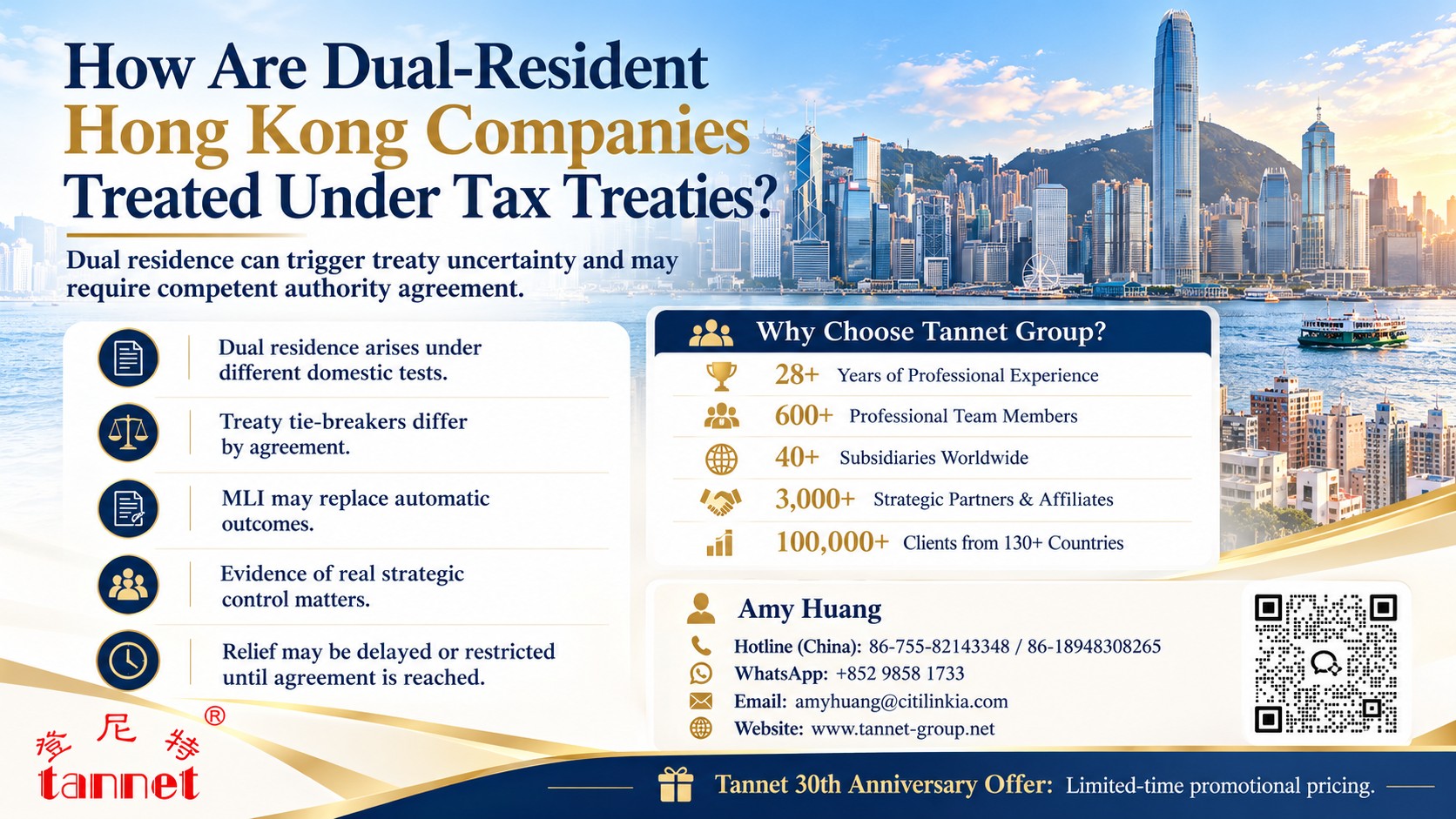
A Hong Kong company can be resident under Hong Kong rules and also resident under another jurisdiction’s domestic law.
A tax treaty does not always resolve that conflict automatically. Some treaties use the company’s place of effective management.
Many newer or MLI-modified treaties require the two competent authorities to agree on a single treaty residence after reviewing management, incorporation, and other facts. Until agreement is reached, treaty relief may be unavailable or restricted.
This issue matters most to groups with overseas directors, remote boards, foreign headquarters, or split decision-making. The main safeguard is contemporaneous evidence showing where real strategic control occurred.
Why dual residence arises
Corporate residence begins with domestic law. Hong Kong treaties generally treat a Hong Kong-incorporated company as a Hong Kong resident. A company incorporated elsewhere may also qualify when it is normally managed or controlled in Hong Kong.
Another jurisdiction may apply a different connecting test. It may look to central management and control, place of effective management, registered seat, incorporation, or the residence of key decision-makers.
The same company can therefore satisfy two domestic tests at the same time. This is not resolved merely by paying Hong Kong profits tax, maintaining a registered office, or holding a Hong Kong business registration certificate.
Domestic residence continues after a treaty tie-breaker
A treaty tie-breaker normally determines residence only for applying that bilateral treaty. It does not necessarily erase domestic residence in either jurisdiction.
The company may still have to register, submit returns, keep records, report transactions, pay provisional tax, or meet payroll obligations in both places. Domestic remedies and foreign tax credits may remain important.
This distinction prevents a common error. A company treated as the Hong Kong resident for one treaty can still be a domestic tax resident elsewhere and may receive a different answer under another treaty.
Three treaty treatment models
The exact residence article controls. Companies should not rely on a generic summary because Hong Kong agreements differ and may have been modified by protocols or the OECD Multilateral Instrument.
First, some agreements use a place-of-effective-management tie-breaker. The company is treated as resident only where its effective management is situated. The United Kingdom synthesised text illustrates this approach, with competent authority consultation in doubtful cases.
Second, many modern agreements require competent authority agreement. The authorities consider effective management, incorporation or constitution, and other relevant factors. The Chinese Mainland consolidated arrangement uses this model.
Third, the consequences of no agreement differ. Under the MLI-style approach, the entity generally receives no treaty relief or exemption except to the extent and manner agreed by the authorities. Some treaties preserve limited articles, such as nondiscrimination or mutual agreement procedure.
How the Multilateral Instrument changes the analysis
The MLI can modify a covered treaty without rewriting the original agreement. Hong Kong’s IRD publishes a DTA list, MLI information, and synthesised texts for affected agreements.
Article 4 of the MLI replaces certain automatic corporate tie-breakers with a competent authority process when both jurisdictions’ positions match. It directs the authorities to consider effective management, incorporation or constitution, and other relevant factors.
The MLI does not alter every Hong Kong treaty in the same way. Reservations, notifications, entry-into-effect dates, and bilateral compatibility determine the result. The current synthesised text should be checked for the relevant income period.
What authorities examine
Residence is determined from substance, not a single document. Authorities may examine where senior management set commercial policy, approved financing, selected markets, accepted risks, appointed executives, and controlled major contracts.
Board meetings matter when the board genuinely decides. Meetings carry less weight when directors simply confirm instructions already issued by an overseas parent, founder, investment committee, or executive team.
Remote meetings complicate the analysis. Minutes should record participant locations, materials considered, competing options, questions raised, and the place from which authority was exercised.
Day-to-day activity also provides context. Office functions, employees, bank control, accounting, contract execution, regulatory supervision, and implementation responsibility should align with the stated management model.
How treaty treatment affects income
Resolving residence determines who may invoke the treaty as a resident. It can affect dividend, interest, royalty, capital-gain, business-profit, and other articles.
Residence alone is not enough. The source jurisdiction may still test beneficial ownership, holding periods, permanent establishment, arm’s-length pricing, limitation provisions, and the principal purpose test.
The treaty may allocate taxing rights but not eliminate every domestic obligation. Relief may take the form of a reduced withholding rate, exemption, foreign tax credit, refund, or corresponding adjustment.
Certificate of Resident Status is supporting evidence
The Hong Kong IRD issues a Certificate of Resident Status to support claims under an effective DTA. It generally issues one certificate for each DTA and year.
The IRD states that a certificate does not guarantee foreign treaty benefits. The treaty partner makes the final decision on its own relief procedure and relevant conditions.
For a dual-resident company, the certificate establishes Hong Kong residence evidence but may not settle the tie-breaker. The competent authorities may still need to determine the company’s deemed treaty residence.
Using the Mutual Agreement Procedure
The Hong Kong IRD states that a taxpayer exposed to taxation not in accordance with a DTA may present a case under the Mutual Agreement Procedure. Hong Kong’s competent authority is the Commissioner of Inland Revenue or an authorised representative.
Most treaties specify a deadline, commonly three years from the first notification of the action producing treaty-inconsistent taxation. The exact treaty wording must be reviewed.
MAP requires the authorities to endeavour to resolve the case. It does not guarantee agreement. The taxpayer should therefore maintain domestic objections or appeals where appropriate and obtain advice in the other jurisdiction.
Steps for a defensible analysis
- Identify every jurisdiction that may assert corporate residence.
- Apply each jurisdiction’s domestic residence rules to the relevant year.
- Obtain the original treaty, protocols, MLI positions, and current synthesised text.
- Classify the tie-breaker as automatic, competent-authority based, or otherwise limited.
- Map strategic decisions, delegated powers, executive activity, and implementation by date and location.
- Analyse each payment under the relevant substantive treaty article and anti-abuse rules.
- Preserve domestic filing, objection, refund, and MAP deadlines.
Common mistakes
- Assuming incorporation alone decides treaty residence.
- Treating a Hong Kong CoR as binding on the foreign authority.
- Reading the original treaty without checking MLI modifications.
- Using meeting location as a substitute for real decision-making.
- Confusing residence with permanent establishment or income source.
- Ignoring local remedies while waiting for MAP.
- Applying one treaty outcome to every partner and tax year.
Frequently asked questions
Q1. Is a Hong Kong-incorporated company automatically the Hong Kong resident under every treaty?
No. Incorporation usually establishes Hong Kong residence under the treaty definition, but dual residence may activate a separate tie-breaker.
Q2. Does place of effective management always decide the result?
No. Some treaties use that test directly. Others require competent authorities to agree after considering it with other factors.
Q3. Can treaty benefits be claimed while MAP is pending?
Possibly, but the source authority may withhold at domestic rates or require security. Local procedures and the exact treaty govern.
Q4. Can one company have different treaty residences with different partners?
Yes. Each bilateral treaty has its own wording, modification status, facts, and relevant period.
Q5. Does a foreign office automatically create foreign residence?
No. An office may create a permanent establishment, while residence depends on the applicable domestic and treaty tests.
Q6. What evidence carries the most weight?
Contemporaneous evidence of genuine strategic decisions, authority, deliberation, execution, and commercial substance is usually more persuasive than formal addresses alone.
Q7. Is MAP the same as an appeal?
No. MAP is a treaty process between competent authorities. Domestic objections and appeals may need to proceed separately.
Prepare a dated governance map showing who proposed, reviewed, approved, and implemented every material decision.
Keep clear evidence for review.
When Tannet may assist
Tannet may assist with residence-risk mapping, Hong Kong CoR applications, governance-record reviews, treaty-document checks, and coordination with legal or tax advisers in the other jurisdiction. This support is suitable where management is split across locations, foreign withholding is expected, or a competent authority submission may be needed.
Official sources: OECD Multilateral Instrument Article 4
30th Anniversary Offer: To celebrate Tannet’s 30th anniversary, we are offering exclusive limited-time promotional pricing. Slots are limited and available on a first-come, first-served basis. Contact Consultant Amy Huang for details.
Written by: Tannet Business Services Team
Reviewed by: Consultant Amy Huang
First published: 22 Oct. 2026
Last reviewed: 22 Oct. 2026
————————————————Simplifying Business, Empowering Entrepreneurs————————————————