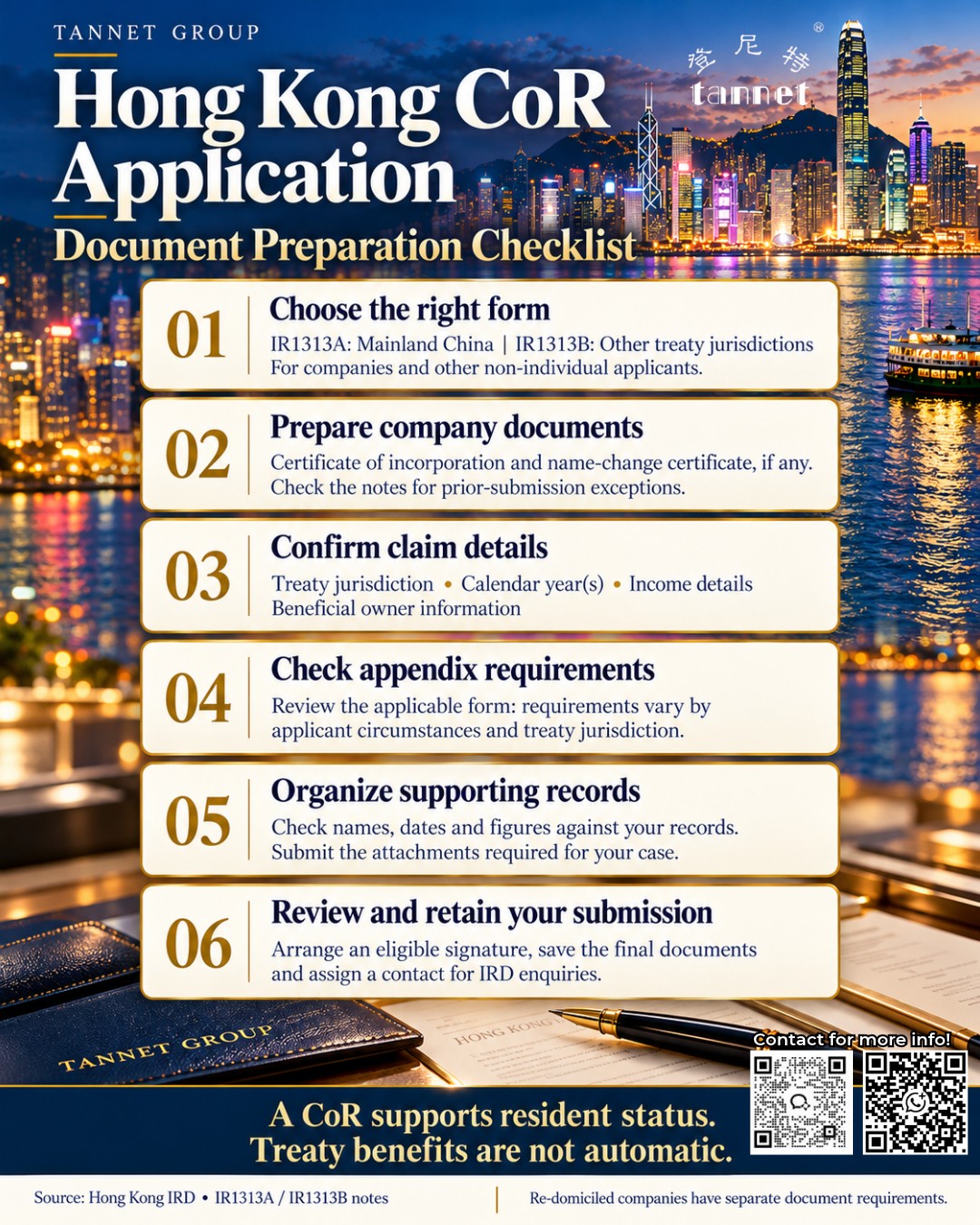
For businesses seeking tax treaty benefits, preparing a Hong Kong Certificate of Resident Status (CoR) application often involves several people. Finance may hold the income records, company administration may maintain incorporation documents, and management may need to confirm information about business activities.
The challenge is bringing those contributions together into one accurate submission. Collecting documents without checking how they relate to the application can leave gaps, conflicting details or unanswered questions.
A practical preparation process starts with understanding the applicable requirements, assigning responsibilities and keeping a clear record of what will be submitted.
Understand the purpose of your application
A Hong Kong CoR provides evidence of resident status for claiming benefits under a Comprehensive Double Taxation Agreement or Arrangement (DTA). Issuance of the certificate does not guarantee treaty relief: the tax authority in the jurisdiction where benefits are claimed determines whether the relevant conditions are satisfied.
Before opening a document folder, write a short internal summary explaining why the certificate is needed. Identify the applicant, the treaty jurisdiction, the calendar year or years concerned and the income involved.
This summary gives colleagues a shared starting point. It also helps prevent a previous application from being reused without checking whether its details remain relevant.
Use the applicable form to build your checklist
A useful document checklist begins with the current application form and its accompanying notes.
For companies and other non-individual applicants, the IRD lists Form IR1313A for Mainland China and Form IR1313B for other treaty jurisdictions. The appropriate form depends on the application concerned.
Read the instructions before requesting records from colleagues. Then create a working list showing each applicable requirement, the person responsible for supplying it and its review status.
Avoid assuming that every document used in another company’s application is necessary for yours. Equally, a short checklist should not replace reading the notes. The goal is to understand which requirements apply to the specific submission.
Establish a reliable set of company records
Company information should be checked against the records used to support the application.
For company applicants, the application notes specify a copy of the certificate of incorporation and any certificate of change of name. They also allow a reference to an earlier application where the same document was previously supplied under the stated exception. Re-domiciled companies have separate supporting-document requirements.
Keep these records together and label them clearly. Where a company has changed its name, make the sequence easy to follow.
Also distinguish between documents ready for submission and older copies retained for reference. Clear labels reduce the chance of someone selecting an outdated file during the final review.
Connect the application’s answers with their supporting information
A completed form is easier to review when the team knows where its answers came from.
As an internal preparation step, record the source of important details. This might be a company record, an accounting schedule or confirmation from the colleague responsible for a particular business function.
For example, if finance prepares an income summary, identify the period covered and the person who checked it. If company administration supplies registration particulars, note which records were consulted.
This internal record does not automatically become an attachment. Its purpose is to make the application easier to verify and help colleagues explain the information supplied.
Separate submission documents from reference material
An application folder can quickly become difficult to navigate when required attachments, working notes and historical records are stored together.
Use a simple structure with separate areas for:
- The completed application and applicable attachments.
- Supporting records used during preparation.
- Internal review notes and outstanding questions.
- Submission evidence and subsequent correspondence.
This arrangement gives each document a clear purpose. It also helps the person submitting the application identify the approved version.
A general preparation checklist should never be treated as a universal list of mandatory attachments. Follow the applicable form, its notes and any specific request from the IRD when deciding what to submit.
Identify additional requirements early
Some applications require an appendix containing further information.
For example, Form IR1313B specifies an appendix for applicants incorporated or established outside Hong Kong, other than re-domiciled companies, and for applications seeking benefits under the Hong Kong–Japan DTA.
Check whether an appendix applies before setting an internal completion date. Additional questions may require input from several departments or people working in different locations.
Where that is the case, divide the work into clear requests. Tell each contributor which information is needed, which period it concerns and who will review the response. This makes coordination more manageable than sending a broad request for “all relevant documents.”
Review consistency across the whole file
Individual documents may be accurate while the application as a whole still contains inconsistencies.
A contact address may have changed. An older company name may appear in a supporting record. A working schedule may cover a different period from the claim described in the form.
Read the application alongside the records used to prepare it. Compare names, dates, references and reporting periods. Where information differs for a valid reason, document the explanation internally and consider whether clarification is needed in the submission.
The aim is to make the information understandable without relying on assumptions known only to the person who prepared it.
Assign responsibility for the final review
When several colleagues contribute, someone needs to take responsibility for bringing the file together.
The final reviewer should confirm that outstanding questions have been resolved, the applicable sections have been completed and the selected attachments match the checklist.
A practical handover question is: could another responsible colleague locate the submitted documents and explain the main information without rebuilding the file?
Keep a brief approval record identifying the final version and its review date. This is an internal organizational measure that helps prevent last-minute edits or duplicate files from creating confusion.
Keep the file usable after submission
Document preparation continues to provide value after filing.
Save an exact copy of the submitted application and attachments, together with the submission date and any acknowledgement or reference received. Assign a contact person to monitor correspondence and coordinate responses.
The IRD may seek further information when examining an application. Keeping the original submission accessible helps your team respond consistently and understand the context of any question.
Add subsequent correspondence to the same file so that colleagues can follow the application’s progress.
Prepare your Hong Kong CoR application with Tannet Group
A clear application file gives your team a dependable record of what was checked, what was submitted and who can assist with further questions.
Contact Tannet Group to discuss the document preparation needs of your Hong Kong CoR application.
📞 Free 1-on-1 Consultation Now,
Official Service Hotline: +86-755-82148419
Cell: +86-13823131503;+60 19-309 2363
WeChat ID: 13823131503;
WhatsApp:+86-13823131503;+60 19-309 2363
Email: mytannet08@gmail.com; susiehu@citilinkia.com