If you want to carry out import and export business in Shanghai, obtaining a business license is only the first step. In practice, a company must first be legally incorporated and then complete the relevant procedures for banking, tax, customs, and foreign exchange before it can formally engage in cross-border trade.
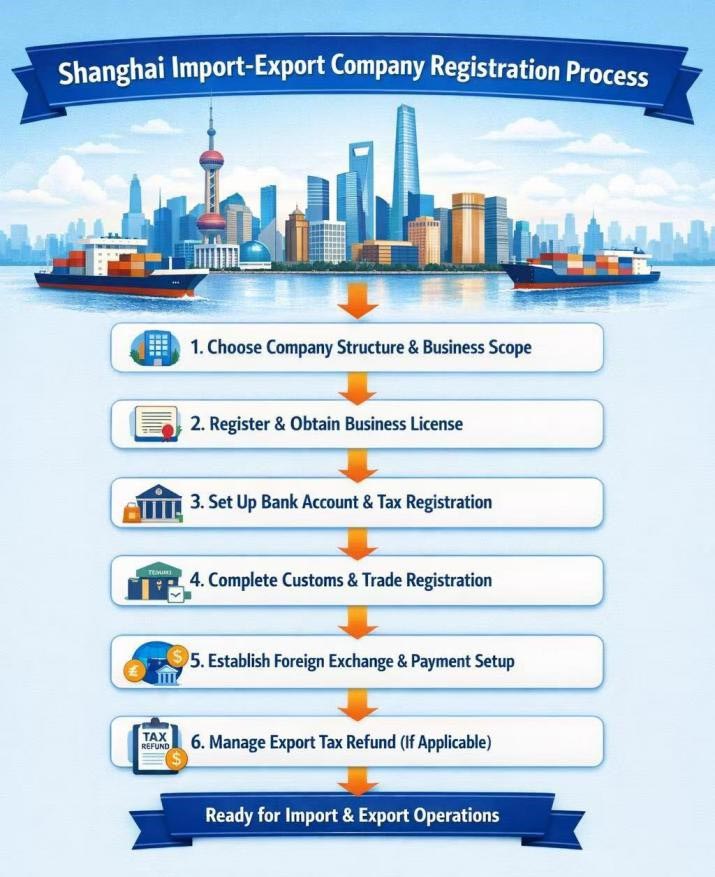
1. Choose the Right Company Structure
Before registration, the company should determine its basic structure, including the company type, shareholders, registered capital, registered address, legal representative, and business scope.
For import & export business, the business scope should match the actual operation model and may include items such as import & export of goods, import & export of technology, import-export agency services, international trade, or supply chain management etc.
For foreign investors, it is also important to confirm whether the business falls outside China’s restricted or prohibited foreign investment sectors.
2. Complete Company Registration
After the structure is confirmed, the company can submit the incorporation application and obtain the business license.
For foreign-invested companies, the overseas investor usually also needs to prepare supporting documents such as the certificate of incorporation, identity documents, appointment documents, and any required notarization or legalization documents.
Once the business license is issued, the company is officially established.
3. Complete Post-Registration Procedures
After incorporation, the company still needs to complete several important follow-up procedures, including:
- Company seal filing
- Bank account opening
- Tax registration
These are necessary for normal business operations, contract signing, invoice issuance, tax filing, and future cross-border payment arrangements.
4. Handle Customs and Trade-Related Registration
A business license alone does not mean the company can immediately start import and export activities.
To carry out goods import and export in practice, the company also needs to complete the relevant customs and trade-related registration procedures. This is an essential step for customs declaration and clearance.
In simple terms, the business license proves the company exists, while customs registration helps enable the company to actually operate import and export business.
5. Set Up Foreign Exchange and Payment Capability
Import and export business also involves cross-border fund flows.
For example, import business requires payments to overseas suppliers, while export business involves receiving overseas payments. As a result, the company usually needs to work with its bank to establish the proper foreign exchange and cross-border settlement arrangements.
6. Pay Attention to Export Tax Refund
If the company is engaged in export business, export tax refund may also become an important issue.
This requires proper tax compliance, supporting documentation, and filing procedures. For many export companies, export tax refund directly affects cash flow and profitability.
Conclusion
Company registration first, then banking, tax, customs, and foreign exchange setup, followed by formal import and export operations.
If the company structure is properly designed and the follow-up procedures are completed in order, the business will be in a much better position to operate smoothly and compliantly in Shanghai’s international trade environment.
Contact Us
Tannet Group Limited was founded in Hong Kong in 1999, now is in its sixth five-year development plan stage, and setting the upcoming two five-year plans. Over the past 28 years, the Group has experienced significant growth and development, serves a diverse client base of over 100,000 customers from more than 130 countries. Tannet has been always devoted to providing with business solutions for investors all across the world. Should you have further inquiry, pls feel free to contact Shanghai Tannet at 0086-18101649652, email to tianyinong@tannet-group.com, or visit our website https://tannet-group.net/.